My ten-year-old grandson was left alone at the airport by my daughter-in-law while she boarded a flight with my son and her own children for a two-week vacation. Then she sent me a text saying she had decided he was grounded and should stay behind.
I did not argue. I acted. And within three days, their perfect vacation was over. My name is Evelyn Harper. I am sixty-eight years old, a widow, a retired teacher, and I have lived long enough to know there is a very clear line between discipline and cruelty. That morning, I was on the balcony of my apartment in Cleveland, watering my basil plants, when my phone rang.
The caller ID showed an airport payphone. At first, I frowned. No one called from payphones anymore unless something had gone very wrong.
I wiped my damp hand on my robe and answered. “Hello?” For a second, all I heard was airport noise. Rolling suitcases. A distant announcement. People talking over one another. Then a small voice whispered, “Grandma?”
It was my grandson, Noah.
He was ten years old.
At first, I smiled because hearing Noah’s voice always softened something in me.
“Noah? Aren’t you supposed to be on a plane to Orlando right now?”
Silence followed.
Not normal silence.
The kind a child makes when he is trying very hard not to cry in public.
Then I heard him take a shaky breath.
“They left me.”
My hand tightened around the watering can.
Water spilled onto my slippers.
“Who left you, sweetheart?”
“Mom. Dad. Everyone.”
His voice broke on the last word.
I set the watering can down so hard it tipped over.
“Where are you?”
“At the airport,” he whispered. “Gate B14.”
“What do you mean they left you?”
He sniffled.
“Mom said I was grounded because I argued with Mason yesterday. She told Dad I was in the bathroom. Then they got on the plane.”
For three seconds, I could not speak.
I could see Noah in my mind exactly as he must have been right then.
Small shoulders.
Blue hoodie.
Backpack clutched to his chest.
Trying to be brave because adults had failed him.
Then my phone buzzed.
A message from my daughter-in-law, Lauren, appeared on the screen.
I opened it with trembling fingers.
“I’ve decided Noah is grounded and will stay home. He needs consequences. We’re already boarding, so please pick him up. Don’t make this dramatic.”
Don’t make this dramatic.
My ten-year-old grandson had been abandoned in one of the busiest airports in Ohio while his father, his stepmother, and her two children flew to Florida for a two-week vacation.
And she had written, “Don’t make this dramatic.”
I closed my eyes.
My late husband, Arthur, used to say I had two kinds of quiet.
Peaceful quiet.
And dangerous quiet.
That morning, I became dangerously quiet.
“Noah,” I said, keeping my voice steady, “listen to me carefully. Are you near an employee?”
“I don’t know.”
“Look around. Do you see anyone wearing a badge? Security? Airport worker? Police officer?”
“There’s a man at the desk.”
“Good. Walk to him. Keep me on the phone. Tell him your grandmother is coming and that you are alone.”
“I’m scared.”
“I know, baby. But you are doing very well. I am coming right now.”
“Are you mad at me?”
That question nearly broke me.
“No,” I said firmly. “You are not in trouble. Not with me.”
“I argued with Mason,” he whispered.
“Mason is twelve and twice your size. Arguing does not mean you get left alone at an airport.”
He was quiet again.
Then he said, “Dad didn’t come back.”
I closed my eyes.
My son Daniel had always been weak around Lauren.
Not cruel by nature.
Not heartless in the beginning.
But weak.
And sometimes weakness becomes cruelty when a child is depending on you.
“I’m coming,” I said again. “You stay with the airport worker until I get there.”
“Okay, Grandma.”
I hung up only after I heard another adult speaking to him.
Then I moved.
I grabbed my purse, my car keys, and the emergency folder I always kept in my desk drawer.
People used to tease me for that folder.
Birth certificate copies.
Medical cards.
School contacts.
Legal paperwork from when Noah used to stay with me during summers.
Arthur always said, “Evelyn, you plan like a general.”
And I would tell him, “Because someday someone will be grateful.”
That day had come.
Fifteen minutes later, I was driving toward Cleveland Hopkins Airport while calling airport police.
My voice did not shake when I explained what had happened.
Not once.
The officer on the phone listened carefully, asked Noah’s age, asked the gate, asked whether the parents were still in the airport.
“No,” I said. “They boarded a flight to Orlando.”
There was a pause.
Then he said, “Ma’am, we’ll have someone with him.”
“Thank you,” I said. “I will be there shortly.”
After I hung up, I called Daniel.
He did not answer.
I called again.
Still nothing.
Then Lauren sent another text.
“Please don’t blow this up. Noah needs to learn that behavior has consequences. We’ll discuss when we get back.”
I nearly drove off the road from anger.
Behavior has consequences.
She was right.
She just did not understand whose behavior would be judged.
By the time I reached the airport, my hands were stiff around the steering wheel.
I parked crooked, barely remembered to lock the car, and walked faster than my knees wanted me to.
At Gate B14, I found Noah sitting beside a security officer.
He was clutching his backpack against his chest like it was the only thing keeping him safe.
His eyes were red.
The sleeve of his blue hoodie was damp where he had cried into it.
He stood when he saw me.
But he did not run.
That hurt more than tears would have.
Children who trust the world run into arms.
Children who have been left behind hesitate first.
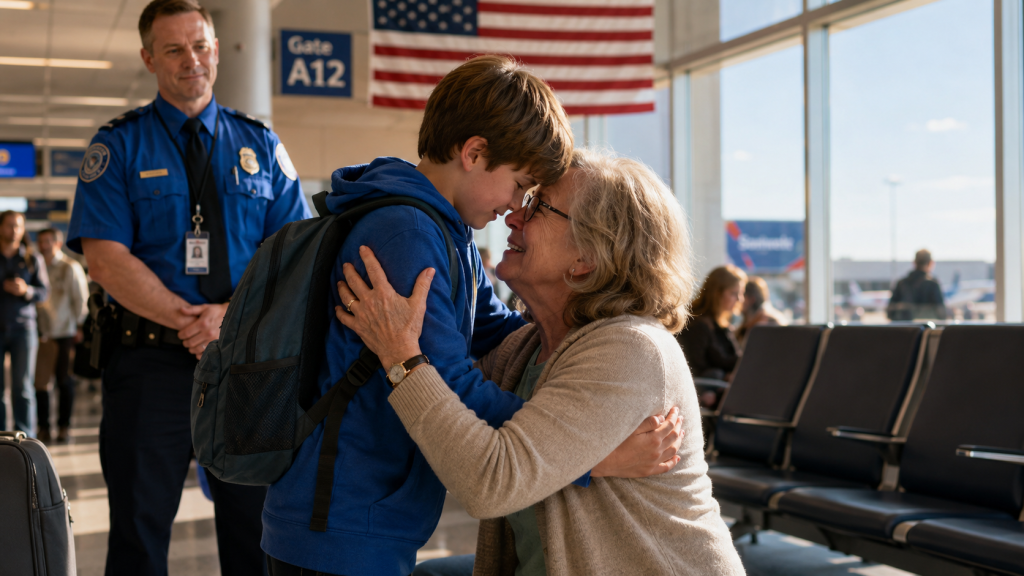
I knelt down in front of him and opened my arms.
He stepped into them carefully, as if he was afraid even I might decide not to keep him.
Then his body finally gave in.
He wrapped both arms around my neck and began to sob.
“I didn’t do anything that bad,” he whispered.
“I know,” I said, holding him tightly. “And you are not in trouble.”
The security officer waited respectfully.
When Noah calmed enough to sit again, the officer asked me questions.
I showed him my ID, a copy of Noah’s birth certificate, and the text Lauren had sent.
His expression changed as he read it.
He looked at Noah.
Then back at me.
“Ma’am,” he said quietly, “this is serious.”
“I know,” I replied.
He asked Noah a few gentle questions.
Noah answered in a tiny voice.
Yes, his father had been there.
Yes, his stepmother had all the boarding passes.
Yes, Lauren told him to wait near the bathroom.
Yes, when he came back, they were gone.
Yes, he tried calling his father, but his phone was in Lauren’s purse because she had taken it that morning as punishment.
That last detail made the officer’s jaw tighten.
“She took his phone and left him here?”
“Yes,” I said.
Noah looked down at his sneakers.
“She said I didn’t deserve it.”
I placed my hand over his.
“No adult gets to decide you don’t deserve safety.”
The officer gave me information for a report and told me child services would likely be notified.
“Good,” I said.
He looked surprised.
Some grandparents might have panicked at the word.
I welcomed it.
Before we left the airport, I called Daniel again.
This time, he answered.
Resort music played in the background.
I heard splashing water.
A woman laughing.
“Mom, please don’t start,” he said immediately.
I looked at Noah sitting beside me.
Then at the officer standing a few feet away.
“Oh, Daniel,” I said. “I haven’t even started.”
He sighed.
“Lauren texted you. Noah is fine. You picked him up, right?”
“You left your ten-year-old son alone at an airport.”
“He wasn’t alone. He was near staff.”
“You did not hand him to staff. You did not call me before boarding. You took his phone and left him at a gate.”
“It was Lauren’s decision.”
I almost laughed.
That was my son.
Forty-two years old and hiding behind his wife like a boy hiding behind a curtain.
“Did you know he was not on that plane?”
A pause.
That pause told me everything.
“Daniel.”
“I thought Lauren had handled it.”
“Handled what?”
“He was acting out.”
“He argued with Mason.”
“He’s been disrespectful lately.”
“No,” I said. “He has been unhappy. There is a difference.”
He lowered his voice.
“Mom, we are not doing this right now. We just landed. The kids are excited. Lauren is already upset.”
I looked at Noah again.
His face had gone still.
He could hear enough.
“Your wife is upset?” I asked.
“Mom.”
“Your son thought his family had abandoned him.”
“We didn’t abandon him.”
“What do you call leaving a child at an airport after taking away his phone?”
He said nothing.
I continued, “I am filing a report.”
His voice sharpened.
“Don’t be dramatic.”
There it was again.
That word.
Dramatic.
People use that word when they want victims to stay quiet.
“No,” I said. “I am being precise.”
“Mom, if you do this, you’ll ruin our vacation.”
I smiled then.
Not because I was happy.
Because finally, Daniel had spoken the truth.
He was not worried about Noah.
He was worried about a vacation.
“Goodbye, Daniel.”
I hung up.
Noah stared at me.
“Is Dad mad?”
“Yes,” I said honestly. “But not because you did something wrong.”
“Is he coming back?”
“Not yet.”
His chin trembled.
I brushed his hair back from his forehead.
“But I came.”
He nodded slowly.
“Yes.”
“And I will keep coming.”
On the drive home, Noah sat silently in the back seat.
He looked smaller than usual.
I kept glancing at him in the mirror.
His eyes were open, but he did not seem to be looking at anything.
“Are you hungry?” I asked.
He shrugged.
“Can I make grilled cheese when we get home?”
Another tiny shrug.
“With tomato soup?”
His eyes lifted.
“The one with the little crackers?”
“Yes.”
He nodded.
“Okay.”
At my apartment, I made him grilled cheese with extra butter, tomato soup, and a small pile of oyster crackers.
He ate slowly at first, then faster.
Only then did I realize he had probably not had breakfast.
“Did they feed you this morning?”
He looked down.
“Lauren said we’d eat at the airport, but then Mason wanted candy, and she said I could wait.”
I turned toward the stove so he would not see my face.
I needed a moment.
There is anger, and then there is the special kind of rage that comes when a child has learned to explain neglect like it is normal.
After lunch, I tucked Noah under the quilt I kept for him in the guest room.
It was blue and green, with little squares sewn by my sister years ago.
He held the edge of it in both hands.
“Grandma?”
“Yes, sweetheart?”
“Are they still going to Disney?”
I sat beside him.
“I don’t know.”
“They promised me I could see the fireworks.”
His voice was not angry.
That made it worse.
He sounded like he had already learned not to expect fairness.
I touched his cheek.
“One day, I will take you myself.”
“Really?”
“Really.”
He closed his eyes.
After a minute, he whispered, “Please don’t send me back yet.”
I leaned over and kissed his forehead.
“I won’t.”
Only after he fell asleep did I allow myself to shake.
I sat in my kitchen with my phone, my folder, and a notebook.
Then I began making calls.
First, the airport police officer who had given me his card.
Then my family attorney, Marlene Cross, who had helped me after Arthur died.
Marlene was sharp, steady, and not easily shocked.
But when I explained what had happened, she went silent.
Then she said, “Evelyn, save everything.”
“I am.”
“Screenshots. Call logs. The child’s statement. The police report. Do not communicate by phone if you can avoid it. Text only.”
“Understood.”
“Is Noah safe with you?”
“Yes.”
“Good. Keep him there.”
By sunset, I had filed reports, contacted my attorney, saved screenshots, and written down everything Noah told me while it was still fresh.
Lauren sent three more texts.
First: “You are overreacting.”
Second: “Noah manipulates people with tears.”
Third: “We are not cutting our trip short because he made bad choices.”
I forwarded every message to Marlene.
She replied with two words.
“Very useful.”
That night, Noah woke up crying.
I found him sitting upright in bed, breathing hard.
“I thought I was still there,” he said.
“At the airport?”
He nodded.
“I kept watching the plane leave.”
I sat beside him until his breathing slowed.
When he finally lay down again, he asked, “Do you think Dad forgot me?”
I could have lied.
A soft lie.
A grandmother lie.
But children know when adults put sugar over poison.
“I think your father made a terrible choice,” I said. “And I think he let Lauren make an even worse one.”
Noah stared at the ceiling.
“Lauren says I make everything harder.”
My heart cracked.
“You are a child,” I said. “You are not supposed to make adult lives easy. Adults are supposed to keep children safe.”
He turned his face toward me.
“Was Mom like Lauren?”
His mother, Claire, had died when Noah was four.
She was my daughter-in-law before Lauren.
Soft-spoken.
Kind.
The only woman I had ever seen make Daniel want to be better without demanding it.
“No,” I said. “Your mother loved you very much.”
“I don’t remember her voice.”
“I do.”
“Can you tell me?”
So I did.
I told him how Claire sang little songs while buckling him into his car seat.
How she called him “Noah Bear.”
How she cried the first time he wrote his name.
His eyes grew heavy as I spoke.
Before sleep took him, he whispered, “Would she have left me?”
“No,” I said. “Never.”
The next morning, Marlene called Daniel and Lauren at their resort.
By noon, airport police had contacted them.
By evening, child services had contacted them too.
That was when the voicemails started.
Daniel left the first one.
“Mom, what the hell are you doing? We are in Florida. You have no idea how embarrassing this is.”
I saved it.
Lauren left the second.
“You are making Noah think he can avoid consequences by crying to Grandma. This is exactly why he acts spoiled.”
I saved that too.
Then Daniel called again.
“The resort manager pulled us aside. Do you understand how humiliating that was?”
Humiliating.
Not frightening.
Not heartbreaking.
Humiliating.
I saved it.
Noah spent most of that day quietly building a Lego set at my dining table.
He had always loved building things.
Tiny houses.
Spaceships.
Bridges.
That day, he built an airport.
I watched him place a small Lego figure alone near a gate.
Then he stared at it for a long time.
I sat across from him.
“Tell me about what you’re building.”
He shrugged.
“It’s just an airport.”
“Who is that?”
He touched the little figure.
“That’s a kid.”
“Where is his family?”
He did not answer.
Then he moved another Lego figure beside the child.
“This is his grandma,” he said.
I swallowed hard.
“What does she do?”
“She comes back.”
On the third day, Marlene called me before breakfast.
“They’re returning today,” she said.
“Already?”
“The pressure worked. The airline has records. The airport report is strong. Child services wants interviews. Daniel’s employer has also been notified somehow.”
“I did not contact his employer.”
“I didn’t say you did.”
I later found out Daniel himself had told a coworker while complaining loudly by the resort pool.
That coworker had a sister who worked in child advocacy.
Bad choices travel faster than airplanes.
By four that afternoon, Daniel and Lauren were back in Cleveland.
They came straight to my apartment.
I knew because Lauren texted first.
“We are coming to get Noah. Have his things ready.”
I replied with Marlene’s instruction.
“Noah will not be leaving with you today. My attorney will be present.”
No response.
Twenty minutes later, someone pounded on my door.
Noah flinched on the couch.
I touched his shoulder.
“Go to the guest room, sweetheart.”
“Is it them?”
“Yes.”
“Do I have to talk?”
“Only if you want to.”
He disappeared down the hall.
I opened the door with Marlene standing beside me.
Lauren stormed in first.
She wore sunglasses on top of her head and vacation clothes that looked wrong in my quiet apartment.
Daniel followed, pale and tense.
Behind them stood Mason and Ava, Lauren’s children.
Mason looked annoyed.
Ava looked uncomfortable.
Lauren pointed a finger at me.
“You had no right.”
I stepped aside.
“Marlene?”
My attorney smiled politely.
“Mrs. Harper absolutely had the right to retrieve a minor child abandoned at an airport after receiving written instruction from that child’s custodial step-parent.”
Lauren blinked.
Daniel rubbed his forehead.
“Can we not do legal talk in front of the kids?” he muttered.
Marlene looked at him.
“You left one at an airport. I would be careful about pretending concern now.”
His face flushed.
Lauren snapped, “He was not abandoned. He was grounded.”
“You boarded a plane,” Marlene said. “He remained at the gate without a phone. That is abandonment.”
Lauren’s mouth tightened.
“He was with airport staff.”
“After he found help himself.”
Daniel looked toward the hallway.
“Where is Noah?”
“In the guest room,” I said.
“I want to see my son.”
That was the first time he had used those words with any weight.
My son.
I studied his face.
There was anger there.
Shame too.
Maybe fear.
But fatherhood requires more than arriving after consequences begin.
“Noah decides whether he wants to come out,” I said.
Lauren laughed sharply.
“He is ten. He doesn’t decide anything.”
From the hallway, a small voice said, “I decide this.”
We all turned.
Noah stood near the guest room door, holding the sleeve of his hoodie.
His face was pale, but he did not look away.
Daniel took a step toward him.
“Noah.”
Noah moved back.
Daniel stopped as if the movement had struck him.
“Buddy,” he said softly. “I’m sorry.”
Noah’s lips trembled.
“You left me.”
Daniel swallowed.
“I didn’t know exactly what Lauren was doing.”
Noah looked at him.
“You got on the plane.”
Daniel opened his mouth.
Closed it.
There are moments when excuses die because a child says the truth too simply.
Lauren crossed her arms.
“Noah, this is exactly what I’m talking about. You are making everyone feel guilty because you didn’t like your punishment.”
Noah’s eyes filled with tears.
I started forward, but Marlene gently touched my arm.
Noah looked at Lauren and said, “I thought you weren’t coming back.”
The room went silent.
Even Mason looked down.
Ava whispered, “Mom…”
Lauren turned on her. “Not now.”
That was when Daniel finally looked at his wife.
Really looked.
Not as a man avoiding conflict.
Not as a husband trying to keep peace.
As a father seeing the shape of what he had allowed.
“Lauren,” he said quietly. “Stop.”
She stared at him.
“What?”
“I said stop.”
Her face hardened.
“Oh, so now you’re taking their side?”
Daniel looked exhausted.
“No. I’m taking his.”
Noah’s face changed slightly.
Not trust.
Not yet.
But surprise.
Marlene explained the temporary arrangement.
Noah would stay with me while child services completed interviews.
Daniel could request supervised visits.
Lauren was not to contact Noah directly until instructed otherwise.
Lauren exploded.
“This is insane. I am his stepmother.”
“You are also the person who put in writing that you intentionally left him behind,” Marlene said.
Lauren’s face went red.
Daniel sat down as if his legs had weakened.
For the first time since he walked in, he looked like a man who understood his life had changed.
Not because his vacation was ruined.
Because his son was afraid of him.
The weeks that followed were difficult.
There were interviews.
Home visits.
Calls from school.
Meetings with lawyers.
Lauren tried to paint Noah as troubled, manipulative, defiant.
But Noah’s teachers told a different story.
Quiet.
Bright.
Withdrawn since his father remarried.
Often hungry after weekends with his father.
Anxious when plans changed.
The airport report was clear.
Lauren’s texts were clear.
Daniel’s voicemails were clear.
By the end of the month, temporary custody was granted to me.
Daniel received supervised visitation and parenting classes.
Lauren was barred from being alone with Noah.
When the judge said those words, Lauren cried like she was the victim.
Noah sat beside me, holding my hand under the table.
His palm was sweaty.
When we walked out, Daniel approached us.
He looked thinner.
Older.
“Noah,” he said.
Noah stayed close to me.
Daniel did not force a hug.
That was the first decent choice he made.
“I know saying sorry isn’t enough,” he said. “But I am sorry.”
Noah stared at his shoes.
Daniel continued, “I should have protected you. I didn’t. That is my fault.”
Lauren stood several feet away, furious.
Noah looked up.
“Why didn’t you come back?”
Daniel’s face broke.
“I was weak,” he said.
It was the first honest answer he had given.
“I let someone else decide what happened to you because it was easier than fighting. That was wrong.”
Noah’s fingers tightened around mine.
“Grandma came.”
Daniel nodded.
“Yes. She did.”
He looked at me then, and for once there was no accusation in his eyes.
Only shame.
“Thank you,” he said quietly.
I did not soften it for him.
“You should have been the one.”
“I know.”
“No,” I said. “You are beginning to know.”
He nodded.
In the months that followed, Noah began to heal in small ways.
Not all at once.
Children do not recover because adults finally admit fault.
Trust returns like spring after a hard winter.
Slowly.
Unevenly.
With cold days still appearing when you thought warmth had won.
At first, he would panic if I was late picking him up from school.
Even two minutes.
He would stand near the office window, backpack on, eyes scanning every car.
So I started arriving ten minutes early.
Every day.
Rain or shine.
Eventually, he stopped watching the clock so fiercely.
He began sleeping through the night.
He joined art club.
He laughed more.
One afternoon, he asked if we could make a “future vacation jar.”
“Where do you want to go?” I asked.
He shrugged.
“Maybe Orlando. But not yet.”
“That’s okay.”
“I still want to see fireworks.”
I smiled.
“Then we will.”
We put a jar on the kitchen counter.
He decorated it with stickers.
Each week, I added a few dollars.
Sometimes he added coins from helping Mrs. Pette carry groceries.
Daniel came for supervised visits every Saturday.
At first, Noah barely spoke.
Daniel sat across from him at a community center table, trying too hard.
He brought gifts until the supervisor told him to stop.
Then he brought patience.
That worked better.
They played chess.
Then cards.
Then one day, Noah asked him for help with math homework.
Daniel cried in his car afterward.
I know because he called me and tried to hide it.
“He asked me something normal,” he said.
“That matters,” I replied.
“Yes,” he whispered. “It does.”
Lauren and Daniel separated six months after the airport incident.
I do not know all the details.
I did not ask.
But I know this: when a family system is built on silence, truth feels like an earthquake.
Mason came to Noah’s school once and apologized.
Ava sent a handmade card.
Lauren never apologized.
Some people would rather lose everything than admit they were cruel.
That was her choice.
One year after the airport, I took Noah to Orlando.
Just the two of us.
I saved every receipt, planned every detail, and kept his phone fully charged.
At the airport, he went quiet near the gate.
I noticed his hands gripping his backpack straps.
I knelt beside him, though my knees protested.
“Look at me, Noah Bear.”
He looked at me.
“We board together,” I said. “We fly together. We come home together.”
His eyes shone.
“Promise?”
“Promise.”
When our boarding group was called, I held out my hand.
He took it.
We walked onto the plane together.
In Orlando, we ate too much popcorn, rode gentle rides because I refused the roller coasters, and bought matching ridiculous hats.
On the last night, we stood beneath the fireworks.
Colors burst over the sky.
Noah leaned against me.
“I thought I’d be sad here,” he said.
“Are you?”
“A little.”
“That’s okay.”
He nodded.
“But I’m happy too.”
I put my arm around him.
“That’s allowed.”
He looked up as gold sparks fell like rain.
“Grandma?”
“Yes?”
“You came back for me.”
My throat tightened.
“I always will.”
He smiled then.
A real smile.
The kind that reaches a child’s whole face.
When we returned to Cleveland, Daniel was waiting at the airport.
Not at baggage claim.
At the gate exit, exactly where he had failed to be before.
He had asked permission to come.
Noah saw him and froze.
Daniel did not rush forward.
He simply stood there holding a small sign.
WELCOME HOME, NOAH.
Noah looked at me.
I nodded once.
He walked slowly toward his father.
Daniel knelt.
“I’m here,” he said.
Noah stared at him for a long moment.
Then he stepped into his arms.
Not fully relaxed.
Not healed in a single embrace.
But willing.
Sometimes that is enough for one day.
People later asked if I regretted making reports.
If I regretted involving police, attorneys, child services, and the court.
The answer is no.
I regret that my grandson ever had to use an airport payphone to ask whether anyone was coming.
I regret that he learned adults can board planes while children cry at gates.
I regret that my son needed legal consequences to remember his duty as a father.
But I do not regret acting.
Not for one second.
Discipline teaches a child right from wrong.
Cruelty teaches a child they are disposable.
And love?
Love gets in the car.
Love calls the police.
Love keeps screenshots.
Love stands in court.
Love sits beside a frightened child at night and says, “You are not in trouble for being hurt.”
Noah is twelve now.
He is taller, louder, and starting to develop the kind of sarcasm that makes me ask heaven for patience.
He still keeps the blue hoodie.
It no longer fits, but he refuses to throw it away.
Once, I asked why.
He said, “Because that was the day I found out who comes for me.”
I had to leave the room before I cried.
Daniel is still earning his way back.
That is how it should be.
Trust is not a gift children owe adults.
It is a debt adults repay with consistency.
Every Saturday, Daniel shows up.
Every birthday, he arrives early.
Every promise, he writes down.
Noah notices.
He does not forgive quickly, but he is watching.
And Daniel is learning that fatherhood is not a title.
It is attendance.
As for me, I still water my basil plants on the balcony.
I still keep an emergency folder in my desk.
I still answer unknown numbers.
Because once, a payphone rang, and a little boy whispered, “Grandma?”
And the whole world divided into two kinds of people.
Those who leave.
And those who come.
I know which one I am.
I knew it the moment I saw Noah sitting at Gate B14, trying not to cry, believing he had done something bad enough to be forgotten.
He had not.
No child has.
So I brought him home.
I protected him.
I reminded every adult involved that consequences are not just for children.
And within three days, their perfect vacation was over.
But Noah’s real life finally began again.
THE END! THANK YOU FOR READING!