I called my son from our kitchen in Detroit to tell him his mother had died. He let out a tired sigh and said, “Dad, please don’t turn this into something bigger than it has to be. I’m leaving for Europe with my wife. The tickets can’t be refunded.”
So I buried Diane in a small chapel with only five people sitting in the pews. Ten days later, his wife walked into my living room carrying a designer handbag, completely unaware of what Diane had left behind. The phone rang twice before Darnell answered.
His voice was distant and annoyed, like I had interrupted something far more important than the death of his own mother.
In the background, I could hear music, laughter, and glasses touching together. Maybe he was at a restaurant.
Maybe some rooftop place in Chicago where people take pictures under city lights and call it happiness. I stood alone in our kitchen in Detroit, one hand braced against the counter.
Diane had been gone less than a day.
Her coffee mug still sat beside the sink, the one with the faded blue rim and the tiny crack near the handle.
Her reading glasses were still near the window.
Her chair was still pulled slightly away from the table, as if she had only stepped into the next room.
But she had not.
She was gone.
I told my son his mother had died.
For a moment, there was silence.
Then he sighed.
“Dad, come on,” Darnell said. “Don’t make such a big deal out of it.”
I stared at the kitchen wall, trying to understand how those words had come from my child.
“Darnell,” I said slowly, “your mother died this morning.”
Another pause.
Then his voice sharpened with impatience.
“I’m sorry, Dad, but what exactly do you expect me to do? We’re leaving in a few days. Mom would understand. The tickets are non-refundable.”
Mom would understand.
People always say the dead would understand when what they really mean is that they do not want their plans disturbed.
I gripped the edge of the counter.
“Your mother asked for you yesterday,” I said.
That was true.
Diane had been weak, thinner than she had ever been, her skin almost transparent beneath the hospital blanket. Her voice had been so soft that I had to lean close to hear her.
“Did Darnell call?” she asked.
I told her he was busy.
She closed her eyes.
Not angry.
Not surprised.
Just tired.
I should have told him then.
I should have screamed into the phone, should have ordered him to come, should have reminded him of every night Diane stayed awake with him when he had asthma attacks, every lunch she packed, every school project she finished at midnight because he had forgotten until the last minute.
But Diane had squeezed my hand.
“Don’t beg him,” she whispered.
Even dying, she was protecting him from shame.
Even dying, she was protecting me from disappointment.
Now he was on the phone, acting like grief was an inconvenience.
“I can’t do this right now,” Darnell said. “Email me the funeral details. I’ll see what I can work out.”
“Your mother is dead,” I repeated, because some desperate part of me thought maybe he had not heard.
“I heard you, Dad.”
Then his wife’s voice floated faintly in the background.
“Babe, hurry up. They’re bringing the champagne.”
Darnell covered the phone, but not enough.
“I have to go,” he said.
“Will you come home?”
He exhaled again, longer this time.
“Dad, please don’t start. We’ve planned this trip for months. The tickets can’t be refunded. Mom wouldn’t want us wasting money.”
Then he ended the call first.
I stood there holding the phone while a garbage truck rattled down the street and someone across Fielding Street kept cutting their grass, as if the world had not just ended inside my house.
I wanted to throw the phone through the window.
Instead, I placed it on the counter beside Diane’s coffee mug.
The house became too quiet.
When you live with someone for thirty-six years, silence has weight.
It sits in the other chair.
It moves through rooms.
It waits for you at the bottom of the stairs.
That afternoon, I made the calls.
The funeral home.
Mrs. Pette next door, who always knew when to bring food and when to bring quiet.
The church on Harper Avenue, where Diane had once volunteered during holiday food drives.
Every conversation felt too normal for the words I had to say.
“Yes, my wife passed this morning.”
“Yes, Diane Walker.”
“No, not many guests.”
“Yes, Thursday is fine.”
Fine.
Nothing was fine.
By Thursday, I buried my wife.
There were only five people in the chapel.
Mrs. Pette and her husband sat in the second pew, both dressed in black, both crying like Diane had been family.
Diane’s old friend Beverly came wearing the same lavender perfume she had worn to our wedding years ago. She held my hands for a long time and said, “Your wife was the best woman I ever knew.”
Deshawn, our mail carrier, stopped by after finishing his route, still in uniform, because Diane used to leave cold water on the porch for him in July and coffee inside the storm door in January.
The fifth person was Harold Whitfield, our estate attorney.
He sat alone near the back, holding a leather folder on his lap.
He had been calling Diane’s phone often during the weeks before she passed.
At the time, I did not know why.
Darnell was not there.
Neither was his wife, Simone.
No flowers from them.
No card.
No message.
I stood at the front of that little chapel and looked out at the empty rows.
Diane had spent her whole life holding other people together.
She made lunches, remembered birthdays, paid every bill on time, and baked Thanksgiving pies in the same dented pan she had owned before we were married.
She never asked to be praised.
At the end, all she wanted was her son.
And he chose Europe.
I did not say that during the eulogy.
Some truths are too painful to place in front of strangers.
Instead, I talked about Diane’s laugh.
I talked about how she danced while cooking, even when no music played.
I talked about the way she made every child in the neighborhood feel like they had another auntie watching over them.
I talked about how she loved Darnell before he was even born.
I said, “She believed love was not something you said. It was something you showed up for.”
My voice broke on those last words.
Mrs. Pette covered her mouth.
Harold looked down at the folder in his lap.
After the burial, everyone came back to the house.
Mrs. Pette brought chicken and rice.
Beverly arranged flowers in a vase Diane had bought at a yard sale.
Deshawn stood awkwardly by the door until I hugged him and told him Diane would have been glad he came.
Harold waited until the others left before approaching me.
“Raymond,” he said quietly, “Diane asked me to give you some time before we spoke.”
I looked at him.
“What about?”
He glanced toward Diane’s chair.
“She made changes to her estate documents before she passed.”
I frowned.
“Diane handled most of the paperwork. I knew we had a will.”
“You did,” Harold said. “She updated hers three days before her death.”
I felt something cold move through me.
“Why?”
Harold’s face softened.
“She wanted to make sure her wishes were clear.”
I was too tired to ask more.
My body felt hollow, like grief had scraped everything out of me.
“Can it wait?” I asked.
“Yes,” he said. “But not too long.”
He handed me a sealed folder.
“Keep this somewhere safe.”
I took it.
Diane’s signature was on the flap.
I stared at it for so long that Harold placed a hand on my shoulder.
“She knew what she was doing,” he said.
Then he left.
Ten days passed.
Darnell did not call.
Simone did not call.
Every morning, I woke expecting to hear Diane in the kitchen.
A cabinet door opening.
A spoon scraping inside the coffee tin.
That soft little cough she always made before saying my name.
Every morning, I remembered the house belonged to me now in the loneliest way possible.
I wandered through rooms like a ghost visiting the life I used to have.
Her slippers were still beside the bed.
Her sweater still hung over the back of the chair.
Her Bible was open on the nightstand, a folded tissue marking the page.
I could not bring myself to move anything.
On the tenth day, I was sitting in the living room, staring at the sealed folder from Harold.
I had not opened it yet.
Not because I was afraid of legal words.
Because I was afraid of hearing Diane’s voice in them.
Then the front door opened.
Not knocked.
Opened.
Heels clicked across the hardwood floor.
A bright voice floated through the hallway like nothing terrible had happened.
“Hello? Raymond?”
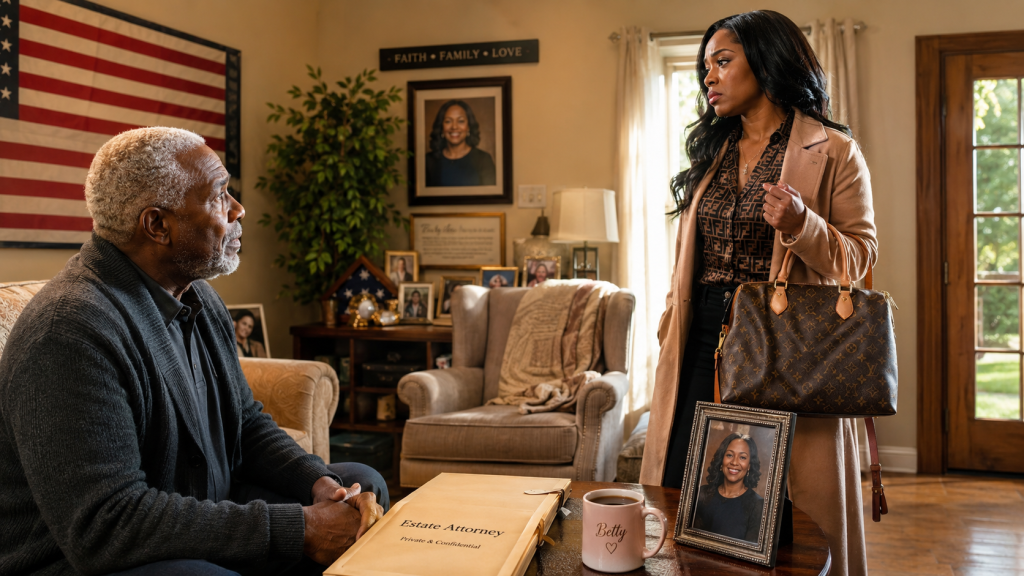
Darnell’s wife stepped into my living room wearing expensive clothes, perfume too strong for a grieving house, and a designer handbag tucked under her arm.
Simone smiled at me.
Not with sympathy.
With expectation.
She was dressed like she had just come from a magazine cover. Cream coat, gold watch, sunglasses pushed into her hair, nails polished the color of wine.
“Raymond,” she said, looking around the room. “You should really keep the door locked.”
I stared at her.
“How did you get in?”
She held up a key.
“Darnell gave me his copy. We came back early from Europe. Well, not early exactly. We just landed this morning.”
Ten days.
His mother had been buried ten days ago.
And he had sent his wife.
“Where is my son?” I asked.
“At the hotel,” she said casually. “He’s exhausted. Jet lag is awful.”
I waited for grief to appear on her face.
It did not.
She looked at Diane’s chair, then at the mantel, then at the hallway leading to the bedrooms.
“This house feels smaller than I remembered,” she said.
Something inside me went still.
“Why are you here, Simone?”
She blinked, as if the question surprised her.
“Darnell asked me to pick up anything his mother left for us.”
“For you?”
“Well, for him,” she said quickly. “For us, eventually. He figured there might be documents, jewelry, bank information. You know, things we should start organizing.”
I almost laughed.
Not because it was funny.
Because Diane had known them better than I did.
I looked at the sealed folder sitting on the coffee table between us.
Simone saw it too.
Her eyes sharpened.
“Is that from the attorney?”
I did not answer.
She stepped closer.
“Raymond, Darnell is Diane’s only child. We don’t want this to become uncomfortable.”
I looked at her expensive handbag.
Then I looked at the chair where Diane had sat through chemo, through pain, through the slow betrayal of her body.
I remembered her whispering, “Don’t beg him.”
And for the first time since she died, I felt something stronger than grief.
I felt my spine straighten.
“Sit down,” I said.
Simone hesitated.
“I really don’t have much time.”
“Sit down.”
My voice was calm, but something in it made her obey.
She sat on the edge of the sofa, careful not to wrinkle her coat.
I picked up the folder.
Diane’s signature crossed the seal.
For a moment, my thumb rested over her name.
Then I opened it.
Inside was a will.
A trust document.
A letter addressed to me.
Another addressed to Darnell.
And a small inventory list written in Diane’s careful handwriting.
I read the first page slowly.
Then the second.
Then the third.
With every line, my wife came back to me.
Not weak.
Not dying.
Strong.
Clear.
Certain.
Diane had left our house to me for the rest of my life, protected from sale, transfer, or pressure.
Our savings were divided, but not the way anyone expected.
The largest portion was placed into a charitable trust in Diane’s name, to fund scholarships and emergency assistance for children in Detroit who had lost parents or had no family support.
The church food pantry received a donation.
Mrs. Pette received Diane’s wedding china because Diane knew she was the only person who had ever truly admired it.
Beverly received Diane’s pearl earrings.
Deshawn received an envelope with enough money to help with his daughter’s community college tuition.
And Darnell?
Darnell received one thing.
Diane’s old recipe box.
Nothing else.
Simone leaned forward, impatience rising in her face.
“Well?”
I looked up.
“What did she leave us?”
I closed the will.
“Your husband received his mother’s recipe box.”
She stared at me.
“That’s not funny.”
“No.”
“Where’s the money?”
“Not with him.”
Her mouth opened.
Then closed.
“That can’t be legal.”
“It is.”
“Raymond, don’t be ridiculous. Darnell is her son.”
“I know who he is.”
“She can’t leave everything away from her own child.”
“She did not leave everything away,” I said. “She left him exactly what she wanted him to have.”
Simone’s face hardened.
“I need to call him.”
“Go ahead.”
She snatched her phone from her purse and stepped into the hallway, though not far enough that I could not hear.
“Darnell, your father is being difficult.”
A pause.
“No, she didn’t leave the house.”
Another pause.
“She left you a box of recipes.”
His voice exploded so loudly through the phone that I heard every word.
“What? That’s impossible!”
Simone lowered her voice.
“I told you we should have come before the funeral.”
Before the funeral.
Not for the funeral.
Before it.
To collect.
I stood and walked to Diane’s chair. My hand rested on its back.
For thirty-six years, that woman had given everything to this family.
And somehow, even after death, they had arrived with open hands instead of broken hearts.
Simone came back into the living room, pale with anger.
“Darnell wants to speak to you.”
I took the phone.
For the first time since Diane died, my son called me without being asked.
“Dad,” he snapped. “What did you do?”
I closed my eyes.
There it was.
Not “How are you?”
Not “I’m sorry I wasn’t there.”
Not “I miss Mom.”
What did you do?
“I did nothing,” I said. “Your mother made her own decisions.”
“She was sick. You influenced her.”
My hand tightened around the phone.
“Your mother was sick, not confused.”
“This isn’t fair.”
“Neither was burying her without you.”
Silence.
Then he said, “Dad, we had a trip.”
“Yes,” I said. “You had a trip.”
“Mom understood.”
“No, Darnell. She didn’t. She accepted it. That is not the same thing.”
He breathed hard into the phone.
“I’m coming over.”
“No.”
“What?”
“You will not come here to yell in your mother’s house.”
“It’s my house too.”
“No,” I said. “It is not.”
I heard Simone shift behind me.
Darnell’s voice lowered.
“Dad, don’t do this. We can fix it. You can contest it with me. Say she wasn’t in her right mind.”
My grief sharpened into anger.
“You want me to call your mother incompetent because she refused to reward your selfishness?”
“That’s not what I’m saying.”
“That is exactly what you’re saying.”
“I’m her son.”
“And she was your mother.”
The silence that followed was different.
For one small second, I thought maybe the words had reached him.
Then he said, “So you’re choosing strangers over family?”
I looked down at Diane’s letter to him.
“No,” I said. “Your mother chose children who needed help. Maybe because she finally accepted that the child she raised had forgotten what help looked like.”
He cursed under his breath.
I handed the phone back to Simone.
“Tell him the recipe box is here.”
Simone did not take it.
“This is cruel,” she said.
I looked at her.
“Cruel was champagne while his mother was dying.”
Her face flushed.
“I didn’t know she was that bad.”
“You knew she was dying.”
She looked away.
That was enough.
Darnell came the next morning.
Not alone.
He brought Simone, a lawyer friend, and the kind of anger people bring when they believe money has been stolen from them.
He walked into the house without hugging me.
He did not look at Diane’s chair.
He did not ask where we had buried her flowers.
He pointed at the folder on the table and said, “I want to see it.”
So Harold Whitfield came.
I called him before Darnell arrived because Diane had taught me to prepare for storms before clouds showed.
Harold sat across from my son at the dining table and explained everything calmly.
Diane had been evaluated.
Diane had been mentally competent.
Diane had signed every page.
Diane had included a clause stating that anyone who contested the will would lose even the recipe box.
Darnell’s lawyer friend stopped talking after that.
Simone stared at the table.
Darnell stared at me.
“You’re really going to let this happen?” he asked.
“I am going to honor your mother’s wishes.”
His face twisted.
“After everything I’ve done?”
I leaned back.
“What exactly have you done, Darnell?”
He looked offended.
“I’m her son.”
“That is what you are,” I said. “Not what you’ve done.”
His mouth tightened.
I saw, for a second, the little boy he had been.
The boy Diane walked to school every morning because he was afraid of big dogs.
The boy who cried when he scraped his knee.
The boy who used to climb into our bed and sleep between us.
I wondered when we lost him.
Maybe slowly.
Maybe one small entitlement at a time.
Maybe every time Diane excused his selfishness because she loved him too much to call it what it was.
Harold slid the recipe box across the table.
It was blue metal, chipped along the corners, filled with cards Diane had written over the years.
Darnell looked insulted by it.
“That’s it?”
“That’s it,” Harold said.
Darnell opened it carelessly.
A folded note sat on top.
His name was written across it.
For the first time, his hand hesitated.
He unfolded the paper.
I watched his face as he read.
My son,
If you are holding this, then I am gone, and you have come looking for what I left you.
I hope, before disappointment reaches you, memory does.
This box holds every meal I made when money was short.
The soup I cooked when you were sick.
The cake you asked for every birthday until you decided homemade things were embarrassing.
The cornbread your father burned the first time he tried to help me.
The recipes are not valuable to anyone who only wants money.
But they are proof that you were loved.
I called for you at the end.
You did not come.
I forgive you because I am your mother.
But forgiveness is not inheritance.
I will not use my death to reward the parts of you that forgot how to love.
If someday you remember, start here.
Cook something.
Serve someone.
Show up.
Love,
Mom
Darnell stopped reading halfway through.
His jaw clenched.
For a moment, I thought he might throw the note down.
Instead, his eyes moved back to the top.
He read it again.
The room was completely silent.
Then his face changed.
Not fully.
Not beautifully.
Not like a movie where one letter fixes a lifetime.
But something cracked.
His shoulders dropped.
He looked suddenly exhausted, not from travel, but from being forced to see himself.
“Dad,” he said, and his voice was smaller.
I waited.
He looked at Diane’s chair.
Then at the recipe box.
Then at me.
“I didn’t know she asked for me.”
I felt my throat tighten.
“I told you.”
“I thought…” He swallowed. “I thought you were exaggerating.”
“Your mother did not exaggerate death.”
He flinched.
Good.
Some words should leave marks.
Simone touched his arm, but he pulled away gently.
“Where is she buried?” he asked.
Harold closed his folder and stood.
No one spoke.
I looked at my son for a long time.
Then I gave him the cemetery name.
That afternoon, Darnell went to his mother’s grave.
I did not go with him.
Some grief must be faced without an audience.
He stayed there for two hours, according to Mrs. Pette, who saw his car when she drove past after church.
The next day, he came back alone.
No Simone.
No lawyer.
No anger.
He knocked this time.
When I opened the door, he stood on the porch holding Diane’s recipe box against his chest.
His eyes were red.
“I made her chicken soup,” he said.
I looked at him.
“What?”
“From the card.” His voice broke. “It tasted wrong.”
Despite myself, I almost smiled.
“She always added more pepper than she wrote down.”
He nodded, wiping his face quickly.
“I didn’t know that.”
“No,” I said. “You didn’t.”
He looked past me into the house.
“Can I come in?”
I stepped aside.
We sat in the kitchen, where Diane’s mug still rested beside the sink.
For a long time, neither of us spoke.
Then Darnell said, “I was ashamed.”
I turned to him.
“Of what?”
“Of this place,” he whispered. “Of not having more growing up. Of Mom saving coupons. Of you fixing the same old car. I wanted to become someone people respected.”
I stared at him.
“Your mother respected you before you had anything.”
He covered his face.
“I know.”
“No,” I said softly. “I don’t think you did.”
He cried then.
My grown son cried in the kitchen where his mother had fed him, scolded him, prayed over him, and waited for him.
I did not comfort him right away.
That may sound cruel, but I had spent too many years watching Diane rush to soften every consequence he earned.
So I let him cry.
Then, when his breathing slowed, I placed my hand on his shoulder.
“Your mother loved you,” I said. “But she was tired of proving it to someone who only measured love in what he could take.”
He nodded.
“I want to fix it.”
“You cannot fix missing her funeral.”
“I know.”
“You cannot fix her dying without you there.”
His face crumpled.
“I know.”
“But you can decide whether her last lesson becomes the beginning of something better or just another thing you resent.”
He looked at the recipe box.
“What do I do?”
I thought about Diane’s scholarship fund.
The children she had chosen.
The ones who might sit at kitchen tables with empty chairs, needing someone to show up.
“You start where she told you,” I said. “You serve someone.”
Months passed.
Darnell did not become perfect.
People rarely do.
Simone hated the will and made that clear. Their marriage cracked under the weight of what Diane’s death revealed. I stayed out of it.
But Darnell began visiting on Sundays.
At first, it was awkward.
He would sit in the living room, staring at his phone, unsure how to be in a house where he could no longer ask his mother to make things easy.
Then one Sunday, he brought groceries.
“I want to try the chicken soup again,” he said.
I showed him the pepper.
He laughed through tears.
Later, he volunteered with Diane’s scholarship foundation.
The first time he handed a check to a young woman who had lost her mother and was trying to stay in school, he called me from his car and cried again.
“I get it now,” he said.
I looked at Diane’s empty chair.
“Good.”
One year after her funeral, the church on Harper Avenue held a small ceremony for the first five recipients of the Diane Walker Memorial Scholarship.
The chapel was fuller than it had been the day we buried her.
Children came.
Parents came.
Neighbors came.
Deshawn brought his daughter, now enrolled in community college.
Mrs. Pette wore Diane’s favorite shade of blue.
Beverly wore the pearl earrings.
Darnell stood beside me, holding the recipe box.
When it was his turn to speak, he walked to the front of the chapel.
His hands shook.
“My mother taught me love by showing up,” he said. “I learned that lesson late. Too late to give her what she deserved. But not too late to honor what she gave.”
He opened the recipe box and pulled out Diane’s note.
He did not read all of it.
Some things belonged only to him.
But he read one line.
“Forgiveness is not inheritance.”
Then he looked at me.
“It’s responsibility.”
I closed my eyes.
For the first time since Diane died, the chapel did not feel empty.
After the ceremony, I went to the cemetery alone.
I placed fresh flowers on Diane’s grave and sat beside her stone.
“You were right,” I said.
The wind moved softly through the grass.
“He needed the box.”
I touched her name carved into the stone.
“I still miss you every morning.”
Of course, she did not answer.
But in my mind, I heard her voice anyway.
That warm, steady voice that had carried me through thirty-six years.
I drove home before sunset.
The kitchen was quiet when I entered, but not as lonely as before.
Diane’s mug still sat by the sink.
Her chair was still pulled slightly away from the table.
And on the counter was a container of chicken soup Darnell had dropped off while I was gone.
A note sat on top.
Dad,
I added extra pepper this time.
Love,
Darnell
I stood there for a long moment, holding that note.
Then I sat in Diane’s chair for the first time since she passed.
I ate the soup slowly.
It was not perfect.
But it was close.
And for the first time in a year, I smiled in that kitchen.
Diane had known exactly what she was doing when she called Harold Whitfield.
She had not left our son money.
She had left him memory.
She had left him hunger.
She had left him a mirror.
And finally, after losing the mother who had loved him most, Darnell began to understand what love had always cost.
THE END! THANK YOU FOR READING!