PART 3
There was also a document I had signed the previous afternoon.
It wasn’t a document transferring my house to anyone.
It was a statement of my wishes concerning my property, accompanied by instructions for ensuring that any future decisions about the house would be made according to my own wishes and the law.
I had spent twenty-two years building a home with Leonard.
I wasn’t going to surrender it simply because someone else had decided that my time in it was over.
I returned downstairs with the envelope tucked beneath my arm.
Serene was scrolling through photographs of nursery furniture on her phone.
“Oh, look at this one!” she exclaimed, turning the screen toward me. “A beautiful white crib. We could put it right where your husband’s desk is.”
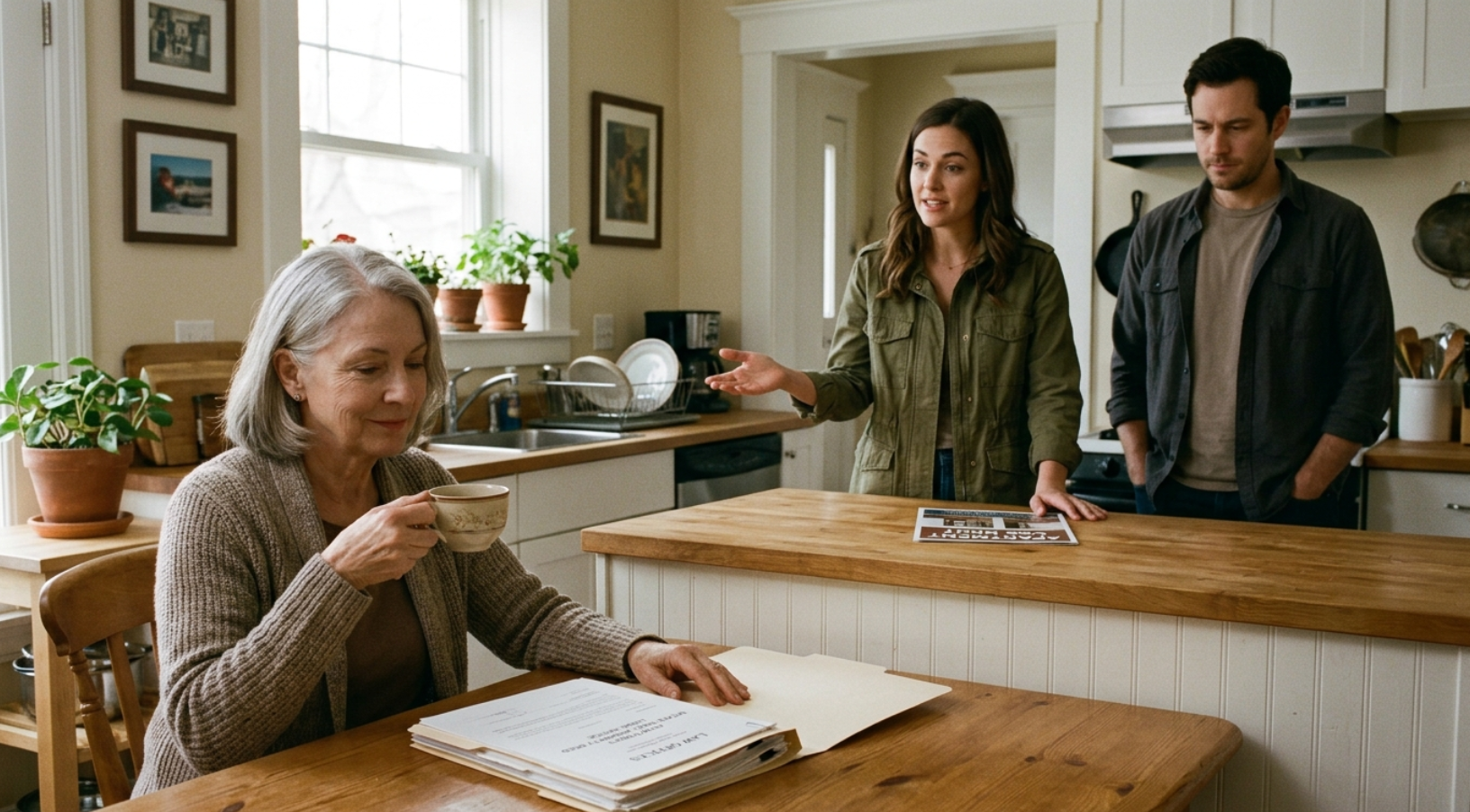
I set the envelope on the kitchen counter.
“Before we discuss furniture, I think we should discuss the house.”
Fletcher looked up.
Something in my voice must have caught his attention because he put down his coffee.
“What is that?” Serene asked.
“Something I should have discussed with you both a long time ago.”
I opened the envelope and removed the first page.
“This house belongs to me. It belonged to Leonard and me for most of our married life, and after he died, it became my responsibility to maintain it. When you asked to stay here temporarily, Fletcher, I welcomed you because you’re my son. I never agreed to give up my home.”
Serene’s smile faded.
“Mom, nobody is asking you to give up your home. We’re just trying to find you somewhere more suitable.”
“Then why have you arranged an apartment, contacted moving companies, and planned to turn my study into a nursery without asking me?”
She opened her mouth, then closed it.
Fletcher rubbed his forehead.
“Mom, this is getting unnecessarily serious.”
I looked at him.
“Is it? Because I remember a time when you asked me before borrowing my car. You asked before inviting friends to stay overnight. You even asked before painting your bedroom blue.”
He gave a small, uncomfortable laugh.
“That was years ago.”
“Yes. It was. And somewhere along the way, you seem to have forgotten that asking permission is still important.”
The kitchen fell silent.
I placed the apartment listing beside the envelope.
“You have both been living here because I offered you a temporary place to stay. I love you, Fletcher, and I am happy that you’re going to have a child. But I will not be pressured into leaving my own home.”
Serene folded her arms.
“So what are you saying? That you want us out?”
I took a breath.
“I am saying that we need to agree on a proper arrangement. If you intend to remain here, we will need clear boundaries and a realistic plan. If we cannot agree, I will follow the legal process my attorney has explained to me.”
Fletcher stared at the envelope.
“You hired an attorney?”
“Yes.”
His face changed.
“You went behind my back?”
I almost smiled at the irony.
“I met with an attorney about my own property. I didn’t realize I needed your permission.”
“That’s not what I meant.”
“Then tell me what you meant.”
He looked away.
For the first time that morning, Serene had nothing to say.
I gathered the papers and returned them to the envelope.
“You don’t have to answer me right now. But I need you to understand one thing. I will not be moving into that apartment simply because you have decided that you need my bedroom.”
Then I picked up my teacup and carried it to the sink.
The conversation was over.
At least, I thought it was.
By lunchtime, the atmosphere in my house had changed completely.
Serene barely spoke to me. She walked through the hallway with exaggerated sighs, opening and closing drawers more loudly than necessary. Fletcher disappeared into the garage and stayed there for nearly an hour.
I spent the afternoon in my study.
I dusted Leonard’s books, straightened the photographs on his desk, and opened the window to let in the cool autumn air.
For the first time in weeks, I felt as though I could breathe.
Then my phone rang.
It was Gail.
“Have you spoken to your son?” she asked.
“I have.”
“And how did he respond?”
“He was surprised. My daughter-in-law was offended.”
Gail sighed gently.
“That’s not unusual. People sometimes confuse being given help with being entitled to it.”
I looked toward the window.
“I don’t want to hurt Fletcher.”
“Protecting your home doesn’t mean you don’t love him.”
“I know. I just wish he remembered that.”
“Give him time to think. But don’t sign anything, agree to anything, or hand over any important documents under pressure. And if they refuse to respect your decision, contact me before taking further steps.”
After we hung up, I sat in Leonard’s chair.
I remembered Fletcher at ten years old, sitting on the porch steps with a scraped knee after falling off his bicycle. Leonard had knelt beside him, cleaning the wound while Fletcher tried desperately not to cry.
“You’re allowed to be hurt,” Leonard had told him. “But you don’t get to hurt someone else just because you’re hurting.”
I wondered what my husband would say if he could see our son now.
That evening, Fletcher came into the study alone.
“Can we talk?”
I closed my book.
“Of course.”
He sat on the small sofa opposite me. For a moment, he looked like the teenager who used to come to me when something had gone wrong at school.
Then he said, “Serene thinks you’re trying to punish us.”
“I’m not.”
“She says you’re making everything difficult when we’re about to have a baby.”
I studied his face.
“Fletcher, when you were born, your father and I were terrified. We had bills, responsibilities, and a house that seemed to need repairing every weekend. But we never thought the solution was to make someone else give up their home.”
He stared at the floor.
“We need space, Mom.”
“I understand.”
“And we can’t afford a bigger place right now.”
“I understand that, too.”
“Then why can’t you just help us?”
His question hurt more than I expected.
“I have helped you. I opened my home to you. I have cooked meals, paid the additional utility bills without asking you for anything, and made room for both of you. I have done those things because I love you. But helping you does not mean I must give you everything you want.”
He rubbed his hands together.
“Serene says you have plenty of space.”
“I do. And I am willing to discuss how we can share it respectfully. But the study is not automatically a nursery, and my bedroom is not automatically yours.”
He remained quiet for a long time.
Then he asked, “Are you really going to make us leave?”
I leaned forward.
“I hope we can work this out without that happening. But I will not allow myself to be treated as though I am an inconvenience in my own home.”
His eyes lifted toward mine.
For a second, I thought he might apologize.
Instead, he stood.
“I need to think.”
“I hope you do.”
He left without another word.
I stayed in the study until the light outside began to fade.
I had not won anything.
I had simply spoken the truth.
And sometimes, the truth is the loneliest thing a person can say in a house full of family.
The following morning, I woke to the sound of drawers opening downstairs.
When I entered the kitchen, Serene was sorting through a stack of papers.
“What are you doing?” I asked.
“Organizing things.”
“Whose things?”
She looked up impatiently.
“Household things. Bills, receipts, documents. Someone needs to keep track of everything.”
I walked closer.
Among the papers on the counter were my property tax statements and a folder containing old insurance documents.
“Those are private,” I said.
She paused.
“I was only trying to help.”
“Then please ask before going through my documents.”
She slid the papers into a neat pile.
“Honestly, I don’t understand why you’re being so defensive. Fletcher and I are going to be responsible for this house eventually anyway.”
I felt something cold settle in my stomach.
“Who told you that?”
She blinked.
“Well, Fletcher is your only child.”
“That wasn’t my question.”
Her expression hardened.
“I’m just saying it’s normal for a house to pass to the children.”
“Eventually, perhaps. But I am alive, Serene. I own this house, and I will decide what happens to it.”
She let out a short laugh.
“You can’t expect to live here forever.”
“No,” I replied. “But neither can you expect me to disappear just because you have decided it’s your turn.”
She stared at me.
Then she picked up her phone and walked out of the kitchen.
I remained beside the counter, looking at the documents she had touched.
It was a small thing, perhaps.
But I could no longer ignore the pattern.
They weren’t simply trying to make room for a baby.
They were beginning to think of my home as an inheritance that had arrived early.
And that afternoon, I learned just how far those assumptions had gone.
I was returning from the grocery store when I heard Fletcher speaking on the phone in the garage.
“No, we haven’t decided anything yet,” he said.
A pause.
“Because Mom is making it complicated.”
I stopped outside the door.
He lowered his voice.
“Once the baby comes, she’ll understand. She won’t want to be in the way.”
I gripped the grocery bag.
Then he said something that made me forget the cold air around me.
“And if she still refuses, Serene thinks we should talk to someone about whether she’s capable of managing the property herself.”
For a moment, I couldn’t move.
Capable?
I had managed the house for twelve years after Leonard died. I paid the bills, arranged repairs, handled insurance renewals, and kept every important document organized. I drove myself to appointments, maintained my garden, and balanced my accounts without anyone’s help.
Yet my son was discussing whether I was capable of managing my own property simply because I refused to surrender it.
I stepped away from the garage before he could see me.
I put the groceries away, made myself a cup of tea, and waited until my hands stopped shaking.
Then I called Gail.
I told her exactly what I had heard.
She listened without interrupting.
When I finished, she asked, “Has either of them raised concerns about your memory, your finances, or your ability to live independently before this dispute?”
“No.”
“Have you been diagnosed with any condition that affects your decision-making?”
“No.”
“Then don’t panic. A disagreement over property does not, by itself, establish that someone is incapable of making decisions. Keep a factual record of what has happened, preserve your documents, and let me know if they take any formal action.”
I thanked her.
Before ending the call, she added, “And please remember: you do not need to prove that you deserve to remain in your own home by being endlessly patient with people who refuse to respect your boundaries.”
After I hung up, I opened my notebook.
I recorded the date, the time, and the words I had overheard as accurately as I could remember them.
Then I closed the notebook and looked at Leonard’s photograph on the mantel.
“I wish you were here,” I whispered.
The house offered no answer.
But I knew what I needed to do next.
I needed to stop hoping that everyone would suddenly understand my feelings.
I needed to make sure my wishes were protected.
And I needed to find out whether my son still understood what family meant.
Three days later, Serene announced that she had invited her parents over for Sunday lunch.
“They’re excited about the baby,” she explained. “And they want to see the house.”
I looked up from the newspaper.
“Of course. They’re welcome to visit.”
She smiled in a way that made me suspicious.
“We thought it would be nice to discuss the nursery together.”