PART 3
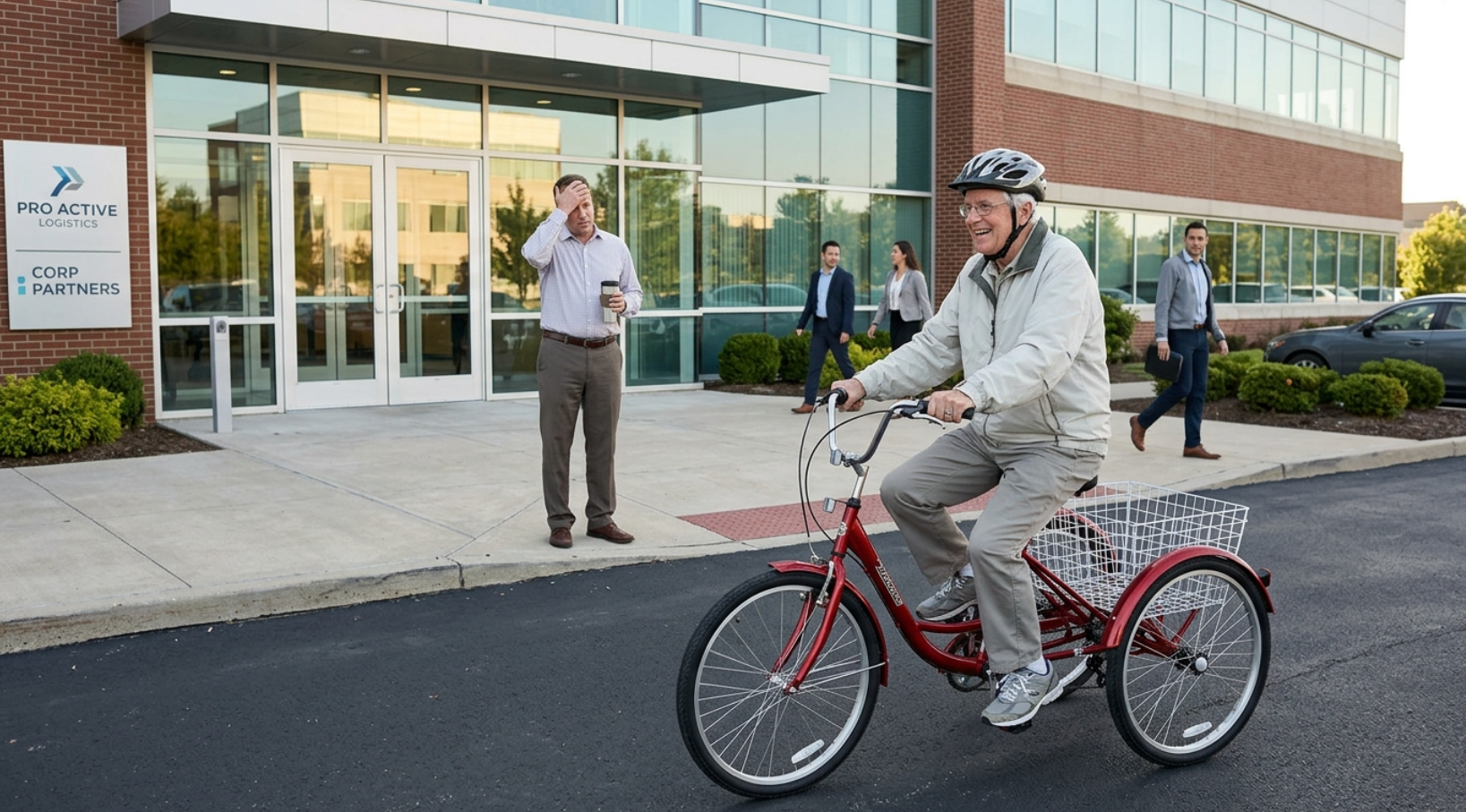
He looked at the bicycle again. The red frame, the three wheels, the little chrome bell Eli had given me for free.
“How did you even get here?”
“I pedaled.”
“Mom.”
“That’s generally how bicycles work.”
Despite myself, I almost smiled. He didn’t.
“Please come inside,” he said. “People are staring.”
I looked down at my cardigan, brushed a tiny piece of lint from the sleeve, and stepped away from the curb.
“Fine. But I’m bringing my bicycle.”
He closed his eyes briefly.
“Of course you are.”
He walked beside me as I pushed it through the office entrance. His receptionist, Linda, rose from her chair.
“Good morning, Mrs. Bennett.”
“Good morning, dear.”
She smiled at me, then looked at Brian with an expression I couldn’t quite interpret.
His office smelled of printer paper, coffee, and the lemon cleaner the building’s maintenance man used every Friday. There were photographs on the wall: Brian at his college graduation, Brian receiving an award from his insurance company, Brian with his wife, Megan, and their two children.
In every photograph, he wore the same confident smile.
I wondered when he had begun believing that confidence gave him the right to make decisions for everyone around him.
Brian closed his office door.
“Mom, sit down.”
I chose the chair opposite his desk.
He remained standing.
“Look, I know you’re upset about the Buick. But I did what I thought was right. You hit a mailbox. What if it had been a child?”
“What if the mailbox had been made of gold?” I asked. “Would that have made selling my car without permission acceptable?”
“That’s not what I’m saying.”
“Then tell me what you are saying.”
He rubbed his forehead.
“You’re seventy-six. You live alone. Your reflexes aren’t what they used to be. You don’t always see things the way you used to.”
I watched him carefully.
“Did your father stop being a person when he turned seventy-six?”
His face changed.
His father, Thomas, had been gone eleven years. He’d worked at a machine shop for most of his life, coming home with grease beneath his fingernails and a joke ready for dinner. He had loved that Buick. He’d bought it for me on our fortieth anniversary, a used blue sedan with a cracked dashboard and a heater that took ten minutes to warm up.
When he died, Brian helped me sort through the paperwork.
That’s when the title ended up with both our names on it, connected by the word or.
At the time, Brian had said it would make things easier if I ever needed help.
I had believed him.
“Dad couldn’t drive near the end,” Brian said.
“Your father was seriously ill. He could barely stand without help. I am not seriously ill, Brian. I clipped a mailbox in the rain.”
“You’re making this personal.”
“It became personal when you took my keys.”
He finally sat down.
For a moment, he looked less like a successful insurance agent and more like the little boy who used to come into my bedroom after thunderstorms, pretending he needed a glass of water.
“I’m worried about you,” he said.
“Then why didn’t you ask me what I needed?”
He didn’t answer.
I opened my purse and removed a folded envelope. Inside was a receipt for the bicycle, the cashier’s check from the sale of my car, and a small notebook.
Brian frowned.
“What is all that?”
“Records.”
“Records of what?”
“Everything I own, everything I spend, and everything I intend to decide for myself.”
He stared at the notebook.
“Mom, nobody is trying to take your life away.”
I looked at him for a long time.
“Then why does it feel as though you’re taking pieces of it away, one decision at a time?”
His eyes dropped to the desk.
I had expected an apology. Perhaps a promise to discuss things differently next time.
Instead, he said something I would remember for the rest of my life.
“Sometimes, Mom, people need someone else to make the hard decisions for them.”
I stood.
“Then I hope you never become one of those people who mistakes love for ownership.”
I pushed my bicycle toward the door.
“Where are you going?”
“Home.”
“Let me drive you.”
I looked at him.
“Brian, you already drove me home once. That’s how this started.”
I left before he could answer.
Outside, Linda held the door open for me.
“Take care, Mrs. Bennett,” she said softly.
“You too, dear.”
I climbed onto the bicycle and began pedaling.
I wasn’t angry anymore.
I was disappointed, and disappointment has a peculiar way of making a person see clearly.
For eleven years, since his father died, I had allowed Brian to help me with everything from insurance forms to bank appointments. I had mistaken his involvement for care and his confidence for competence.
Perhaps he had made the same mistake.
But I was not finished living.
And I had a feeling that my little red bicycle was going to take me somewhere neither of us had expected.
The first thing I did when I reached home was call Wilma.
She answered on the second ring.
“Well?”
“Well what?”
“Did he apologize? Did he buy your car back? Did he faint when you rang that little bell?”
I laughed so hard that I had to sit down.
“No fainting. No apology. No car.”
“Men,” she said. “Give them a desk and a necktie, and suddenly they think they’re kings.”
“Not all men.”
“Fine. Some men are kings. Yours is a retired king with a red bicycle.”
I laughed again.
Then I told her everything.
When I finished, Wilma was quiet.
“You know,” she said eventually, “my daughter once told me I shouldn’t climb the ladder to clean my gutters. I told her I wouldn’t. Then I hired a man to do it. She was happy, I was happy, and nobody broke a hip.”
“That sounds reasonable.”
“Because I asked you to listen to the story, not argue with the conclusion. There’s nothing wrong with being careful, Evelyn. There’s something wrong with someone deciding that being careful means you no longer get a vote.”
I looked out the kitchen window toward the empty carport.
The oil stain remained where the Buick had stood for years.
“I suppose you’re right.”
“I’m always right. It’s one of my few remaining pleasures.”
After we hung up, I made tea and opened the notebook I’d taken to Brian’s office.
On the first page, I wrote three things.
My health. My money. My independence.
Under each heading, I made a list.
My health: schedule an appointment with my doctor for a proper driving assessment, discuss my eyesight, and ask whether there were any concerns I needed to address.
My money: review my accounts, check the Buick title paperwork, and speak with an attorney about my rights.
My independence: find safe ways to get around town, including my bicycle, the bus, and rides with friends.
I didn’t write those things because I intended to prove Brian wrong.
I wrote them because I needed to know the truth for myself.
That afternoon, I called the clinic and scheduled an appointment.
Then I called a local attorney whose advertisement I’d seen in the newspaper.
His name was Mr. Collins, and his receptionist offered me an appointment for the following Tuesday.
Finally, I called Brian’s wife.
Megan answered while I could hear children playing in the background.
“Evelyn! How are you?”
“I’m well, dear. I was wondering if you knew what happened to the Buick.”
There was a pause.
“What do you mean?”
“Brian sold it.”
Another pause, longer this time.
“Oh.”
That single word told me more than a whole speech might have.
“You knew?”
“I knew he was worried about you driving. I didn’t know he’d actually sold it.”
I leaned back in my chair.
“Did he discuss it with you?”
“He said he was handling it.”
“Handling what?”
“I don’t know, Evelyn. Your car, I suppose.”
I heard a door close on her end.
“Listen,” she said quietly, “Brian’s been under a lot of pressure lately. Work has been difficult, and the kids’ school expenses are piling up. He’s been worried about everything.”
“I understand that.”
“He thought he was helping.”
“Perhaps. But helping someone doesn’t mean you get to decide everything for them.”
“No,” Megan said. “I suppose it doesn’t.”
Her voice sounded tired.
I almost asked whether Brian had told her something else, but I decided not to.
Instead, I said, “I hope you’re doing well, dear. Give the children a kiss for me.”