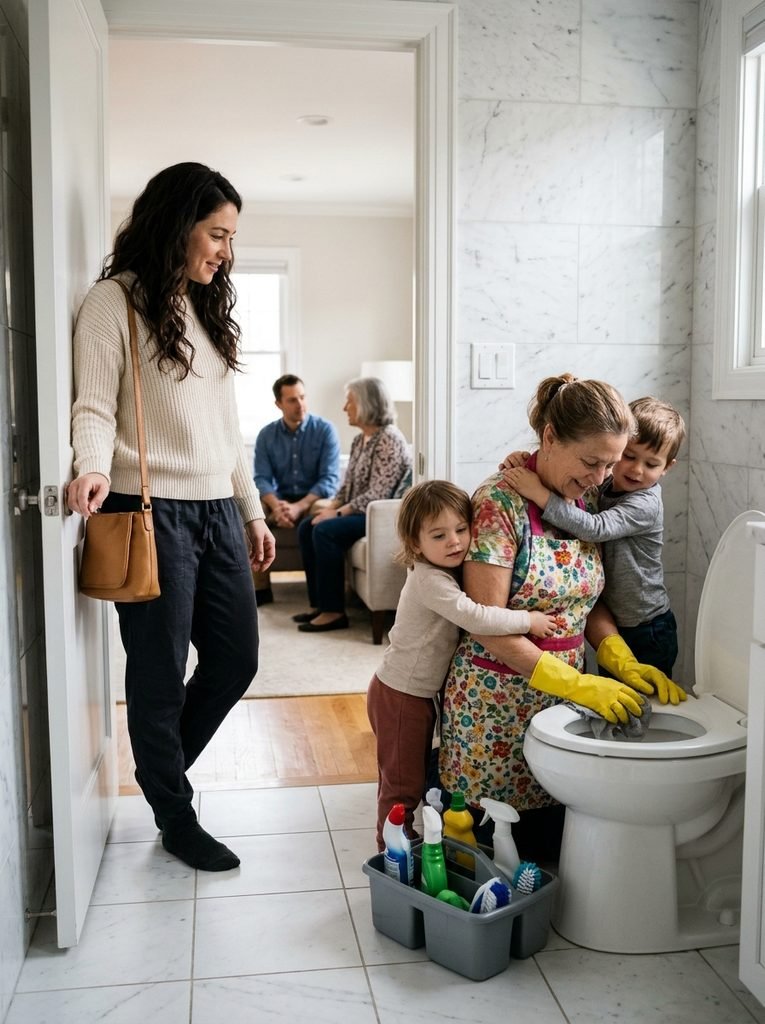
Whenever I called from business trips, he stood nearby.
If she tried to tell me something was wrong, he interrupted or convinced her that she had misunderstood his intentions and was becoming unnecessarily suspicious because of her age.
Then she told me about the money.
Marcus had demanded that she transfer money from her savings account to help cover household expenses, even though I had never asked her to contribute financially to our family.
When she refused, he threatened to send her to an assisted living facility and tell me she could no longer safely care for herself without constant professional supervision.
“He said you’d believe him,” she whispered. “He said I was getting old and that nobody would trust my memory if I tried to explain what was happening.”
I closed my eyes.
My mother had spent months living in fear beneath my roof while I traveled for work, convinced that my success was providing my family with comfort and financial security.
“Where’s your sewing machine?” I asked.
Mom’s expression changed immediately.
“Why?”
“Because Dad told me something before he died. Something I should have listened to much sooner.”
She stared at me for several seconds.
Then her lips began trembling.
“Your father knew,” she whispered.
Those three words sent a chill down my spine.
Before I could ask another question, I heard Marcus walking through the hallway. He was speaking angrily on the phone, his voice low but unmistakably tense as he passed the bathroom.
I asked Mom to stay with the children while I retrieved my phone. Then I called my longtime friend Rebecca, an attorney who had helped me through several complicated business contracts.
I explained that my mother had visible injuries, was frightened of my husband, and had disclosed controlling behavior and threats involving her finances and freedom of movement within our home.
Rebecca instructed me to prioritize everyone’s immediate safety, preserve any evidence, and seek medical attention for Mom’s injuries. She also advised me not to confront Marcus about financial documents without support.
I arranged for my brother David to collect us.
Then I helped Mom change into comfortable clothes, packed medication and essentials, and told the twins we were going to spend the afternoon with their uncle.
Marcus appeared at the bottom of the staircase as we approached the front door.
“Where exactly do you think you’re going?”
I kept my voice steady.
“Mom needs a medical examination. The children are coming with us.”
He folded his arms.
“You’re not taking my kids anywhere without discussing it with me.”
I stopped beside the door.
“Marcus, the children just watched you threaten their grandmother. We can discuss parenting arrangements through appropriate channels later. Right now, they need somewhere calm and safe.”
He glanced toward the driveway.
David’s truck had just arrived.
My brother climbed out and stood near the front entrance, watching carefully. Marcus’s posture changed immediately when he realized another adult had witnessed part of our confrontation.
“Fine,” Marcus muttered. “Go create your little family drama. But don’t expect me to apologize for trying to keep this house running while you’re never around.”
I said nothing.
We left.
At the medical clinic, a physician examined Mom’s wrist and knees. She documented the bruising, recommended additional evaluation, and asked my mother privately whether she felt safe at home.
Mom cried as she answered.
David stood beside me in the waiting room, clenching his fists. He kept asking how we could have missed the warning signs, but I knew blaming ourselves would not help her.
That evening, the children stayed with David’s wife while Mom and I went to her temporary room at their house. She sat quietly beside the window, holding her hands together.