less fragile began:
evidence of change.
The criminal case
moved slowly.
Dad’s attorney argued
that family informality
created confusion
about property access.
The deed defeated that.
The text messages
defeated that.
The changed locks,
written refusal,
security footage,
guest payments,
forged medical letter,
and loan application
defeated everything else.
Mom accepted
a cooperation agreement.
She admitted
helping create advertisements
and falsified records.
She sold
her jewelry,
the second car,
and most furniture
to fund restitution.
Their house entered foreclosure.
For the first time,
their financial emergencies
remained theirs.
Dad refused
to accept responsibility.
He insisted Kyle
had manipulated files.
Then investigators recovered
deleted messages
from his cloud account.
One read:
If Claire resists,
Patricia handles the emotional side.
Another read:
Once the loan funds,
the property becomes irrelevant.
The final one
was sent
two hours
before Friday’s confrontation:
She always caves
when people are watching.
He had brought twenty witnesses
because he believed
public shame
would open my door.
Instead,
twenty witnesses watched it
remain closed.
Six months later,
Dad entered
a guilty plea
after the lender
produced authentication logs.
He received
a custodial sentence,
followed by probation,
restitution,
and a permanent order
prohibiting financial contact
with me.
Mom received probation,
community service,
mandatory financial counseling,
and the same restriction.
The court hearing
occurred on a rainy Tuesday.
I sat behind Dana.
Kyle sat
across the aisle.
Mom looked smaller
than I remembered.
Dad did not turn around.
Before sentencing,
the judge allowed
victim statements.
Angela spoke first.
She described
the parents
who had saved
for rare weekends away.
The couple
whose daughter was dying.
The promises
designed to exploit
their need for rest.
Then Kyle stood.
His voice trembled,
but he continued.
“I helped my parents
because obedience
felt safer than honesty.
My sister paid
for that cowardice.
So did strangers.
I cannot undo it.
I can only stop
protecting the lie.”
When my name was called,
I walked forward.
The courtroom felt
colder near the bench.
I unfolded
my prepared statement.
Then I set it aside.
“My parents believed
family meant access,” I said.
“Access to my labor,
my money,
my identity,
my silence,
and my home.
When I refused access,
they called me unstable.
They forged documents
to make that lie official.”
Dad stared
at the table.
Mom wept quietly.
“I spent years believing
that saying no
made me unloving.
This case taught me
something simpler.
Love without consent
is control.
Help obtained through fear
is not help.
And family loyalty
cannot require
one person’s disappearance.”
I looked
at both of them.
“I do not ask
for the harshest punishment.
I ask for consequences
that cannot be transferred
onto me.”
The judge nodded.
“That is precisely
what the court intends.”
When proceedings ended,
Mom approached
under supervision.
She stopped
several feet away.
“Claire.”
I waited.
“I’m sorry.”
The words were quiet.
No explanation followed.
No demand.
No immediate request
for mercy.
I studied her face.
“Which part?”
She closed her eyes.
“All of it.”
“That answer is too broad.”
She nodded slowly.
“I am sorry
I studied your pain
instead of protecting it.
I am sorry
I used your work
as proof
you owed me.
I am sorry
I helped your father
steal your name.
I am sorry
I called your boundaries illness.”
Her voice fractured.
“And I am sorry
I believed being your mother
meant you could never leave me.”
The apology entered
the space between us.
It did not erase anything.
It did not rebuild trust.
But for once,
it asked me
to carry nothing.
“Thank you
for saying it,” I replied.
She looked hopeful.
I could not feed
that hope falsely.
“I’m not ready
for a relationship.”
“I understand.”
“Do you?”
Tears filled her eyes.
“I’m beginning to.”
The guard directed her away.
She obeyed.
Dad passed me next.
He stopped briefly.
“You won,” he said.
I shook my head.
“This was never
a game.”
He searched my face
for guilt.
Finding none,
he walked onward.
Outside,
rain had stopped.
Kyle waited
beneath the courthouse awning.
We descended
the stone steps together.
At the bottom,
he asked,
“Do you want coffee?”
“Not today.”
He nodded.
“Okay.”
I took three steps,
then turned.
“Maybe next month.”
His expression changed,
but he controlled it.
“Whenever you decide.”
That was the first promise
from my family
that sounded like respect.
Spring reached Devils Lake
slowly.
Snow withdrew
from shaded ground.
Tiny green shoots appeared
near the porch.
Mrs. Harper complained
about her knees
while planting herbs
she insisted
she did not need help with.
Angela visited
one Saturday
with her husband, Marcus.
The restitution process
had returned most
of their payment.
They brought
a blueberry pie
and refused
to enter
until I invited them.
That simple pause
moved me unexpectedly.
We ate
beside the windows.
Marcus repaired
a loose screen.
Angela helped me
create a legitimate listing
for something entirely different:
free weekend stays
for hospital families
whose loved ones
needed extended treatment
in Lincoln City.
I did not rent
the whole house.
I offered
one guest room,
only when I chose,
through a verified
hospital support program.
The first guests
were parents
of a nineteen-year-old
awaiting heart surgery.
They arrived carrying
one small suitcase
and the careful exhaustion
I recognized immediately.
At the threshold,
the mother asked,
“Are you certain?”
“Yes,” I said.
“I am.”
Permission transformed everything.
The house no longer felt
like a fortress.
It felt
like a home
with a door
I controlled.
Kyle visited
in early June.
He parked
outside the gate
and texted:
I’m here.
No pressure.
I opened it remotely.
He drove slowly
toward the house.
The red scarf
was folded
inside a gift box.
He carried no luggage.
“I booked a motel,” he said.
“You can use
the downstairs room.”
His eyes widened.
“Are you sure?”
“For one night.”
He nodded.
“Thank you.”
We spent the afternoon
repairing the dock
I eventually decided
to build.
Kyle measured twice.
Then three times.
He no longer assumed
confidence was competence.
Around sunset,
we sat
at the water’s edge.
The lake reflected
bands of copper light.
“I used to resent you,”
he said.
“For what?”
“For leaving.”
“I moved forty minutes away.”
“You left their system.”
I watched
a fishing boat
cross the distance.
“You could leave too.”
“I didn’t know that.”
We remained quiet.
Then Kyle asked,
“Do you remember
when I broke
Grandma’s blue bowl?”
“Yes.”
“You took the blame.”
“Mom said
Dad would hit you.”
His face tightened.
“I remembered that
during therapy.”
“So did I.”
“I was seven.”
“I was twelve.”
He looked down.
“You were always protecting me.”
“Yes.”
“And when you stopped,
I called you selfish.”
The sunset brightened
one side of his face.
“I don’t expect forgiveness.”
“Good.”
A faint smile touched
his mouth.
“Still direct.”
“I’m learning.”
He nodded.
“So am I.”
I picked up
a flat stone
and threw it.
It skipped twice,
then disappeared.
“I forgive the boy
who broke the bowl,” I said.
Kyle’s breath caught.
“The man who gave away
my access code
still has work to do.”
“That’s fair.”
“It isn’t punishment.”
“I know.”
“Do you?”
He looked
across the water.
“I think forgiveness
used to mean
nobody could mention
what happened.
Now I think
it means the truth
can remain
without controlling everything.”
June’s words returned.
Truth was light.
Kyle had found
his own version.
“That sounds right,” I said.
We stayed outside
until mosquitoes
drove us indoors.
In August,
Mrs. Harper suffered
a minor stroke.
I found her
on the kitchen floor
after she missed
our morning coffee.
Because I was there,
treatment began quickly.
Because she was stubborn,
she argued
with the paramedics.
Because she was Margaret,
her first clear sentence
at St. Mercy was:
“Who is watching
Claire’s gate?”
She recovered
most of her strength
within weeks.
During rehabilitation,
I visited daily.
One afternoon,
she asked me
to open
her bedside drawer.
Inside rested
a sealed envelope.
My name appeared
in careful handwriting.
“What is this?”
“Something I should
have given you earlier.”
I opened it.
The letter inside
was dated
seven years before.
It came
from the former owner
of my lake house,
a retired teacher
named Helen Ward.
I had met her
only twice
during the sale.
Claire,
the letter began,
Margaret tells me
you believe
you were lucky
to find this house.
The truth is,
I chose you.
Several buyers offered more.
One planned
to demolish it.
Another wanted
vacation rentals.
You stood
in the kitchen
and asked whether
the morning light
always reached
the wooden table.
Nobody else noticed
the light.
A house remembers
who sees it.
I hope this place
gives you
the quiet
you have earned.
And I hope
you never confuse
an open heart
with an unlocked door.
I read
the final sentence twice.
Mrs. Harper watched me.
“Helen knew?”
“She recognized people
who apologized
for wanting peace.”
Tears slipped
down my face.
“Why did you wait?”
“Because you needed
to believe
you bought it
with your own strength.”
“I did.”
“You did,” she said.
“But being chosen
doesn’t weaken that.”
I folded the letter carefully.
Helen had rejected
higher offers.
The house had not entered
my life by accident.
Someone had seen me
before I learned
to see myself.
The revelation changed nothing
about the deed.
It changed everything
about belonging.
I placed the letter
inside my coat.
“When you leave rehabilitation,”
I told Margaret,
“you’re staying with me.”
She narrowed her eyes.
“Are you ordering me?”
“I am offering.”
“For how long?”
“As long as you choose.”
She considered this.
“Separate bathrooms.”
“Agreed.”
“And decent coffee.”
“Impossible.”
Her laugh filled
the hospital room.
By autumn,
the criminal case ended.
The restitution fund
repaid every identified guest.
The fraudulent loan disappeared
from my credit reports.
The counterfeit company
was dissolved.
St. Mercy formally cleared
my professional record
and strengthened safeguards
around employee documents.
Deputy Ruiz received
a commendation
for his handling
of the confrontation.
Angela insisted
everyone attend.
Kyle sat
two rows behind me.
Mom did not come.
She sent
a handwritten letter instead.
I did not open it
for three weeks.
When I finally did,
it contained no defense.
She described
her counseling,
community service,
and a rented studio apartment.
She had found work
at a grocery store.
For the first time
since she was nineteen,
she paid
her own expenses.
Near the end,
she wrote:
I used to think
your independence rejected me.
Now I understand
it showed me
what I refused to become.
I will not ask
for your address,
your schedule,
or your forgiveness.
If you ever contact me,
I will answer honestly.
If you never do,
I will still keep changing.
I placed the letter
beside Helen’s.
One came
from a stranger
who recognized my need
for peace.
The other came
from my mother,
finally recognizing
the cost
of denying it.
I did not call her.
Not then.
But I kept the letter.
Christmas arrived
under clear skies.
Mrs. Harper,
walking with a cane,
moved into
the downstairs guest room.
Kyle came
for lunch,
not the weekend.
Angela and Marcus arrived
with another pie.
A hospital family
occupied the upstairs room
while their daughter recovered
from emergency surgery.
Nobody assumed
where they would sleep.
Nobody opened
a cabinet
without asking.
Nobody called permission
an insult.
We ate
around the wooden table.
Morning light had faded,
replaced by candles
and the golden reflection
of the fireplace.
After dinner,
Kyle washed dishes.
Marcus dried them.
Angela taught Margaret
a card game
and immediately regretted it.
Margaret cheated
without remorse.
Laughter moved
through the house.
Not loud enough
to overwhelm it.
Warm enough
to make the silence
between voices
feel safe.
My phone buzzed once.
A message from Mom.
Merry Christmas, Claire.
No request followed.
I read it.
Then I typed:
Merry Christmas.
I did not add
an invitation.
I did not apologize
for that.
Across the room,
Kyle looked toward me.
I nodded slightly.
He understood.
Later,
after everyone slept,
I stepped onto the porch.
The lake lay dark
beneath the winter sky.
Frost silvered
the railing.
The new dock extended
into still water,
solid and quiet.
I wrapped
Grandma Evelyn’s red scarf
around my neck.
Inside,
Mrs. Harper’s cane rested
beside the fireplace.
Kyle’s repaired toolbox
sat near the door.
Helen’s letter remained
inside the cedar desk.
Nothing in the house
felt empty.
Nothing felt occupied
against my will.
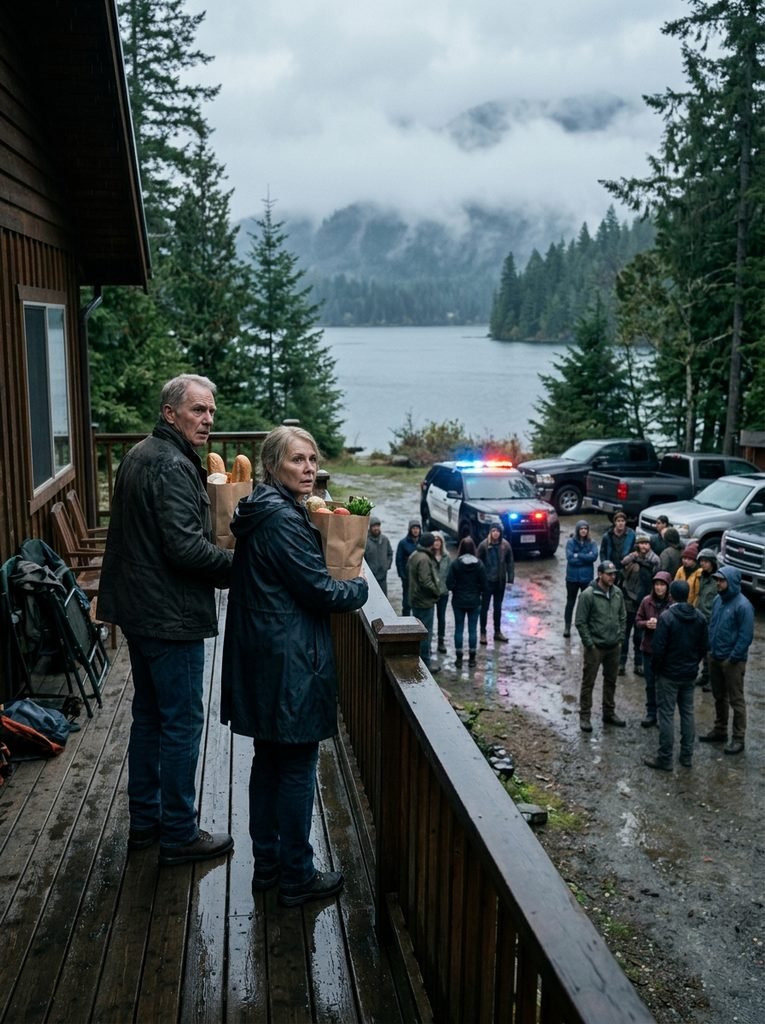
I remembered Friday morning.
Twenty people
on the porch.
Dad shouting
through the phone.
Mom demanding
that I behave.
The cruiser
turning into the driveway.
At the time,
I thought
I was defending a building.
I understood now
that I had defended
the person
I became inside it.
The nurse
who survived twelve-hour shifts.
The woman
who built peace
from overtime
and stolen sleep.
The daughter
who finally stopped
mistaking surrender
for love.
Wind moved gently
through the pines.
Behind me,
the door opened.
Mrs. Harper stepped outside,
wrapped in a blanket.
“You’ll freeze,” she said.
“So will you.”
“I am supervising.”
“Of course.”
She stood beside me.
Together,
we watched moonlight
touch the water.
“Any regrets?” she asked.
I considered the question.
There were losses.
There was grief.
There were relationships
that might never heal.
Peace had not arrived
without cost.
It had arrived
because I finally stopped
paying every cost alone.
“No,” I said.
Mrs. Harper nodded.
“Good.”
We returned inside.
Before closing the door,
I looked once more
across the quiet lake.
Then I turned the lock.
Not from fear.
Not from anger.
Simply because
the house was mine.
And for the first time,
so was my life.”