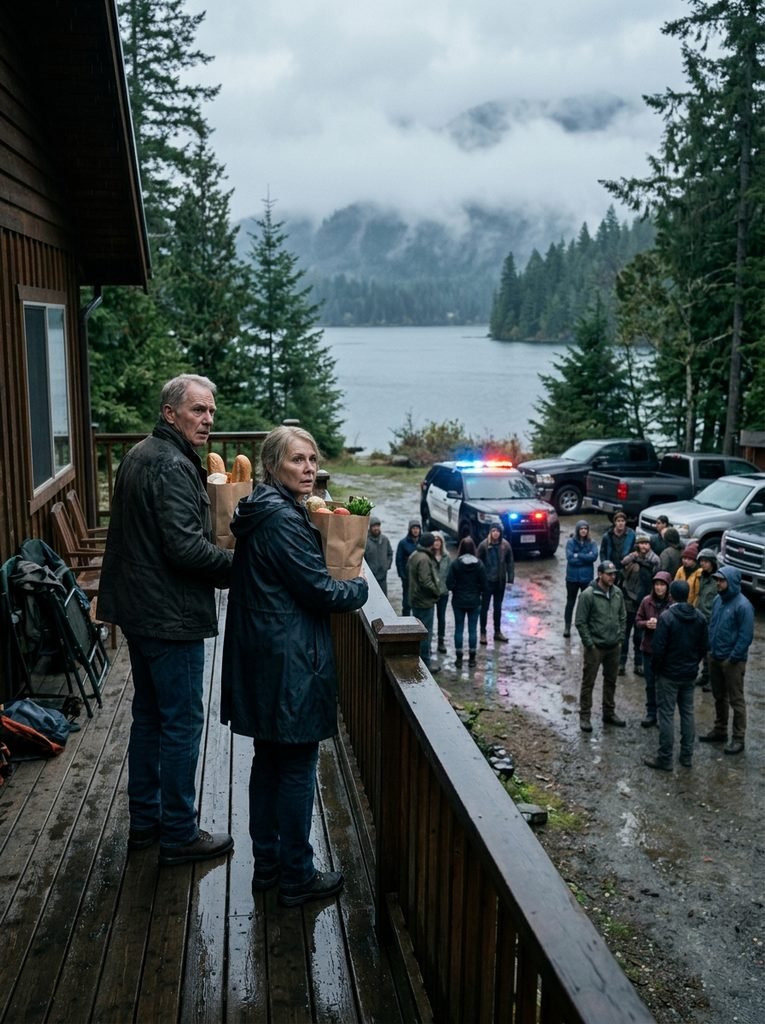
“My parents announced they were bringing
“My parents announced they were bringing
20 guests to my lake house
and told me to fill the fridge.
When I said no, Mom laughed
and asked if I really thought
I could stop them.
By Friday morning, Dad was shouting,
“What did you do to the house?”
I had just finished
a twelve-hour shift
at St. Mercy Medical Center,
most of it on my feet,
most of it spent watching people
fight for one more breath
beneath fluorescent lights.
By the time I parked
outside my apartment
in Portland, Oregon,
my scrubs smelled like antiseptic
and stale coffee,
and my phone had been buzzing
for nearly twenty minutes.
Family group chat.
Dad had tagged me three times.
Dad: We’re using your lake house
this weekend. 20 guests.
Mom: Fill the fridge and behave.
My younger brother, Kyle,
added a row of laughing faces.
I stared at the messages
until the words blurred.
My lake house was not “family property.”
It was mine.
I bought it
after six years of double shifts,
overtime, and living with roommates
who stole my food.
A quiet place near Devils Lake
where I could sleep, breathe,
and not hear my mother criticize
every part of my life.
I typed one word.
Me: No.
Mom replied almost instantly.
Mom: 😂😂😂 You really think
you can stop us?
Dad sent a voice message,
but I did not play it.
I already knew the tone:
an order dressed up
as family love.
So I did not argue.
I showered, changed clothes,
and made one call
to my neighbor, Mrs. Harper,
who lived across the gravel road
from the lake house.
“Margaret,” I said,
“if any cars show up this weekend,
they do not have permission to enter.”
She paused.
“Your parents again?”
“Yes.”
“Good,” she said.
“I’ll keep watch.”
Then I opened my laptop
and logged into
the smart security system.
I changed every door code.
I disabled the old garage keypad.
I shut off the guest Wi-Fi.
I activated the cameras
and called the local locksmith,
the same man who had helped me
after my father “borrowed” the place
last summer
and left beer cans
in the hot tub.
By noon, the locks were changed.
By three, I had emailed
the sheriff’s office non-emergency line
with a written statement:
no one had permission
to enter the property.
Then I slept.
Friday morning, my phone exploded.
Forty missed calls.
Dad’s name filled the screen
again and again.
I answered on the forty-first.
“What did you do to the house?”
he screamed.
His voice was windy and furious.
In the background, Mom yelled,
“Tell her to stop acting crazy!”
I sat up slowly.
“Good morning.”
“Don’t you good morning me!
The front door code doesn’t work.
The garage is locked.
There are cameras everywhere.
Your mother is standing outside
with groceries melting,
and everyone is staring at us!”
“Then everyone should leave.”
“This is a family weekend!”
“No,” I said.
“It was an attempted break-in
with witnesses.”
For once, he went silent.
Then Dad lowered his voice.
“Open the door, Claire.”
I looked at the live camera feed.
Twenty people stood crowded
on my porch.
And behind them,
a sheriff’s cruiser
was turning into the driveway…
The cruiser stopped behind Dad’s truck.
Red gravel dust drifted
through the morning light.
Dad turned toward it.
His shoulders lost
some of their certainty.
Deputy Ruiz stepped outside.
I recognized him
from the photograph
beneath my emailed statement.
He was broad-shouldered,
calm,
and entirely unimpressed
by the crowd.
Mrs. Harper emerged behind him.
She carried her walking stick,
though I knew
she rarely needed it.
That morning,
it looked less
like medical equipment
and more like punctuation.
Dad spoke first.
“Officer, thank God.
My daughter locked us out.”
Deputy Ruiz glanced
toward the porch camera.
Then he looked directly
into its lens.
“Ms. Claire Bennett?”
“I’m here,” I said
through the exterior speaker.
Several guests startled.
Mom stared upward.
Her face tightened
when she found the camera.
Deputy Ruiz removed
a folded page
from his shirt pocket.
“I have your written declaration.
Can you confirm nobody present
has permission to enter?”
“I confirm it.”
Dad laughed too loudly.
“That’s ridiculous.
We’re her family.”
“That wasn’t my question,”
Deputy Ruiz said.
Dad’s laughter stopped.
Mom stepped forward,
still holding
two grocery bags.
One had split
along the bottom.
A carton of cream
leaned dangerously sideways.
“She’s exhausted,” Mom said.
“She works nights.
She gets emotional.”
My stomach tightened.
She had used that sentence
throughout my childhood.
Claire gets emotional.
Claire remembers things incorrectly.
Claire needs quiet.
Claire does not understand jokes.
Different words,
always serving the same purpose:
to make my boundaries
sound like symptoms.
“I understand clearly,” I said.
“This property belongs solely to me.
They were told not to come.”
A murmur moved
through the guests.
A woman wearing sunglasses
lowered them slowly.
Dad looked over his shoulder.
“Don’t listen to her.
She’s being dramatic.”
Deputy Ruiz remained still.
“Mr. Bennett,
did your daughter deny permission
before you arrived?”
Dad’s mouth opened.
Mom answered instead.
“She said no,
but she didn’t mean it.”
“I meant it,” I said.
Kyle stood near the steps,
his hands buried
inside his sweatshirt pockets.
He had stopped smiling.
Deputy Ruiz turned toward him.
“Were you in the group chat?”
Kyle glanced at Dad.
Then Mom.
Finally, he nodded.
“Did your sister write no?”
Another pause.
“Yes.”
The single word crossed
the driveway like thunder.
Dad’s head snapped around.
“Kyle.”
“What?” Kyle muttered.
“She did.”
Mom placed her bags down.
“Claire, stop humiliating us.
Open the house,
and we’ll discuss this privately.”
“No.”
Her expression changed.
The pleasant public mask vanished.
“You ungrateful little—”
Deputy Ruiz raised one hand.
“Ma’am.”
Mom swallowed the rest.
Behind her,
the woman with sunglasses
stepped from the group.
“Excuse me,” she said.
“Is the house unavailable?”
Dad turned quickly.
“Angela, please.
It’s a family disagreement.”
Angela folded her arms.
“You charged us six hundred dollars.”
Silence settled
across the gravel.
Even the wind seemed
to leave the trees.
I sat completely motionless.
“What did she say?”
Angela faced the camera.
“We each paid your father
six hundred dollars
for this weekend.”
She gestured toward
the other guests.
“He advertised
a private lakeside retreat.
Meals, boating,
rooms,
and guided activities.”
My exhaustion vanished.
I leaned closer
to the screen.
“How many people paid?”
A gray-haired man answered.
“Ten couples.”
Dad moved between them
and the camera.
“This is none
of Claire’s concern.”
“It concerns my house.”
“You weren’t using it.”
His words came instantly,
with astonishing sincerity.
“You leave it empty
half the month.”
“That does not make it yours.”
“We were going
to reimburse expenses.”
Angela gave a humorless laugh.
“You told us
you owned the property.”
More voices joined hers.
“You said it was debt-free.”
“You promised private bedrooms.”
“You advertised a boat.”
“There isn’t even a dock,”
Mrs. Harper said dryly.
Dad pointed toward her.
“Stay out of this, Margaret.”
She planted her walking stick.
“I am standing
on my own land, Leonard.
Unlike you.”
Deputy Ruiz requested receipts.
Phones appeared
from pockets and purses.
Within moments,
he was looking
at payment confirmations,
screenshots,
and an online advertisement.
Angela held her screen
toward the porch camera.
The listing displayed photographs
of my living room,
my kitchen,
and my upstairs bedroom.
Photographs I had never published.
One showed my cedar nightstand.
My framed nursing-school photograph
had been cropped away.
Another showed
the locked owner’s closet.
My throat went cold.
Only three people
had ever stayed there alone.
I was one.
Mrs. Harper was another.
Dad was the third.
He had taken those photographs
during his unauthorized weekend.
This had not been spontaneous.
It had been planned
for nearly a year.
“Send those screenshots to me,”
Deputy Ruiz said.
Angela did.
The deputy’s phone chimed.
He studied the images,
then looked at Dad.
“You represented yourself
as the property owner?”
Dad’s face reddened.
“It’s complicated.”
“The deed isn’t,” I said.
Deputy Ruiz nodded.
“No, it isn’t.”
Mom picked up
the leaking grocery bag.
Cream dripped
over her sandal.
She looked down
with offended disbelief,
as though even gravity
had betrayed her.
“This can still be fixed,”
she said.
“Claire opens the door.
Everyone enjoys the weekend.
Leonard refunds part
of the money later.”
Angela stared at her.
“You knew?”
Mom’s silence answered.
Angela stepped backward.
The other guests followed.
Their confusion hardened
into anger.
Dad saw it happening.
His voice became warmer,
almost fatherly.
“Folks, come on.
You know me.
This is merely
a misunderstanding
with my eldest.”
“You took our anniversary savings,”
one man said.
“My wife arranged childcare.”
Another woman wiped her eyes.
“Our daughter is in hospice care.
This was our first weekend away
in eleven months.”
Dad looked irritated,
not ashamed.
That expression told me
everything forgiveness
had prevented me from seeing.
He was not horrified
that people were hurt.
He was horrified
that hurt people
had become inconvenient.
Deputy Ruiz directed everyone
away from the porch.
He asked Dad
for identification.
Then he asked
whether any money remained.
Dad stiffened.
“I need an attorney.”
“That is your right.”
Mom turned toward the camera.
“Claire, call him off.”
“I didn’t call him on you.
Your choices did.”
“You would have nothing
without this family.”
The sentence struck
an old place inside me.
For years,
that place had been tender.
That morning,
it finally felt empty.
“I have exactly
what I built,” I said.
“And you are standing outside it.”
Dad lunged toward the door.
His hand closed
around the new handle.
He shook it once,
hard enough
to rattle the frame.
Deputy Ruiz caught his wrist.
“Step away.”
“It’s my daughter’s house!”
“And she denied access.”
Dad jerked free,
then stopped himself.
The camera captured
every second.
He looked straight at me.
Something cruel
and familiar
entered his eyes.
“You’ll regret this.”
“No,” I said.
“I’ve regretted letting it continue.”
Deputy Ruiz instructed Dad
to leave the property.
He issued
a formal trespass warning
to both my parents.
When Dad argued,
the deputy repeated himself
more slowly.
Mom began crying.
Not quietly.
Not with grief.
She produced
the loud, wounded sobs
she used
whenever an audience
might reward them.
Kyle moved toward her.
Then he hesitated.
She reached for his arm.
He stepped away.
That surprised us both.
The guests returned
to their vehicles.
Several remained nearby,
sending evidence
to Deputy Ruiz.
Angela stood beside his cruiser,
organizing names
and payment amounts.
She had the steady manner
of someone accustomed
to emergencies.
Later, I learned
she managed an elementary school.
That morning,
she managed twenty furious adults
and one unraveling fraud.
Dad climbed into his truck.
Mom entered
from the passenger side.
Before closing her door,
she looked up
at the camera.
“You have destroyed this family.”
“No,” Kyle said.
His voice was quiet,
but the microphone caught it.
Dad froze.
Kyle stood alone
near the porch steps.
“You did.”
Dad leaned across Mom.
“Get in the truck.”
Kyle shook his head.
“Kyle.”
“No.”
The word sounded unfamiliar
in his mouth.
Perhaps it was.
Dad opened his door.
Deputy Ruiz moved
between them.
“He is an adult,”
the deputy said.
“He can decide
where he goes.”
Dad gripped the wheel.
For one breath,
I thought he might
ignore the warning.
Then Angela lifted her phone.
She was recording.
Dad saw her.
He slammed the door
and reversed too quickly,
scattering gravel.
Mom twisted around
to stare at Kyle
through the rear window.
He did not wave.
The truck disappeared
between the pines.
Nobody spoke
until its engine faded.
Then Kyle sat
on the porch step
and covered his face.
I watched him
through the camera.
The laughing emojis
remained vivid
in my memory.
So did every holiday
when he joined their jokes.
Every dinner
when he let them
reduce my work,
my clothes,
my solitude,
and my choices
to entertainment.
I wanted to disconnect.
Instead, I asked,
“Why are you still there?”
His hands lowered.
“I don’t know
where else to go.”
“That isn’t an answer.”
He looked toward
Deputy Ruiz,
then Mrs. Harper.
“I sent them the dates.”
A pressure formed
behind my ribs.
“What dates?”
“The weekends you worked.”
His voice cracked.
“They said
they wanted family time.
Dad told me
you had agreed before,
then changed your mind
to punish Mom.”
“I never agreed.”
“I know that now.”
Mrs. Harper moved closer.
Kyle stared
at the gravel.
“I gave him
the old door code too.”
I closed my eyes.
There it was.
Not merely weakness.
Participation.
The pain arrived quietly.
That made it worse.
“Why?”
“They said
you were keeping
the house from us.
They said
you thought you were better
because you owned something.”
“Did you believe them?”
“For a while.”
He wiped his face.
“It was easier.”
The honesty hurt
more than an excuse.
“Easier than what?”
“Admitting they use people.”
Wind moved
through the microphone.
Pine branches whispered overhead.
Kyle reached inside
his sweatshirt pocket
and removed a flash drive.
“I copied Dad’s files.”
Deputy Ruiz looked at him.
“What files?”
“Reservations.
Payments.
Messages with Mom.
A spreadsheet
of every weekend
they planned to rent
Claire’s house.”
My skin prickled.
“How many?”
Kyle looked
into the camera.
“Eight more this year.”
Mrs. Harper whispered something
I could not hear.
Deputy Ruiz held out
an evidence envelope.
Kyle did not surrender
the drive immediately.
“Claire,” he said,
“there’s more.”
I waited.
“Dad used your name.”
“For what?”
“A business account.
The retreat company
is registered under
Claire Bennett Hospitality.”
The bedroom seemed
to tilt around me.