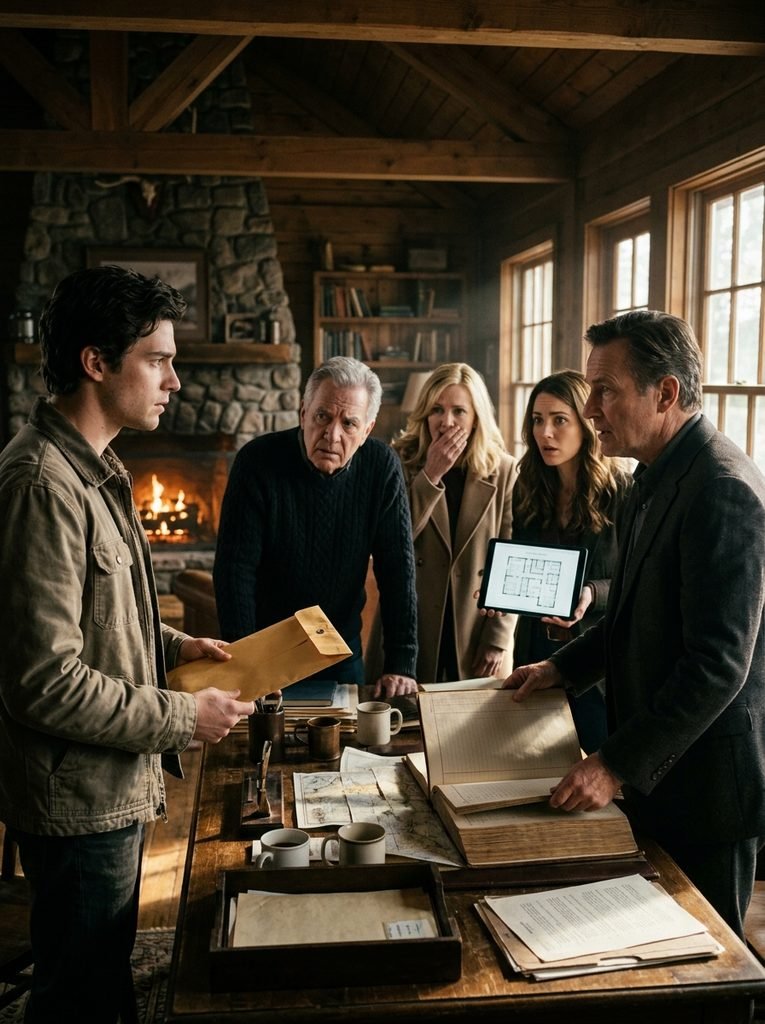
Not the clearest film in the world, but paired with my note about the broken safe and Garrett’s inventory lists, it was damning.
The crew handed copies to me and to Mara.
Step two was official.
Garrett filed a formal complaint with the sheriff’s office, supplied the footage, the photographs of the pride lock, the notorized will, and the revocation documents we’d found in the attic, and the timeline proving my parents were on the property when the safe was opened.
He also drafted a concise cease and desist and sent it certified mail.
No more visits, no more attempts to list the property and a warning that any attempted sale would be met with immediate legal action.
Garrett had a way with words that made threats sound boring and inevitable.
That helped.
Step three was public.
Mara agreed to write an expose, but she didn’t want it sensational.
She wanted it to look like reporting.
She ran the title past me.
“How a mountain cabin became the center of a family’s feud.”
The piece included the footage, quotes from the neighbors who’d seen late night vans and unfamiliar contractors circling the property, the property listing screenshots my parents had floated to the realtor, and Garrett’s explanation of the legal chain of custody of the will.
When it went live, the local Facebook groups lit up.
People who remembered Grandma called the paper.
One neighbor I’d barely spoken to before brought over an envelope with text messages he’d recorded.
Rachel had been bragging to a friend about getting things set up and even mentioned the attic.
That friend sent the screenshots to Mara.
I didn’t ask for public pity.
I wanted the truth on record and I wanted the kind of pressure that makes people with greedy plans shrink away.
Scrutiny.
Within 48 hours of the article, the realtor who’d been talking to my parents backed off and sent a tur saying they wouldn’t list the property without clear, uncontested title.
The contractor who’d been quoted in Rachel’s binder called Garrett and said he wouldn’t be involved in any family business where clients lied about ownership.
Even the local historical society put a polite hold on any permits to change the property without a review.
Something I gently encouraged them to do, knowing any permit would require affidavit from all interested parties.
I also used the show and blog.
In the next episode of the miniseries, the producer let me run a short segment where I talked about stewardship and respect.
Nothing accusatory, just values.
Then at the end of the episode, they played 20 seconds of the attic footage with the crowbar.
I didn’t speak over it.
Few words sometimes are more damning than images and the quiet sound of someone searching through someone else’s life.
That was the setup.
It let the law do its work and let the town weigh in without me having to shout.
People started calling my parents, not to berate them, mostly to ask basic questions like, “Are you sure you own the cabin?” and “Did you have the right to be in the attic?”
That social pressure nodded at them.
My mother’s old friend stopped answering her calls.
Rachel’s Instagram comments turned from polite curiosity to sharp, blunt questions.
The moral center of our little valley had turned their attention toward who was behaving decently and who wasn’t.
The payoff wasn’t theatrical.
It was quiet and perfect.
One cool Thursday, I sat at my desk and sent a single email to three addresses.
My parents, Rachel, and the realtor who’d been their contact.
Subject line, public notice, and invitation.
The body was short and clinical.
I attached copies of the attic footage, the police report number, the ceaseandist, and the county’s confirmation of completed transfer of title to my name.
I ended the email with one line.
“If anyone would like to discuss this, we’ll be holding a public mediated meeting at the community hall next Thursday at 6 p.m. The local paper, the county clerk, and a mediator will be present. If you do not attend, your concerns will be aired in public record. No private settlements will be accepted after that date.”
I didn’t bait them.
I simply set the terms where their only options were to either face the facts in public or walk away in shame.
The next week, my inbox filled with predictable things.
Tepid appeals to family.
A passive aggressive threat from my father about making grandma’s legacy miserable and most telling, a lawyer’s letter from a small firm claiming to represent Rachel.
Garrett and I read it and shrugged.
They were all flailing.
What I hadn’t expected was how calm it all felt for me.
I slept easier.
I walked the land without checking my rear view.
I let the process breathe and the system take care of the rest.
That more than anything was the revenge I’d wanted to no longer have their chaos define my life.
Two days before the meeting, Mara asked if she could run a follow-up piece announcing the mediation and quoting the seaand desist.
The article went online late at night.
By morning, the whole valley knew there’d be a hearing.
Neighbors RSVPd.
Two of Grandma’s old church ladies said they’d bring pies.
The historical society promised to send a representative.
The sheriff, who was more embarrassed than righteous, confirmed he’d have an officer present for safety.
On the day, I walked into the community hall carrying two thermoses, my notepad, and the envelope with grandma’s letter.
The room smelled vaguely of donuts and pine cleaner.
People whispered when I passed.
My parents arrived last late, smoothed their coats, and sat at the back like accused actors waiting for their queue.
The mediator introduced herself.
Polite, efficient, asked everyone to state their names.
I spoke.
Even though Garrett could have done it for me.
“Cole Mallister,” I said. “I’m here to ensure the wishes of Evelyn Mallister are respected.”
My voice was steady.
The room nodded.
Cameras were set up in the back, but they were small, respectful local outlets.
No national circus.
My father stood when it came to him.
Voice shaky at first.
He stumbled through a version of events that tried to paint him as a beautiful son who had only ever wanted to honor his mother.
Rachel’s lawyer made a perfuncter argument about family rights and uncertain capacity, but Garrett had already preempted that with the cognitive evaluations and the notorized documents.
The mediator asked for specifics.
Garrett presented them.
The sheriff confirmed the complaint.
Mara’s recorder clicked softly.
Midway through, my mother began to cry.
Not the dramatic performative cry she’d practiced for me in the past, but a small raw thing that made a few people in the front row glance away.
She asked if she could speak.
The mediator nodded.
She looked at me and said, “Cole, I I never meant to.”
Then her voice caught.
The room was quiet.
Everyone leaned in.
Even my father’s shoulders seemed to slump.
That was when my phone buzzed.
A new email from an address I didn’t recognize.
Subject.
“You’ll want to hear this before you speak.”
I glanced at Garrett.
He did the same.
I opened it.
Inside was a short audio file.
It had been recorded the night the attic was rifled through, the one I’d stumbled upon.
The file had been sent by someone who’d been staying at the motel.
Rachel used, an off-hand third party who’d heard a private conversation, and shared it when they realized what it meant.
The voice on the recording was unmistakable.
My father speaking in a tone I’d heard a hundred times.
Speaking about money, getting what was ours and a line that made my skin go cold.
“Evelyn’s signature won’t hold if we can show she wasn’t of sound mind. We’ll just find an old draft or make one. It’ll be cleaner that way.”
The mediator’s clipboard lay forgotten.
My mother’s face went white.
My father’s jaw tightened like a clamp.
Rachel’s attorney pald.
I hit play again.
The room heard everything.
People shifted.
A murmur rose.
The mediator closed her notebook slowly and said, “I think we need to pause. The sheriff should review this.”
My parents looked at me then, anger, fear, calculation, all layered on one another.
They had one last frantic thing they could try to do.
Claim character, claim sorrow, claim the messy complexity of family.
They could try and spin, plead, beg, and they would.
But the recording had changed the rules.
It moved this from family disagreement into the territory of proof.
My heart hammered, less with adrenaline and more with a steady, cold certainty.
I’d wanted them stopped, exposed, held accountable.
I hadn’t wanted humiliation for the sake of it.
I wanted a clean field where the cabin could breathe and where grandma’s choices would stand.
Outside, the winter sun slanted low.
Inside, my mother started to stammer an apology.
My father opened his mouth to speak.
At that exact moment, the hall doors burst open and someone rushed in breathless, face flushed from the cold.
Heads turned.
I looked up and froze because the person at the door was not a neighbor, not a reporter, not the sheriff.
It was someone I hadn’t expected to see at all.
The person standing at the door was Lily, my sister, halfsister.
Technically, I hadn’t seen her since I was 15.
She was younger than me by 5 years. Quiet, awkward, always walking on eggshells around our father.
Back then, she’d been the ghost of the house, present, but never spoken to unless she was needed for a chore or to back up a lie.
I left at 19 and never looked back.
She stayed and then vanished.
But here she was, taller, sharper, different, but not same eyes, same nervous energy.
Her coat was damp from snow.
Her breath came fast like she’d run the last mile.
She stood in the doorway, frozen as the whole room turned toward her.
She looked straight at me, then at her parents, then back to me.
“I have something to say,” she said, breathless.
The mediator blinked, clearly thrown.
“Your name?”
“Lily Mallister.”
My father’s face dropped.
Pale then read.
“Lily, don’t.”
But she walked past him like he didn’t exist.
Marlo was already moving her recorder closer.
Garrett leaned forward, lips pressed in a line, and I just stared, unsure if I was still breathing.
Lily stopped beside the center table.
She was shaking, shoulders tight, fists clenched, but her voice was steady.
“I lived with them after Cole left,” she said, voice thin but clear. “I know what they did.”
My mother gasped.
My father stepped forward.
“Lily, no—”
But it was too late.
“I heard them talk about forging a will,” she said. “Back in January, before grandma died. I thought they were joking at first, but then Rachel started bringing over samples of old paperwork, trying to find signatures that
matched. They said Cole didn’t deserve the cabin, that he’d probably sell it or let it rot.”
She pulled a small envelope from her pocket.
“I saved this. I didn’t know what to do with it, but I found it in Rachel’s car after she left one night. A draft of a will with grandma’s name typed on it. Not signed, dated wrong. It didn’t match the real one.”
She handed it to the mediator.
Silence.
Total absolute silence.
Until my father finally exploded.
“This is absurd!” he barked. “You’re just trying to what? Getting Cole’s good graces. You think he’s going to share it with you? You think—”
“Be quiet,” Lily said, soft but final.
He stopped cold.
And I saw it then.
Not just anger, not just betrayal, fear.
The walls were closing in.
I don’t remember the rest of the meeting word for word, just the feel of it, like a weight being lifted off my chest in slow, satisfying increments.
The mediator excused my parents from the room.
The sheriff escorted them outside.
Mara asked Lily for an interview.
Garrett whispered something about escalation, criminal fraud, and revocation of parental credibility in future claims.
I walked out into the cold, stunned.
Lily followed.
We stood in the parking lot for a long moment before I found words.
“Why now?”
She gave a small sad smile.
“Because I watched them try to bury you and then I watched you rise and I realized I didn’t want to be part of their silence anymore.”
I swallowed the lump in my throat.
“You still talk to them?”
She shook her head.
“Not anymore.”
Then she looked up at the cabin in the distance, nestled between trees and snow and quiet sky.
“Is it really as peaceful up there as it looks?”
I smiled.
“Come see for yourself.”
A month later, I hosted the first winter gathering at the cabin.
Small group, 10 people, a wood stove, hot soup, old music playing from a radio.
Lily came, stayed in the loft room Grandma used to use for guests.
She helped me mend curtains, fix a loose stair, paint the trim.
We didn’t talk about the past much.
We didn’t need to.
One night, sitting by the fire, she turned to me and said, “I think she knew about all of it. I think she was waiting for us to find each other again.”
I didn’t answer, but I looked out across the room at the picture of Grandma on the mantle, smiling, hands folded, hair wild and gray, and I swore she smiled back.
The investigation into the forgery attempt stalled after a few months.
No hard proof of signatures used, no physical breakin, but it didn’t matter.
My parents were finished.
The community had turned its back on them.
Rachel’s marketing job quietly disappeared.
My father resigned from the community board.
My mother moved to Arizona.
No one threw stones, but no one opened their doors either.
They were forgotten and I was finally free.
The cabin still stands.
The blog lives on.
The workshops are full.
And every now and then, when the fires low and the night’s quiet, I take out Grandma’s letter, the first one, and read it again.
“You’re more than what they told you.”
She was right.
If you came here from Facebook because of this story, please go back to the Facebook post, tap Like, and comment exactly “Worth reading.” That small action means more than it may seem. It supports the storyteller
directly and gives the writer real encouragement to keep sharing more stories like this with people who take the time to read them.