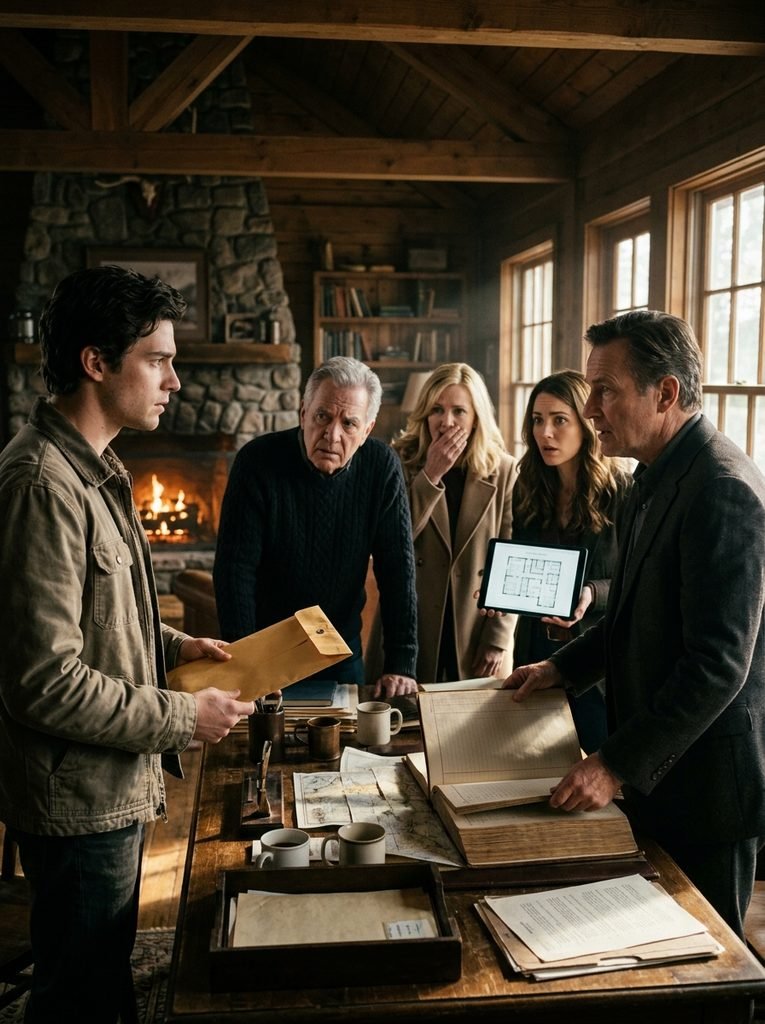
I hadn’t seen my parents since they kicked me out at 19 – until they walked into my grandmother’s will reading, talking about renovation plans for their new mountain lodge, they didn’t know she left behind one final letter… and it had my name on it – only mine.
I was 19 the last time I saw my parents. They stood in the doorway of our home, my childhood home, and told me I had until sunset to pack my things and leave. No tears, no long emotional goodbye.
Not even a decent explanation, just a cold stare from my father and a tight-lipped silence from my mother, as if I were some tenant whose lease had expired. I remember standing there, backpack already on my shoulder, half
full suitcase at my feet, trying to understand how everything unraveled so fast. One day I was their son.
The next I was a burden they couldn’t wait to shake off. My name’s Cole. I’m 27 now. And while I’ve moved on, built a life for myself. Quiet, modest, nothing flashy, there’s a part of me that still circles back to that moment, like an echo I can’t shake.
It’s not just the betrayal that stings, but the sheer speed of it. One minute I was eating dinner at our worn down oak table, and the next my parents were accusing me of being ungrateful, of taking too long to grow up, of costing too much for someone doing so little.
The truth, I wasn’t perfect. I wasn’t some prodigy or overachiever. I had just dropped out of college that spring, unsure of what I wanted, struggling with anxiety I hadn’t yet learned to name.
My friends were graduating, moving into internships, posting their new apartments on social media, and I was stuck, lost, but I was trying. I worked two part-time jobs, and had started taking online classes again. I helped out around the house, paid rent when I could, and never asked for more than the bare minimum.
None of that seemed to matter. My parents, my father especially, saw me as dead weight. And when I pushed back, when I finally spoke up during one of his tirades and said I wasn’t going to be talked to like some stranger on the street, he made good on his promise. He kicked me out that night. Said if I wanted to live like an adult, I
could start by figuring things out without his roof or money. I never went back, never called, never sent a letter, and they never reached out either. Not once in 8 years.
The only person who ever kept in touch was my grandmother, my dad’s mom. Believe it or not, she was the only one who looked at me with softness, even when I was at my lowest. Her name was Evelyn, and if I had to describe her, I’d say she was half whiskey, half wildflower. A woman who grew up during the war, married young, raised three kids, buried two, and still managed to smile like life hadn’t broken her. She lived up in the mountains about 3 hours away from where I eventually settled.
And over the years, we exchanged letters and phone calls. Nothing overly sentimental. She wasn’t that kind of person, but enough to know she still thought about me. She passed away last month peacefully in her sleep. 93 years old. When I got the call from her lawyer, it was like being dowsted in cold water. I hadn’t even known she was sick. She’d hidden it from me, probably on purpose. She hated pity. The lawyer, a man named Garrett Andrews, said she’d left a will, that I’d been named in it, that she wanted me to be present for the reading.
It was all very formal, very specific. She insisted on it being read in person. Garrett told me at the cabin. The cabin. God, I hadn’t been up there since I was a kid. Back when family still meant Sunday dinners and summer hikes. I had memories of fishing with her on the dock. Of her swatting at mosquitoes with a dish towel while
telling me stories about the war, of me falling asleep on that old plaid couch while she played some dusty record in the background. I took time off work and made the drive up the mountain on a crisp Tuesday morning.
The trees were just starting to turn. Golden reds and fire orange leaves dotting the sides of the winding road. The air smelled like pine and smoke and something older I couldn’t name. When I pulled into the gravel driveway,
the first thing I saw was the truck, a brand new lifted Ford F1 150, too clean to belong here. I parked beside it, already uneasy, and stepped out of my car. That’s when I saw them. My parents. My mother was in a beige coat furlined, her hair styled in soft waves I didn’t remember her ever having.
My father stood beside her, arms crossed. That same condescending frown on his face he always wore when he was trying to look important. Behind them stood my cousin Rachel, early 30s, all sharp cheekbones and fake
sympathy, holding a tablet and looking like she was about to pitch a sales plan. I should have turned around then, but I didn’t. I walked forward, slow and cautious, like stepping into a room with too many traps. My mother turned first. Her eyes went wide for a second before she plastered on a smile.
“Cole,” she said, voice, as if we were bumping into each other at a farmers market. “Oh my, I didn’t know you were coming.”
“You were invited?” my father added, squinting at me like I was some contractor who’d wandered onto his land.
“She left me a message,” I replied evenly. “Said the will was being read today here.”
Rachel stepped forward, sliding her sunglasses onto her head.
“Isn’t it wild being back? Gosh, it’s been what, years?”
“Eight,” I said.
She laughed like I told a joke.
Garrett Andrews appeared on the porch just then, holding a thick folder and a small box under one arm. His suit looked too crisp for the cabin, but he wore it like armor. He glanced between us, clearly sensing the tension, then motioned for everyone to come inside. We filed into the living room like strangers.
The fireplace was lit, the air inside just warm enough to feel cozy. Nothing had changed. The couch was still there. The record player, the photos on the wall, me and grandma fishing, her wedding picture, one of her three children at the beach back when they were all still alive.
My dad lingered near the fireplace, staring at the photo for a second too long before returning to his usual indifference.
Garrett didn’t waste time. He cleared his throat and began reading the will.
Most of it was standard. Small sums of money left to friends. A few personal items given to neighbors.
Then came the bigger stuff.
“To my son, Ronald”—that’s my dad—”and his wife, Karen, I leave my Buick and my collection of vinyl records.”
My mother blinked.
“Wait, the Buick and the records?”
Garrett confirmed. Moving on.
Rachel got a set of antique silverware and a note that said, “For hosting the worst Thanksgiving I ever endured.”
I almost choked.
Rachel didn’t laugh.
Then Garrett paused. His expression shifted just a little. He reached into the folder and pulled out a sealed envelope.
“This,” he said slowly, “was a letter Evelyn asked me to deliver by hand to Cole and Cole only.”
He handed it to me.
The room fell into a suffocating silence.
My father shifted. My mother frowned. Rachel looked like someone had slapped her.
“What’s in it?” my dad asked.
Garrett raised a brow.
“That’s not for you to know.”
I held the envelope. My name was written on the front in Grandma’s careful handwriting. Just seeing it again made my throat tighten.
“Wait,” my mother said suddenly, glancing between Garrett and my father. “What about the property?”
Garrett turned to her.
“You mean the cabin?”
“Yes,” she said, laughing a little too loudly. “Evelyn always said she wanted the family to have it. We’ve already started talking to contractors about renovating it into a rental lodge. It’s the perfect location.”
He held up a hand.
“The cabin wasn’t left to either of you.”
Now it was my father who snapped.
“Then who?”
Garrett looked at me.
“Evelyn left it to Cole. The cabin, the land, everything.”
And just like that, the room turned to stone.
My parents froze. Rachel dropped her sunglasses.
And me? I hadn’t even opened the letter yet, but I knew deep down I was about to find out why.
And they were about to find out they’d made a mistake, a very big one.
I didn’t open the letter right away. I probably should have. Maybe it would have given me some armor before the storm hit.
But something in me, something old and bruised, knew I needed to wait. Not out of fear, but because I wanted them to feel it. The not knowing, the unease.
It was the first time in my life I’d held power in a room with them. Real power.
The kind that doesn’t come from yelling louder or dressing sharper or having a bigger bank account.
No, this was different. This was the weight of grandma’s will behind me. Her words still sealed in an envelope and somehow I could feel them humming.
My father was the first to recover. He stepped forward, arms tense at his sides.
“This has to be a mistake.”
Garrett didn’t blink.
“I assure you it’s not.”
“But Evelyn told us. She said she wanted the family to use this place. She talked to me about renovations, updating the foundation, modern plumbing. She wanted it turned into something livable.”
Garrett clased his hands.
“If she said that, it wasn’t reflected in her will. She left the cabin, the land, and all its contents to Cole, sole beneficiary. It’s legally binding.”
My mother’s face was tight, her lips thinning to a line.
“She was in her 90s. She might not have been in her right mind.”
“She was,” Garrett said plainly. “I had her medical evaluations cleared and notorized. She passed two cognitive screenings before finalizing her estate.”
“Maybe Cole manipulated her,” Rachel cut in, voice sharp now. “Maybe he pressured her. Got in her head.”
I snorted. I couldn’t help it.
“I haven’t even seen her in 6 months. The last time we talked, she chewed me out for not replacing the brake pads on my car. Real manipulative of me.”
Rachel’s eyes narrowed.
“Don’t be smug.”
“Why not?” I said, still calm. “You’ve been smug your whole life. I figure I’m overdue.”
It was like someone had cracked the window and let a cold wind blow through.
Rachel blinked slowly, but she didn’t argue. She just took a seat, crossed her legs, and pulled out her phone like she was suddenly too busy for the conversation.
My dad turned on Garrett again.
“And there’s nothing in there for us? No trust, no claws, nothing?”
Garrett scanned the remaining pages.
“No, just a note for you both.”
He handed over a single folded paper.
They unfolded it like it might bite.
My father read it first. His jaw clenched.
Then my mother read it and her hand covered her mouth.
Garrett didn’t ask for it back. He didn’t need to.
I could guess what it said. She’d always had a way with brutal honesty.
After that, the room fractured.
Rachel stood and walked outside without a word. My mother followed slowly, dazed, like someone trying to solve a riddle in a language they didn’t understand.
My father lingered by the fireplace for a moment longer, staring into the flames like he was hoping they’d offer him answers.
When he finally turned to me, there was something unfamiliar in his eyes.
It wasn’t regret.
It wasn’t sadness.
It was resentment.
“You think you’ve won something,” he said quietly. “But you don’t understand what you’re getting into.”
I stared back.
“Neither did you when you kicked me out.”
He flinched.
Not much, but I saw it.
Then he walked out, boots heavy on the floorboards, and the cabin was silent again.
Garrett cleared his throat.
“Do you want to read the letter alone?”
I nodded.
“Yeah, thanks.”
He left without another word.
And just like that, I was alone in the place that had once been a sanctuary and now somehow felt like a fuse waiting to be lit.
I didn’t read the letter until later that night.
After they left, after the sun dropped behind the treetops, and the sky went from bruised purple to velvet black, I made a fire, poured myself a glass of her ancient whiskey I found in the cabinet, and sat in the armchair by the window, the one with the lopsided cushion that had always squeaked when I shifted.
The letter was written on thick cream paper in her usual neat cursive.
“Cole, if you’re reading this, I’m already gone. Which means I no longer have to pretend to be polite to people who don’t deserve it. I want you to know I always saw you. You were never invisible to me. Even when they tried to make you feel like a shadow, I saw how hard you tried, how much you carried, how much you were blamed for simply existing.
“That house was never warm. Not after your grandfather passed. I think your father learned the wrong lessons from him. How to punish, but not how to forgive. How to expect, but not how to give.
“You didn’t deserve what happened. And I couldn’t stop it. But I could give you this. The cabin is yours. Everything in it. The land, too. They’re already planning to rip it apart. I heard them talking when they thought I was asleep.
“They want to flip it. Turn it into another hollow project. But you and I both know this place is more than wood and nails. Keep it or don’t. But make the choice on your own terms.
“You’re more than what they told you.
“Love always, Grandma Evelyn.”
I cried.
Not the loud, heaving kind, just quiet tears slipping down my face, hot and sharp, as if every word had peeled back a layer of armor I didn’t realize I’d worn for years.
For the first time in a long time, I felt seen.
The next morning, I found them still here.
I walked out to the gravel driveway, coffee mug in hand, only to see Rachel pacing near her truck with a Bluetooth earpiece and a binder full of glossy brochures. My parents stood nearby, both looking exhausted but tense like coiled springs.