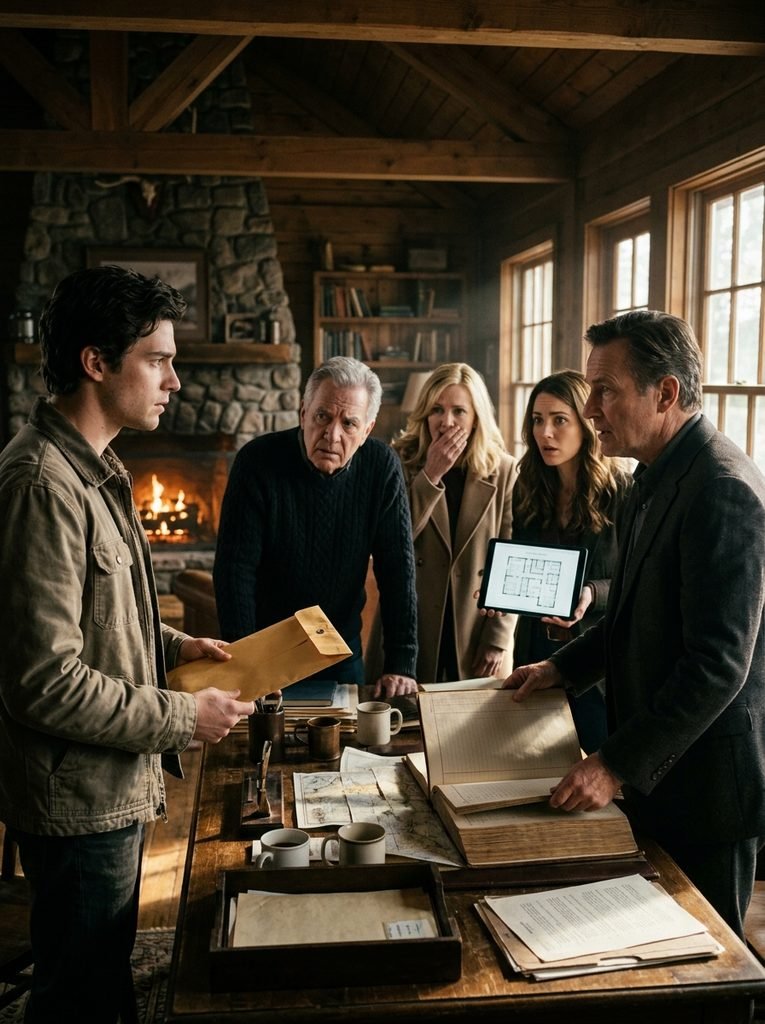
And now she was gone, and all I had left were ashes and signatures and silence.
I stayed in the attic until the sun went down.
Then I walked out onto the porch, sat in Grandma’s rocking chair, and watched the stars come out one by one.
The fallout came quickly.
Garrett filed the final deed paperwork, officially transferring the property into my name.
He also contacted the sheriff about the break-in.
Nothing came of it. No charges were filed, but the message was clear.
Stay away.
My parents didn’t.
At first, it was subtle.
Rachel sent me a passive aggressive text.
“Hope you’re enjoying playing King of the Hill. Just remember what goes up.”
My father left a voicemail.
I didn’t return.
“Cole, I don’t know what kind of lies she fed you, but this isn’t over. That land was meant for the family.”
My mother emailed me a photo of the cabin from 20 years ago.
No caption.
I ignored all of it until the mailbox incident.
I driven into town to pick up some supplies, tools, food, a new space heater to replace the one in grandma’s room.
And when I came back, the mailbox was gone, ripped from the post.
It wasn’t stolen, just destroyed, flattened in the ditch.
I replaced it.
2 days later, someone slashed my back tires.
I called the sheriff, filed a report.
Nothing happened.
No witnesses, no camera footage.
Still, I didn’t retaliate.
Not because I was afraid, but because I was done playing their game.
That winter was the hardest I’ve ever lived through.
The snow hit early, mid-November, and didn’t let up until March.
The cabin, beautiful as it was, wasn’t made for long-term isolation.
The heating system groaned.
The roof leaked near the chimney.
The pipes froze twice.
I chopped wood until my hands blistered, cooked meals on a stove that hissed when it got too hot, and kept my phone on low power mode just in case the generator gave out.
It was peaceful and brutal.
There were days I didn’t speak to another human.
Days I thought about leaving, selling the place, starting over somewhere warm with Wi-Fi and neighbors and takeout, somewhere the ghosts didn’t sit on every shelf.
But every time I reached that breaking point, something stopped me.
Sometimes it was a memory.
Grandma teaching me how to make cornbread.
Humming Py Klein while dusting the window sills.
Sitting beside me on the dock in total silence.
Sometimes it was something I found.
An old postcard from the 1950s tucked into a book.
A half-finished quilt under the bed.
A fishing lure wrapped in tissue paper labeled Cole’s first catch.
Sometimes it was just the wind through the trees whispering like it was trying to say, “You’re not alone.”
I started fixing things, not just out of necessity, but because it gave me purpose.
I recocked the windows, reinforced the roof, repaired the steps on the front porch.
Each nail I drove in felt like a reclaiming of space, of history, of myself.
I started journaling again, something I hadn’t done since I was a teenager.
Just thoughts, ideas, snippets of conversations I imagined having if grandma were still here.
I wrote her a letter, then another, then a whole notebook full of them.
And slowly, something shifted.
The bitterness began to drain away.
Not all at once, not in some dramatic movie montage, but piece by piece.
I stopped checking my phone every morning for another snide message.
I stopped thinking about my father’s face when he realized he’d been cut out.
I stopped fantasizing about revenge or vindication or some final confrontation where I got the last word.
I didn’t want the last word.
I wanted peace.
Then one day in late February, I found a business card wedged into the screen door.
No note, just a name, number, and logo.
A realy group, the same one Garrett had mentioned.
I called the number out of curiosity.
The woman on the other end answered quickly.
“Oh, Cole, you’re that?”
She paused.
“Sorry. Just we’ve been expecting your call.”
“Why?” I asked.
She hesitated.
“Your father told us you’d be reaching out to finalize the sale.”
My throat went dry.
“I’m not selling,” I said.
Silence.
“I see,” she said finally. “Well, that’s disappointing. He was very convincing.”
“Yeah,” I said. “He usually is.”
I hung up before she could say anything else.
And for the first time in weeks, I felt angry again.
Not the wildfire rage from before.
This was colder, focused.
They weren’t done.
Even now, months later, they were still trying to undermine me, still making calls, still telling stories, still trying to wrestle the narrative back into their control.
They thought I was isolated, vulnerable, alone.
They were wrong.
I drove down the mountain the next day, went to the county office, filed every piece of paperwork I needed, had the property boundaries reserveyed, applied for a private mailbox, ordered a P.O. box in town, filed a police report for the destroyed one.
Then I called Garrett.
“Can you help me write a formal cease and desist?” I asked. “I want it sent to all three of them. No more contact. No more visits. No more pretending this is their property. I want a paper trail.”
He agreed.
Then I asked him one more question.
“What would it take to set up a trust? One they can’t touch. One that keeps this place safe even if something happens to me.”
He paused.
“Honestly, not much. But Cole, are you sure you want to do that? It’s a big step.”
“I’m sure.”
Because deep down I knew something they didn’t.
They hadn’t broken me.
They’d only shown me exactly who they were.
And in doing so, they’d freed me from ever needing them again.
It started with an email.
A local journalist, her name was Mara Jenkins, reached out in early spring.
Said she’d heard about the family drama up by the old Mallister cabin and wanted to talk.
I almost deleted it.
I wasn’t interested in turning my grief into a headline, but something about the way she wrote, curious, not exploitative, made me pause.
She’d grown up in the area.
Said she remembered my grandmother from her church days.
Remembered her garden, the rhubarb pies she used to bring to the county bake offs.
Mara hadn’t seen Evelyn in years, but she’d heard whispers after the funeral.
“There’s talk going around town,” she wrote. “That your family’s trying to flip the place even though you inherited it.”
I replied with one line.
“They tried.”
She asked if we could meet.
I agreed reluctantly.
We sat on a bench outside the library, two thermoses of lukewarm coffee between us.
I kept it surface level at first, told her the short version, kicked out at 19, went no contact, stayed in touch with my grandmother.
She left me the cabin, and suddenly everyone remembered I existed.
But Marlo wasn’t just after gossip.
She asked questions that no one else had.
Questions about what it felt like to live there now, what I remembered from childhood summers, whether the land still felt haunted or if it had finally started to feel like mine.
That stuck with me.
Did it feel like mine yet?
I wasn’t sure, but something shifted after that conversation.
Maybe it was saying it out loud.
Maybe it was being seen by someone who didn’t have an agenda.
But I went home that night and stood on the dock and looked out across the lake and realized it wasn’t just where I lived now.
It was home.
I started a project.
It wasn’t planned or polished or profitable.
It just happened.
It began with a single post on an old forum dedicated to historical restoration.
I asked a few questions about restoring hand cut logs, preserving original hardware, insulating stone foundations.
Someone replied, then someone else.
Then someone messaged me directly and asked if I’d document my progress.
So, I did.
I made a blog.
Simple layout, no ads, just photos and journal style updates.
I called it second foundation after something grandma once said when I was helping her replant her flower beds.
“Sometimes the best way to save something is to rebuild it from where it fell apart.”
At first, no one read it except a handful of restoration hobbyists.
But word spread.
People started sharing it.
First local folks curious about the Mallister grandson.
Then strangers, history buffs, DIY enthusiasts, people who wanted to believe that broken things could be made beautiful again.
By early summer, the blog had a few thousand subscribers.
Then 10,000, then 20.
I got an email from a producer at a small streaming network that specialized in slow living and homestead documentaries.
She said my story was quietly powerful and wanted to know if I’d consider filming a limited series about restoring the cabin.
I said no at first.
Then I said yes.
Not for the attention.
For grandma.
For the woman who never had much, but made do with everything she had.
For the woman who gave me the only home I’d ever felt safe in.
For the woman who fought her own son to give me a chance.
I wanted to show the world what she left behind and what I was building on top of it.
Filming started in June.
A small crew came up once a month.
Two cameramen, a director, a field producer.
They stayed in a nearby motel and followed me around while I repaired the front porch, dug out the old cellar, restored the antique stove, and rebuilt the greenhouse that had collapsed in the ’90s.
They asked me questions about the cabin, about my life, about forgiveness.
I didn’t answer all of them, but I said enough.
The show premiered that fall.
It was called Rubound.
It didn’t go viral.
It didn’t break records, but it resonated.
People reached out from all over.
Some shared stories of estrangement.
Some asked about restoration tips.
Some just said, “Thank you.”
That meant more than the rest.
Then came the inheritance my grandmother never told me about.
Garrett called again in early October.
“Do you remember your great aunt Sylvia?”
I didn’t.
“She was Evelyn’s older sister. Lived in Oregon. Never married. Never had kids. She and your grandmother had a falling out in the 70s and didn’t speak again. She passed away earlier this year. No will. You’re the next legal heir through Evelyn.”
I blinked.
“To what?”
He cleared his throat.
“A house? A small one. And about 200 acres of undeveloped land.”
My jaw dropped.
I flew out to see it a month later.
The house was nothing to look at.
Weathered, empty, barely standing.
But the land, rolling hills, a dense forest, a small creek that wounded through the back corner like a silver ribbon.
I didn’t know what to do with it at first.
Then I remembered something grandma told me once.
“If you ever get a chance to leave something behind that makes the world softer, take it.”
So I did.
I donated part of the land to a conservation trust.
Built a small cabin on another part with reclaimed wood and local stone.
Started hosting workshops, tiny weekendlong gatherings for people who’d read the blog and wanted to learn how to start over.
It became a place for healing.
Not just for me, for others like me.
People with broken families.
People who’d been forgotten.
People rebuilding from nothing.
We shared stories around a fire pit and taught each other how to mend things with our hands.
It was simple and it was enough.
The funny thing about healing is that it makes you see clearly.
And once I had distance, real distance, I started to see my parents for who they really were.
Not just villains, not just cold-hearted manipulators, but scared, flawed people clinging to a version of life they could control.
I wasn’t ready to forgive them.
I might never be, but I didn’t hate them anymore.
I just let go.
Stopped checking their profiles.
Stopped wondering if they were watching the show, reading the blog, hearing about the land.
They probably were.
That was fine.
Let them see.
Let them stew.
Because I wasn’t chasing revenge anymore.
I had something better.
The cabin was finished in late November.
It wasn’t perfect.
It didn’t need to be.
The original logs were still there, dark and sturdy.
The new windows let in just enough light.
The fireplace crackled the way it used to when grandma would sit with her tea and knit in silence.
I stood on the front porch that night, snow just beginning to fall, and realized I hadn’t felt afraid in months.
Not of them, not a failure.
Not of being alone, because I wasn’t.
Not really.
I had the cabin.
I had the land.
I had a life built from the ashes of what they tried to destroy.
And I had one more thing, a plan.
Because while I wasn’t chasing revenge anymore, that didn’t mean I wasn’t prepared for what came next.
I learned quickly that the most satisfying revenge isn’t loud.
It’s surgical.
It’s the slow, patient stacking of facts until there isn’t a story your enemies can hide behind.
By the time I started planning, I had things they didn’t.
A small but growing audience who cared about grandma and the cabin.
A producer who owed me favors.
Garrett with a lawyer’s calmness.
And a county clerk who was tired of the rumor mill and liked neat paperwork.
The trick was to turn every one of their moves into a public documented thing, one that couldn’t be spun into family disagreement or misunderstanding.
Step one was evidence.
The crew had kept more footage than I expected.
Between formal shoots and the off-camerara burroll, they’d recorded hours of us walking the property, interviews, and crucially, random clips from days Rachel and my parents were around.
I asked quietly if the production team could comb through anything from the week of the funeral.
They did more than that.
The field producer called me the next day, voice low and excited.
“We found something,” she said. “You should see this.”
There it was.
Grainy footage from the day I’d left the attic, accidentally filmed because a camera had been left rolling in the hallway for 40 seconds.
The clip shows my father moving the bookshelf, Rachel rifling through boxes with an obvious sense of purpose, my mother hovering like a lookout.
In another clip, this one from a cameraman who’d been nosy and saved a copy.
There’s a close-up of a crowbar and a hand trying to jimmy a lock.