My stomach tightened.
“What happened?”
“Nothing. I’m sorry. Nothing medical.”
He stopped in front of me, catching his breath.
Then he brought his hand forward.
An envelope.
My name was written across it in Mark’s unmistakable handwriting.
Sally.
That one word nearly took my legs out from under me.
Dr. Bennett handed it to me.
“Mark gave this to me three weeks ago.”
I stared at it.
“Why?”
“He made me promise.”
“Promise what?”
“That no matter how often you asked, I wouldn’t tell you.”
My eyes lifted to his.
“All those private meetings…”
“Weren’t about changing his treatment.”
“What were they about?”
Dr. Bennett swallowed.
“Read the letter first.”
I sat on a bench because I no longer trusted my knees.
The envelope tore unevenly beneath my fingers.
Inside was one sheet of paper.
Mark’s handwriting wandered slightly, evidence of how weak his hands had already become.
Sal,
If Bennett followed instructions, you’re furious with both of us.
Sorry.
Actually, I’m not.
You’ll forgive him eventually.
Hopefully me too.
I covered my mouth.
Then kept reading.
I need you to know something about the donation.
I’m not doing it because I’m brave.
I’m doing it because I’m terrified.
I’m terrified that when she grows up, there will be nothing physical left in this world that proves I was here.
Photos aren’t warm.
Videos don’t breathe.
Letters don’t have heartbeats.
So I asked Bennett for one favor.
If my heart can be donated, and if the recipient survives, and if someday that person is willing to meet you, I want you to go.
Not for you.
For her.
My vision blurred.
I wiped my eyes desperately.
There was more.
In the bottom drawer of Bennett’s desk is a stethoscope.
I bought it the week we learned she was a girl.
I wanted to use it when she got sick and pretend I knew what I was doing while you rolled your eyes at me.
If there ever comes a day when she can put that stethoscope against someone’s chest and hear my heart…
Tell her that’s Dad saying hello.
I folded forward over the letter.
A sound came out of me that I had never heard before.
Dr. Bennett sat beside me without touching me.
After a long time, he reached into his coat.
And handed me a black stethoscope.
A tiny silver plate had been attached near the chest piece.
Three engraved words.
For our peanut.
“Can that happen?” I whispered.
Dr. Bennett looked at me carefully.
“We can’t promise his heart will be medically suitable. And even if it is, transplant privacy rules mean the recipient decides whether contact happens.”
“So Mark knew it might never happen?”
“Yes.”
I laughed once through my tears.
“That sounds like him.”
There was one final line in the letter.
Sal—
If it never happens, don’t spend your life waiting for it.
You and our girl are not the part of my life I’m leaving behind.
You are the part that continues.
Four weeks later, my daughter was born.
I named her Madeline Grace Dalton.
She had dark hair.
My nose, unfortunately.
And Mark’s stubborn chin.
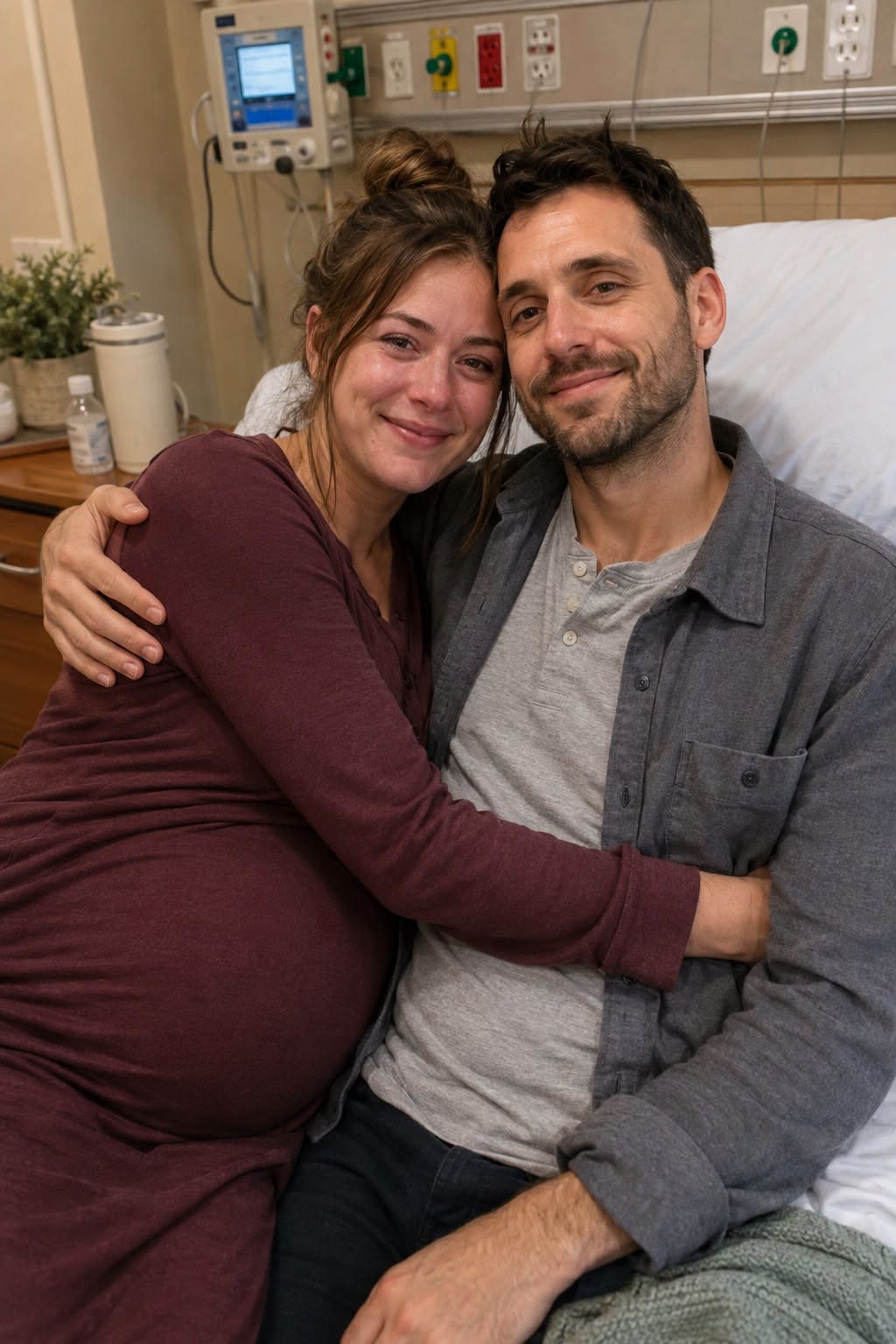
When the nurse laid her against my chest, I cried so hard I frightened her.
“Hi, peanut.”
Her tiny face wrinkled.
“You kept him waiting, you know.”
I kissed her forehead.
“He loved you very much.”
For months, I heard nothing about the transplant.
Then a letter arrived from the donation organization.
Mark had saved four lives.
Both kidneys had been transplanted.
His liver had gone to a woman in Ohio.
And his heart had gone to a forty-one-year-old father of two named Thomas.
I sat on the kitchen floor and read that sentence ten times.
His heart had survived.
Somewhere, it was beating.
I wrote to Thomas through the transplant organization.
No request.
No pressure.
Just a letter.
I told him about Mark.
I told him about Madeline.
I did not mention the stethoscope.
A year passed.
No answer.
Then two.
I kept Mark’s promise.
I did not wait.
Madeline grew.
She learned to walk while holding onto the same porch swing where Mark had first talked about donation.
She called every man with brown hair “Daddy” for six embarrassing months.
At three, she discovered Mark’s photographs.
“Who’s that?”
I knelt beside her.
“That’s your dad.”
“Where is he?”
I had practiced answers.
None worked.
“He died before you were born.”
She considered that.
“Did he know me?”
The question broke something open.

