Mark and I had been married for three years when I finally saw two pink lines appear on a pregnancy test.
For several seconds, I simply stared.
Then I sat down on the bathroom floor because my knees stopped working.
We had wanted that baby almost from the day we married.
There had been appointments, blood tests, calendars with circles around certain dates, months when I convinced myself every headache or cramp meant something, and mornings when I had watched Mark quietly throw another negative test into the trash because he knew I couldn’t bear to do it.
That morning, I carried the test into our bedroom with both hands.
Mark was still half asleep.
“Mark.”
He opened one eye.
Something in my voice made him sit up immediately.
“What happened?”
I held out the test.
He looked at it.
Then at me.
Then back at it.
“Is that—”
I nodded.
His mouth opened, but no sound came out.
And then the man I had seen stay calm through car accidents, layoffs, funerals, and one disastrous kitchen fire covered his face with both hands and started crying.
He slid out of bed and knelt in front of me.
“Really?”
“Really.”
He pressed his forehead against my stomach even though there was nothing there to feel yet.
“Hi,” he whispered.
I laughed through my tears.
“She can’t hear you.”
“You don’t know that.”
“She’s approximately the size of a sesame seed.”
“Then she has excellent hearing for a sesame seed.”
That was Mark.
Even happiness made him gentle.
For six months, our life became ordinary in the most beautiful way.
We argued over names.
He assembled the crib incorrectly twice.
He talked to my stomach while making coffee.
Every Sunday morning, he measured my belly with his hands as if he could somehow calculate how much our daughter had grown overnight.
We learned she was a girl on a bright March afternoon.
Mark squeezed my fingers so hard during the ultrasound that I finally whispered, “You’re going to break my hand before I give birth.”
He loosened his grip.
“Sorry.”
The technician smiled.
“There she is.”
A tiny profile appeared on the screen.
Mark stopped breathing.
I looked at him instead of the monitor.
His eyes filled immediately.
“That’s her?”
“That’s your daughter.”
He leaned closer.
“She has your nose.”
“She doesn’t have a nose yet.”
“She absolutely has Sally’s nose.”
The technician laughed.
I laughed.
Mark cried.
It was the happiest day of our marriage.
Three weeks later, he collapsed at work.
At first, they thought it was exhaustion.
Then an infection.
Then something neurological.
The tests kept multiplying.
So did the specialists.
And eventually, Mark’s neurologist entered the small hospital consultation room with another physician beside him and closed the door.
I remember the click.
Nothing else about that afternoon is as clear as the sound of that door closing.
Mark sat beside me.
His hand found mine.
The doctor spoke slowly.
Carefully.
There was a disease name.
Complications.
Progression.
Treatment options.
Words that sounded clinical until one sentence transformed all of them into a death sentence.
“Based on how quickly this is advancing, we believe we’re looking at months rather than years.”
I stared at him.
“How many months?”
He hesitated.
Mark squeezed my hand.
“How many?”
“Possibly three.”
The room became completely silent.
I was six months pregnant.
Three months.
Our baby was due in three months.
I looked at Mark.
He was already looking at my stomach.
Not at the doctor.
Not at me.
At her.
That night, neither of us slept.
The next evening, Mark insisted on sitting outside.
It was warm, with that soft late-spring smell of cut grass and rain somewhere far away.
We sat side by side on the porch swing.
He was already thinner.
I hated noticing that.
He placed one hand over my stomach.
Our daughter kicked beneath his palm.
Mark smiled.
Then his smile faded.
“If anything is still healthy enough when the time comes,” he said quietly, “I want it donated.”
I turned sharply.
“Please don’t talk about dying while she’s kicking.”
“That’s exactly why I need to.”
“Mark.”
He looked at me.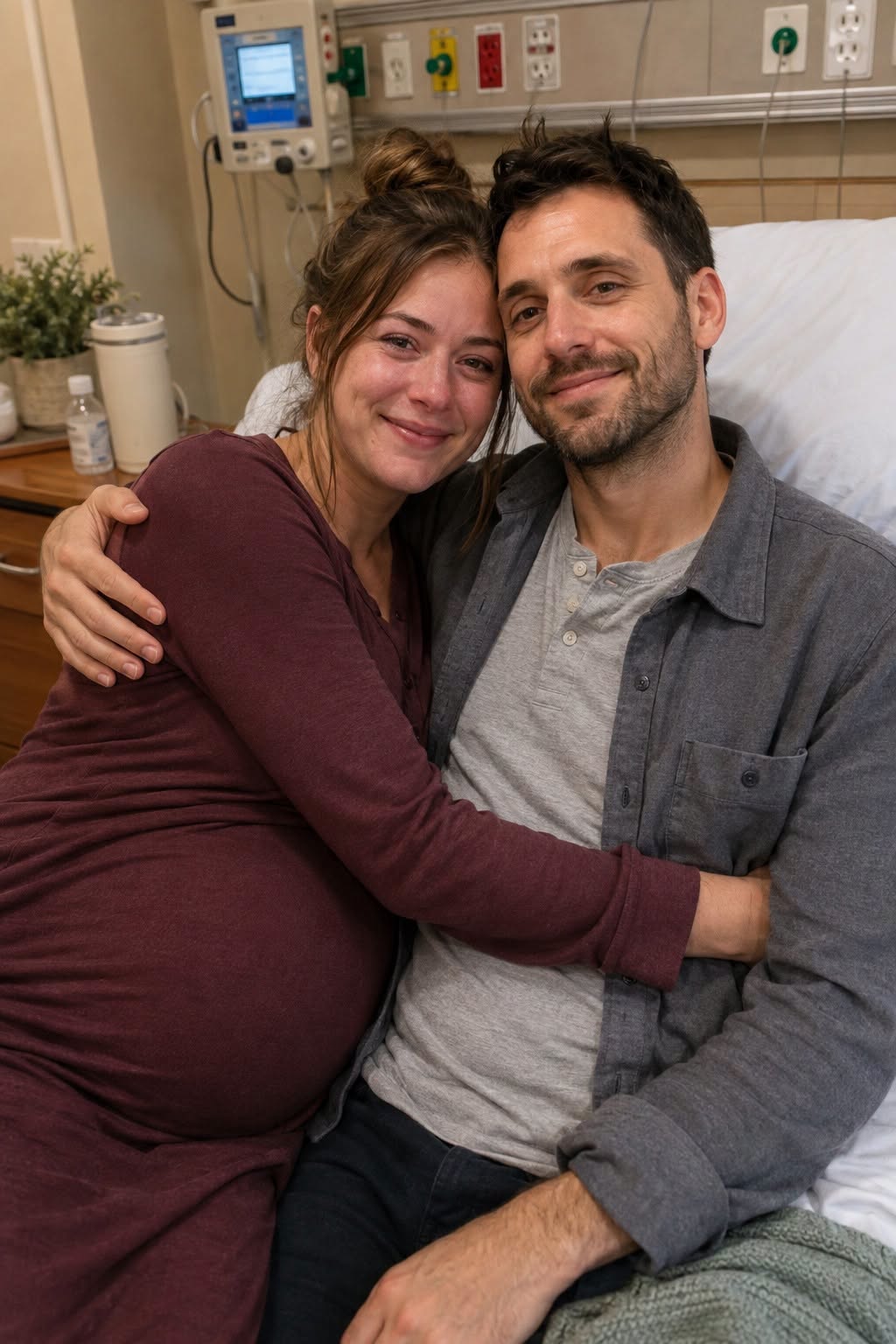
There was fear in his eyes.
But underneath it was something steadier.
“If I can’t stay,” he said, “I don’t want everything that’s still good in me buried just because the rest of me stopped working.”
My throat tightened.
“Stop.”
“If I can give somebody another Christmas…”
“Mark.”
“Another birthday. Another morning making pancakes for their kid. Another stupid argument about leaving cabinet doors open…”
My face collapsed.
He reached for me.
I hit his chest once with my fist.
Not hard.
“I don’t want someone else to have your years.”
“I know.”
“They’re ours.”
“I know.”
“You’re supposed to meet her.”
His voice broke.
“I know, Sal.”
That destroyed me.
I pressed my face against him and cried until his shirt was wet.
He held me as long as he could.
Then his arms began trembling from the effort.
That was the first time I understood love could be enormous and completely powerless at the same time.
Mark’s decline was brutal.
By the time I was seven months pregnant, stairs exhausted him.
By eight months, I buttoned his shirts because his fingers sometimes shook too much.
He began sleeping downstairs because getting to the bedroom had become dangerous.
Still, every evening, he asked the same question.
“Did she kick today?”
And every evening, I guided his hand to wherever our daughter was moving.
Sometimes she responded immediately.
Sometimes nothing happened.
Mark would tap gently.
“Come on, peanut. Dad’s here.”
Usually, she kicked.
He always smiled like she had chosen him.
A few weeks before he died, he began meeting privately with Dr. Aaron Bennett, the physician coordinating much of his care.
The first time, I assumed they were discussing medication.
The second time, I noticed Dr. Bennett carrying a folder when he left.
The third time, I finally confronted Mark.
“What are you two doing?”
We were alone in his hospital room.
Rain streaked the windows.
Mark looked tired.
Too tired.
But there was a familiar spark of mischief behind his eyes.
“Doing?”
“You know exactly what I mean.”
He smiled faintly.
“Very intimidating, Mrs. Dalton.”
“Don’t charm your way out of this.”
“I wouldn’t dare.”
“What are you arranging with Dr. Bennett?”
His smile disappeared.
He looked toward the window.
“Something I need to take care of.”
“Without me?”
“Yes.”
That answer hurt more than I expected.
“We don’t do secrets.”
“I know.”
“Then tell me.”
He reached for my hand.
His skin felt cool.
“Please trust me.”
“I do trust you. That’s why this scares me.”
His thumb moved slowly across my wedding ring.
“Some things are easier to receive after they’re finished.”
“What does that mean?”
He looked at me for a long moment.
Then down at my belly.
“It means I love you.”
I became angry.
Actually angry.
“That’s not an answer.”
“No.”
“Then give me one.”
“I can’t.”
“Why?”
His eyes filled.
“Because if I tell you now, you’ll spend whatever time we have left grieving it before it happens.”
The anger disappeared.
I sat beside him.
He leaned his forehead against mine.
“Please, Sally.”
So I stopped asking.
I trusted him.
Mark died sixteen days later.
It happened on a Tuesday morning while rain whispered against the hospital windows.
His breathing had become shallow during the night.
I sat beside him holding one hand between both of mine.
At 6:12 a.m., he opened his eyes.
“Sally?”
“I’m here.”
“Baby okay?”
Even then.
Even with death standing at the foot of his bed.
“The baby’s okay.”
He smiled.
“Good.”
I bent closer.
“Don’t leave yet.”
“I’m trying.”
“Try harder.”
A tiny laugh escaped him.
Then his eyes moved toward my stomach.
“Tell her…”
His breath caught.
I leaned closer.
“What?”
“Tell her I waited as long as I could.”
I began sobbing.
“Tell her yourself.”
His fingers tightened weakly around mine.
“I love you.”
“I love you too.”
Another breath.
Then another.
Then no more.
Mark died with one hand in mine and the other resting against the place where his daughter was moving inside me.
Afterward, the world became paperwork.
People imagine grief as screaming.
Mine was signatures.
Initial here.
Date there.
Personal belongings.
Funeral home.
Donation authorization.
Would I consent to the recovery of viable organs and tissue in accordance with Mark’s registered wishes?
“Yes,” I whispered.
My pen shook.
The coordinator waited.
I signed.
Because Mark had asked me to.
Because keeping him intact would not bring him back.
Because somewhere another family might be sitting in another hospital room praying for the miracle I had just lost.
Hours later, I walked down the corridor carrying Mark’s coat folded over one arm.
His scent was still inside it.
I had almost reached the elevators when someone shouted behind me.
“Sally!”
Footsteps.
Fast.
I turned.
Dr. Bennett was hurrying toward me.
His face looked pale.
One hand was hidden behind his back.
My stomach tightened.
“What happened?”
“Nothing. I’m sorry. Nothing medical.”
He stopped in front of me, catching his breath.
Then he brought his hand forward.
An envelope.
My name was written across it in Mark’s unmistakable handwriting.
Sally.
That one word nearly took my legs out from under me.
Dr. Bennett handed it to me.
“Mark gave this to me three weeks ago.”
I stared at it.
“Why?”
“He made me promise.”
“Promise what?”
“That no matter how often you asked, I wouldn’t tell you.”
My eyes lifted to his.
“All those private meetings…”
“Weren’t about changing his treatment.”
“What were they about?”
Dr. Bennett swallowed.
“Read the letter first.”
I sat on a bench because I no longer trusted my knees.
The envelope tore unevenly beneath my fingers.
Inside was one sheet of paper.
Mark’s handwriting wandered slightly, evidence of how weak his hands had already become.
Sal,
If Bennett followed instructions, you’re furious with both of us.
Sorry.
Actually, I’m not.
You’ll forgive him eventually.
Hopefully me too.
I covered my mouth.
Then kept reading.
I need you to know something about the donation.
I’m not doing it because I’m brave.
I’m doing it because I’m terrified.
I’m terrified that when she grows up, there will be nothing physical left in this world that proves I was here.
Photos aren’t warm.
Videos don’t breathe.
Letters don’t have heartbeats.
So I asked Bennett for one favor.
If my heart can be donated, and if the recipient survives, and if someday that person is willing to meet you, I want you to go.
Not for you.
For her.
My vision blurred.
I wiped my eyes desperately.
There was more.
In the bottom drawer of Bennett’s desk is a stethoscope.
I bought it the week we learned she was a girl.
I wanted to use it when she got sick and pretend I knew what I was doing while you rolled your eyes at me.
If there ever comes a day when she can put that stethoscope against someone’s chest and hear my heart…
Tell her that’s Dad saying hello.
I folded forward over the letter.
A sound came out of me that I had never heard before.
Dr. Bennett sat beside me without touching me.
After a long time, he reached into his coat.
And handed me a black stethoscope.
A tiny silver plate had been attached near the chest piece.
Three engraved words.
For our peanut.
“Can that happen?” I whispered.
Dr. Bennett looked at me carefully.
“We can’t promise his heart will be medically suitable. And even if it is, transplant privacy rules mean the recipient decides whether contact happens.”
“So Mark knew it might never happen?”
“Yes.”
I laughed once through my tears.
“That sounds like him.”
There was one final line in the letter.
Sal—
If it never happens, don’t spend your life waiting for it.
You and our girl are not the part of my life I’m leaving behind.
You are the part that continues.
Four weeks later, my daughter was born.
I named her Madeline Grace Dalton.
She had dark hair.
My nose, unfortunately.
And Mark’s stubborn chin.
When the nurse laid her against my chest, I cried so hard I frightened her.
“Hi, peanut.”
Her tiny face wrinkled.
“You kept him waiting, you know.”
I kissed her forehead.
“He loved you very much.”
For months, I heard nothing about the transplant.
Then a letter arrived from the donation organization.
Mark had saved four lives.
Both kidneys had been transplanted.
His liver had gone to a woman in Ohio.
And his heart had gone to a forty-one-year-old father of two named Thomas.
I sat on the kitchen floor and read that sentence ten times.
His heart had survived.
Somewhere, it was beating.
I wrote to Thomas through the transplant organization.
No request.
No pressure.
Just a letter.
I told him about Mark.
I told him about Madeline.
I did not mention the stethoscope.
A year passed.
No answer.
Then two.
I kept Mark’s promise.
I did not wait.
Madeline grew.
She learned to walk while holding onto the same porch swing where Mark had first talked about donation.
She called every man with brown hair “Daddy” for six embarrassing months.
At three, she discovered Mark’s photographs.
“Who’s that?”
I knelt beside her.
“That’s your dad.”
“Where is he?”
I had practiced answers.
None worked.
“He died before you were born.”
She considered that.
“Did he know me?”
The question broke something open.
“Yes.”
“How?”
I placed my palm against her chest.
“He knew you from right here.”
She frowned.
“My heart?”
“And his.”
The call came when Madeline was five.
I almost didn’t answer because I was making pancakes.
“Mrs. Dalton?”
“Yes?”
“My name is Thomas Avery.”
The spatula slipped from my hand.
Silence.
Then:
“I have your husband’s heart.”
I sat down.
Thomas’s voice broke.
“I’m sorry it took me so long.”
I couldn’t speak.
“I read your letter a hundred times,” he continued. “I just… I didn’t know how to meet the family of the man whose death gave me my life.”
“You don’t owe us anything.”
“I know.”
Another pause.
“But I have daughters.”
My eyes closed.
“And I kept thinking about yours.”
Three weeks later, we met in a quiet park halfway between our homes.
Thomas stood beneath a maple tree with his wife.
He looked terrified.
Madeline held my hand.
The stethoscope was inside my purse.
Thomas walked toward us.
When he saw Madeline, his face crumpled.
“You must be Maddie.”
She nodded suspiciously.
“You have my daddy’s heart?”
Thomas looked at me.
I nodded.
“Yes,” he whispered.
Madeline thought about that.
Then she pointed at his chest.
“In there?”
Thomas laughed through tears.
“Right in there.”
My hands were shaking when I pulled out the stethoscope.
Thomas saw it.
He understood immediately.
He unbuttoned the top button of his shirt and knelt in the grass so he was level with her.
Madeline placed the earpieces clumsily in her ears.
I guided the chest piece.
For one second, she heard nothing.
Then she froze.
Her eyes widened.
Thump.
Thump.
Thump.
I could see the instant she heard it.
The heart that had raced when I walked down the aisle.
The heart that had pounded beneath my cheek while we danced barefoot in our kitchen.
The heart that had beaten faster when two pink lines appeared.
The heart that had felt his daughter kick beneath his palm.
Still beating.
Five years after Mark died.
Inside another father.
Madeline listened for a long time.
Nobody spoke.
Finally, Thomas whispered, “What do you hear?”
Madeline looked up at me.
Her eyes were wet, though I don’t think she understood why.
Then she smiled.
“Daddy.”
I turned away because I couldn’t hold myself together anymore.
Thomas covered his face.
His wife began crying.
And my five-year-old daughter leaned closer to the stranger who was alive because her father wasn’t, listening to the impossible rhythm inside his chest.
Later, as the sun dropped behind the trees, Madeline ran ahead of me through the grass.
Thomas stood beside me.
“There was something else,” he said.
He reached into his jacket.
Another envelope.
My blood went cold.
“I received this through the transplant team after the surgery. They told me I could open it whenever I was ready.”
My hands started trembling.
On the front, Mark had written:
To whoever gets my heart.
Thomas handed it to me.
Inside was only a short paragraph.
If you’re reading this, then I didn’t make it, and you did.
Please don’t feel guilty.
You didn’t take anything from me.
You gave the best part of me somewhere to go.
I have a daughter coming.
If you ever meet her, don’t tell her you carry her father’s heart.
Tell her something better.
Tell her her father kept his promise.
I read it twice.
Then I looked across the park.
Madeline had climbed onto a swing.
She pumped her little legs, higher and higher, her laughter floating through the evening air.
Thomas pressed one hand unconsciously to his chest.
And suddenly I understood what Mark had meant on our porch all those years ago.
Donation had never been about refusing death.
It had been about refusing to let death have the final word.
Mark never got to hold his daughter.
He never heard her laugh.
Never watched her take her first step.
Never carried her upstairs when she fell asleep in the car.
But somewhere between the hospital room where his life ended and this quiet park where his daughter was learning how high she could fly, something of him had crossed the distance.
Not a photograph.
Not a memory.
Not a grave.
A living rhythm.
A promise still keeping time.
Madeline swung toward the sky, Thomas’s borrowed heart beating behind me, and for one impossible second, the man I had buried five years earlier was standing between us both.

