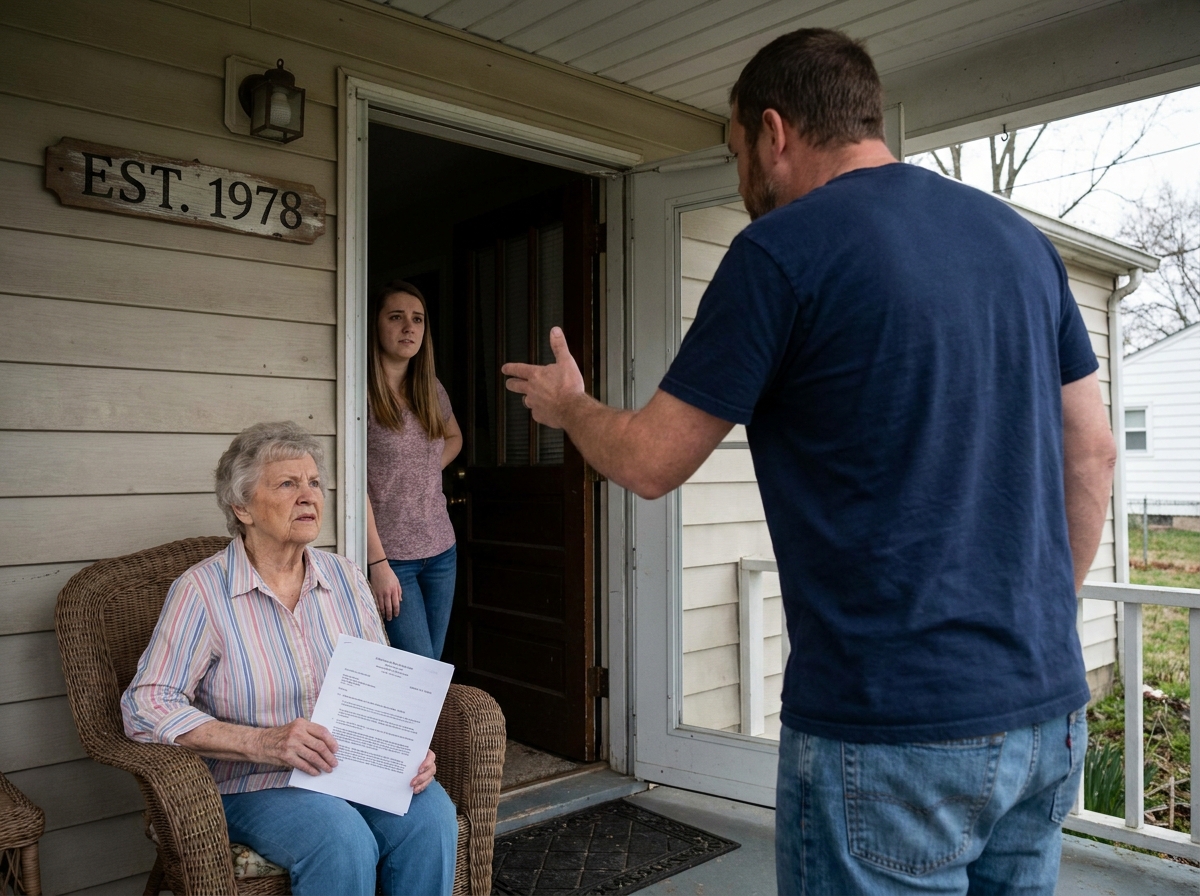
My son called while I was sitting on the porch of my Gulf Shores villa and said, “Megan’s parents live there now. It belongs to them, and you’re no longer welcome.” I smiled, packed one small bag, and let them arrive with a seventeen-foot U-Haul, new curtains, and plans to repaint the bedroom I had rebuilt
with my own hands. What they didn’t know was that six years earlier, a retired judge had helped me prepare for the exact morning they tried to move in.
My son took my beach villa and handed it over to his wife’s parents. He told me, “It belongs to them now. You’re not welcome here anymore.” I smiled and nodded. When they arrived to move in…
I prepared a surprise.
My name is Vivien Ivers. I’m 67 years old, and three weeks ago, my son told me I wasn’t welcome in the house I built with my own hands.
The call came on a Tuesday, 4:17 in the afternoon. Derek’s voice was casual, like he was ordering a sandwich at the deli counter.
“Mom, Megan’s parents are going to be living at the villa now. It belongs to them. You should probably get your things out by Friday.”
Friday? Like I was checking out of a hotel.
What my son didn’t know—what none of them knew—was that I’d been preparing for this moment for six years. Not because I wanted to, but because a retired judge told me I’d need to.
But before I tell you what happened when the Proctors drove up in their rented U-Haul on that Saturday morning, let me tell you about three summers, a porch swing, and a promise I made to a dead man.
Welcome back to Alpha Mom Stories. This is where families get honest, and the truth always finds its way to the surface. If you’re new here, drop a comment and make sure you subscribe.
Twenty years ago, I found a listing in the Mobile Press-Register for a two-bedroom cottage in Gulf Shores, Alabama. $85,000.
The photos showed a rotten porch, water stains on every ceiling, and a bathroom with enough mold to qualify as a science experiment. The real estate agent mentioned raccoons in the attic like it was a bonus feature.
I was a pediatric nurse pulling doubles at Mobile General. Salary: $62,000 a year before taxes. I’d been widowed for six years. Derek was 18, finishing his senior year, about to leave for Auburn.
I drove down on a Saturday in my Honda Civic with 212,000 miles on it. I stood in the overgrown yard with sand spurs poking through my sneakers and saw what nobody else could see.
I saw four bedrooms, a wraparound porch, and the Gulf of Mexico turning gold at six in the evening.
I bought it with cash. My entire savings, plus Arthur’s life insurance payout—$120,000 that I hadn’t touched in six years.
The bank teller double-counted the cashier’s check.
She said, “Mrs. Ivers, are you sure?”
I told her I’d never been more sure about anything except marrying Arthur.
I don’t buy things I can’t pay for in full. Arthur taught me that.
That first weekend, I dragged a camp chair onto the porch. The board sagged so badly I had to stand near the studs, and I drank a thermos of coffee while the sun dropped into the water.
Arthur and I had talked about building a porch swing when we retired. He died at 43.
I built it myself that first summer.
White oak. Three coats of marine varnish. Twenty years later, it still doesn’t creak.
I kept my coffee mug from that first morning. It sits on the kitchen windowsill, chipped on the handle. I won’t replace it.
Three summers. That’s what it took.
Summer one was 2006. I took three weeks of vacation time I’d been banking for four years. I showed up with a crowbar and a case of water bottles.
The first thing I tore out was the porch, every rotted board down to the joists.
My neighbor, Tommy Guidry, came over with his tool belt on the second morning. He’s a contractor. Has been for 30 years. He looked at what I’d done and said, “Vivien, you swing a hammer like a woman with something to prove.”
I told him I was a woman with a mortgage to justify.
Tommy helped me with the foundation and the roof. I did the framing. I did the drywall. I took a weekend electrical course at the community college in Foley and did the rough-in myself.
Cost that summer: $41,000 in materials. Every receipt in a binder.
Summer two, 2007. Interior work.
I built the kitchen cabinets from reclaimed cypress that Tommy found at a salvage yard in Pensacola. $300 for enough wood to outfit a professional kitchen.
I laid the bathroom tile on my hands and knees over six days with a torn rotator cuff I didn’t tell anyone about.
I chose three colors for the house: seafoam for the living room, coral for the master bedroom, driftwood for the kitchen.
I still have the original paint cans in the garage. They’re empty now, but I kept them. They’re proof.
Summer three, 2008. The finishing.
Porch swing mounted. Landscaping in. Gardenias along the back fence.
The cottage was now a four-bedroom villa.
Total renovation cost: $247,000 over three years. Every receipt filed. Every permit documented.
By the time I was done, the county assessor valued it at $340,000. I’d quadrupled my original investment.
But that’s not why I kept every receipt.
I kept them because my hands knew what they’d built, and I wanted paper to match.
Now, let me take you back to three weeks ago. That Tuesday.
I was sitting on the porch swing at four in the afternoon, reading a Patricia Cornwell novel. The Gulf was flat. Pelicans were dive-bombing about 50 yards out.
I had sweet tea sweating onto the armrest and nowhere to be.
My phone buzzed. Derek.
He didn’t ease into it. My son has never been good at preamble.
“Mom, we need to talk about the villa. Megan’s parents lost their lease. They need a place. The villa is sitting there most of the year anyway. We’ve decided they’re going to live there.”
I set my book down, spine up so I wouldn’t lose my page.
“You’ve decided?”
“It’s the right thing to do, Mom. You have your apartment in Mobile. You don’t need two places.”
“Derek, I built this house.”
He paused. Two seconds, maybe three.
Then he said the words I will carry for the rest of my life.
“It belongs to them now, Mom. You’re not welcome here anymore. I’m sorry, but that’s how it is.”
I put down my sweet tea. I looked at the Gulf.
The water was doing that thing it does at sunset, turning from blue to copper, slow and quiet, like it has all the time in the world.
I thought about 34 years of 12-hour shifts. I thought about the summer I laid kitchen tile on my hands and knees with a torn rotator cuff.
And I thought about what Arthur told me in the last real conversation we ever had.
I said, “All right, sweetheart. I understand.”
I hung up.
I did not cry. I set the Patricia Cornwell novel on the swing, went inside, and called Margaret Holloway.
And then I made a list.
I should tell you about Arthur.
Arthur Ivers was a construction foreman for Gulf Regional Builders. He built strip malls, churches, a middle school in Saraland.
He had hands like baseball gloves and a voice that could calm a dog in a thunderstorm. He was six-foot-two. Derek got his height.
In the spring of 2000, Arthur was 43. Derek was 12.
We were sitting on the porch of our rental house in Mobile on a Sunday evening, and Arthur had his reading glasses on, going over our finances.
He put the papers down, took off his glasses, and said something I never forgot.
“Viv, promise me something. If anything happens to me, don’t ever put the house in anyone else’s name. Not even Derek’s. Not until you’re ready. People change when there’s property involved, even people you love.”
I looked at him sideways.
“Why would you say that?”
“Because I’ve seen it on every job site I’ve ever worked. The foreman dies, the family fights over the truck. Promise me.”
I promised.
Arthur never went to college, but he understood human nature better than anyone I’ve ever met with a degree on their wall.
Three months later, August 14, 2000, Arthur fell from scaffolding at a commercial construction site on the east side of Mobile. Forty-two feet.
He died before the ambulance got there.
Derek was in sixth grade, sitting in Mrs. Keller’s math class, when the school secretary came to pull him out.
I kept my promise for 26 years.
I almost broke it once.
I’ll tell you about that. But first, you need to understand how my son became someone who could make that phone call on a Tuesday and not even flinch.
After Arthur died, I did what I had to do.
I worked 60-hour weeks. Night shifts. Double shifts. Holiday shifts.
The NICU at Mobile General paid time and a half on weekends, and I took every one.
I was keeping us afloat on a pediatric nurse’s salary, with a mortgage and a 12-year-old who needed braces.
But to Derek, I was vanishing.
He ate dinner alone most nights. I left meals in the refrigerator with notes.
Little things.
“Heat for three minutes. Love, Mom.”
“Don’t forget your math folder.”
He stopped reading the notes by age 14. I found a stack of them in his desk drawer years later, unopened.
When Derek was 16, his friend Tyler Proctor invited him over for Sunday dinner.
Tyler’s parents, Ray and Donna Proctor, had a table that seated eight and no empty chairs. Ray grilled burgers in the backyard. Donna made peach cobbler from scratch.
They were loud and warm, and the food was always hot.
Derek went back every Sunday.
By the time he graduated high school, he called Ray “Pop” and Donna “Mama D.”
I didn’t find that out until the graduation party, which the Proctors hosted at their house.
I didn’t realize I was losing my son to another family’s dinner table. I was too busy keeping the lights on.
Derek met Megan at a Proctor family barbecue. She was Tyler’s younger sister.
They married when Derek was 22.
I paid for the wedding. $28,000.
Open bar. Live band. Two hundred guests, most of them Proctors.
I thought paying for the wedding meant we were okay. That writing that check was enough. I was buying peace.
I know that now.
The peace lasted about as long as the centerpieces.
Megan Proctor Ivers. Thirty-six years old. Part-time dental hygienist, full-time strategist.
Here’s what I pieced together afterward.
In 2020, Ray Proctor’s plumbing business collapsed. COVID killed his commercial contracts overnight. Office buildings, restaurant buildouts—all of it gone.
He filed Chapter 7 in October. They lost the house in Fairhope.
Donna cried for two days straight, then packed boxes.
They moved into a rental duplex off Highway 59. Two bedrooms, mildew in the walls.
Ray was 60, sitting in a recliner with nothing to do and 20 years of pride burning a hole through his stomach.
Megan watched her father carry boxes into that duplex. Her father, who had worked with his hands for 40 years.
She told Derek that night, “I’m going to fix this.”
And she did.
She started researching.
She found that my beach villa was assessed at $780,000.
She looked up quitclaim deeds. She learned that if Derek was on the deed, he could grant occupancy to anyone.
She printed the forms. She practiced the pitch.
She coached Derek on what to say.
“Tell your mom it’s for estate planning. Tell her it protects the property if she gets sick. She’ll sign anything for you.”
Derek hesitated.
“She’ll be upset.”
Megan didn’t blink.
“Your mother has two properties. She can live in her apartment. My parents have nothing. Who needs it more?”
I found out about all this later. Not from Derek, but from the county clerk’s office and a paper trail that Megan thought she’d covered.
She was smart about almost everything.
She just forgot the most important step.
And so did my son.
But I’ll get to that.
Six years ago, on a Thursday in March, Derek drove down to the villa with a bouquet of grocery store carnations and a manila envelope.
The flowers should have been the first sign. Derek hadn’t brought me flowers since Mother’s Day 2014.
We sat on the porch. He had his pitch ready, and I’ll give him this: he almost made it sound reasonable.
“Mom, for estate planning, if something happens to you, I need to be on the deed so it doesn’t go through probate. Margaret, Dad’s lawyer friend, she’d tell you the same thing.”
I hesitated.
I heard Arthur’s voice in the back of my skull, clear as a church bell.
Don’t ever put the house in anyone else’s name.
But Derek leaned forward and said the one thing he knew I couldn’t resist.
“Dad would have wanted me to have security, Mom. Don’t you want that for me?”
I signed.
He left with the document, and the carnations stayed on the counter until they died.
That night, I couldn’t sleep. I lay in bed, stared at the ceiling fan, listened to the waves, and felt sick.
At 11:30, I called Doris Palmer.
Doris is a retired family court judge. She’s been my closest friend for 30 years. She’s seen hundreds of families ripped apart over property.
“Did he file it yet?” she asked.
“I don’t know.”



