He held my last three pay stubs between two fingers. Not gripped, not clenched. Between two fingers, the way you hold something that carries risk of contamination. He let them hang there for a moment before speaking, which was a technique I recognized: let the audience absorb the visual before the words confirm what they are already being told to think.
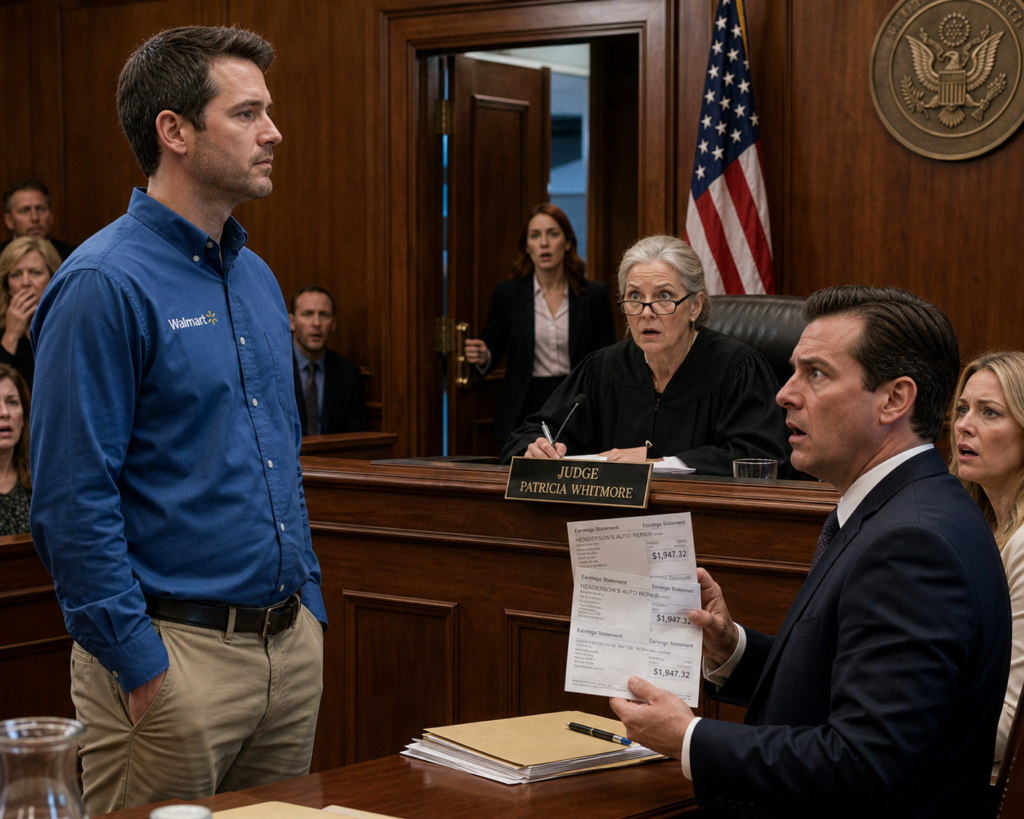
I wore a blue button-down shirt from Walmart. I had known, getting dressed that morning in my one-bedroom apartment that smelled of mildew when it rained, that I was going to be wearing that shirt in this room today, and I had made the decision to wear it anyway, for reasons I had not shared with anyone, including Miguel Santos, who was my public defender and who had told me three times over the past two weeks that I should consider buying something better for the hearing. I had thanked him each time and changed the subject.
“Your Honor,” Hartwell said, “I’d like to enter Exhibit Fourteen.”
He turned just enough toward me that the gallery could see both of us at once: the navy suit and the Walmart shirt, the expensive watch and the grease that had worked permanently into the skin of my knuckles from eighteen months at Henderson’s Auto Repair. He was good at this. He had probably practiced the turn.
“Mr. Dalton earns one thousand nine hundred and forty-seven dollars per month, before taxes, working as a mechanic at Henderson’s Auto Repair.” He said mechanic with the neutrality of a man who has learned that outright contempt is less effective than careful factual recitation. “My client earns fourteen thousand five hundred dollars per month. Their daughter attends Riverside Academy, where annual tuition is thirty-eight thousand dollars.”
He paused.
“Mr. Dalton’s income would not cover half of one year’s tuition.”
From the gallery, Jessica’s mother made a sound. It was not quite a laugh. It was the sound of a person trying to suppress a laugh in a room where suppression is expected, but not trying especially hard.
I did not look back.
I had not looked at the gallery since I sat down. I had not looked at Jessica, who was at the plaintiff’s table in a cream-colored blouse with her dark hair professionally blown out and her hands resting on a yellow legal pad in a posture of composed suffering. I had looked, when I entered, at Judge Patricia Whitmore, who had silver hair pulled back severely and reading glasses she wore at the end of her nose and a face that gave nothing away, which I had been counting on.
Hartwell was still going.
“We are asking for nothing unreasonable. Primary custody to my client. Supervised visitation for Mr. Dalton, twice monthly. Child support calculated at the standard percentage of his income.”
He glanced at the papers as though he needed to check the number, though I suspected he had it memorized.
“Approximately four hundred and twenty-seven dollars per month.”
This time the sound from the gallery did not bother with suppression.
Miguel shifted beside me. He was twenty-nine, earnest, overworked, good at what he did within the limits of what he had to work with. He had looked at my case and seen a losing hand and had spent three weeks trying to figure out how to lose it less badly. I had not told him everything. I had told him enough to guide our strategy, which was: say nothing, wait for the question, answer it.
He had found this approach unsatisfying.
“Mr. Dalton,” Judge Whitmore said, “you’ve been quiet this morning. Is there anything you’d like to say?”
Miguel gave me the small look we had agreed on.
“No, Your Honor,” I said. “Not at this time.”
Hartwell was already moving. “Your Honor, I think Mr. Dalton’s silence speaks to his situation. He knows he cannot adequately provide for his daughter—”
“Mr. Hartwell.”
The judge did not raise her voice. She did not need to. The room snapped to attention around the two words the way a room does when the person who controls it decides to exercise that control.
“I did not invite your interpretation of Mr. Dalton’s response. He answered a question I asked.”
“Of course. My apologies, Your Honor.”
He sat down smiling.
I want to explain, before I explain what happened next, what brought me to courtroom 4B in a Walmart shirt with $1,947 in monthly income and a public defender, because the picture that Hartwell painted for the gallery was not a lie, exactly. It was a true picture of one period of my life, stripped of every circumstance that would explain how I came to be in it.
Eighteen months earlier, I had walked into my bedroom on a Wednesday afternoon and found my wife of six years with her employer, Richard Crane, in a situation that required no interpretation. I stood in the doorway for a moment. Jessica looked at me with the specific expression of someone who has been caught but has already decided how to handle it, which is a different expression from guilt or shame. She had decided. I could see the decision in her face.
She wanted the house. She wanted primary custody. She wanted me to understand that Richard Crane retained attorneys at a firm that had seventeen partners and an address in the building with the reflective glass exterior downtown.
I told her that was fine.
What I did not tell her was why it was fine. I did not tell her what I was going to do, or what I had already been doing for the preceding two years, or what the shape of the next eighteen months would look like from where I was standing. I told her it was fine, and I left the bedroom and went downstairs and poured myself a glass of water and drank it at the kitchen sink while I thought about what came next.
Then I called a man named David Park, who had been my closest friend since we were twenty-four years old, and I told him the situation, and he said: come over. So I went over. And over the following week, between David’s kitchen table and several phone calls, I finalized the plan that had been forming for two years, which would now be accelerating faster than I had expected.
I moved into the one-bedroom apartment. I took the job at Henderson’s. I let my appearance go in the specific way I had calculated would tell the right story to people who were already telling a story about me and did not need much encouragement to keep telling it. The mildew apartment was real. The Walmart shirts were real. The $1,947 per month was real.
What was also real, but not visible to anyone who had not been told, was the company.
I had started it six years before the marriage ended, before Emma was born, before the house and the Riverside Academy enrollment and the life that now belonged to Jessica and Richard Crane. I had started it quietly, the way things that matter get started, without announcement, in hours that belonged to no one else, building something that was mine in a way nothing else had ever been mine. By the time Jessica found out about the company, if she found out at all, it had been growing for three years in a direction she would not have predicted.
I will tell you what the company was. It was a software platform for fleet maintenance management, which is an unglamorous description for something that solved a genuinely unglamorous problem: the problem of commercial vehicle operators trying to track maintenance schedules, compliance records, and repair histories across large numbers of vehicles using systems that were outdated, fragmented, and expensive to operate. I knew this problem from the inside because before Henderson’s, before the deliberate step backward, I had spent eight years as the operations director for a regional logistics company where this problem had cost us, conservatively, two million dollars over five years in avoidable repairs and compliance failures.