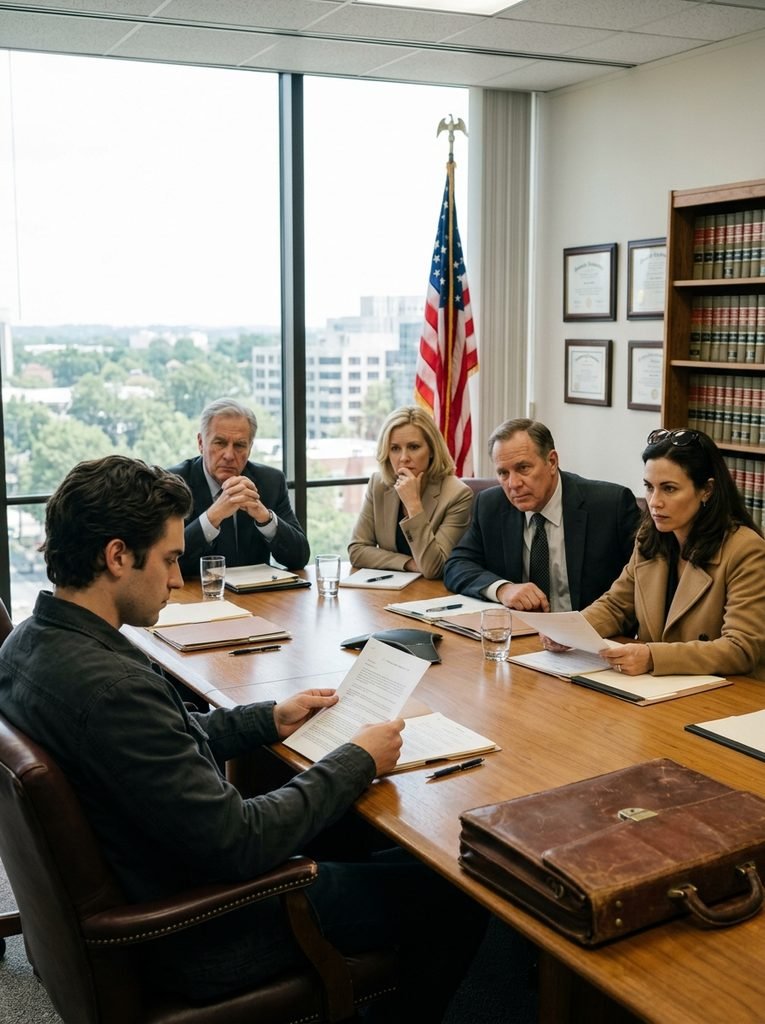
Because now I wasn’t just defending myself.
I was setting the stage.
And soon enough, they were going to realize just how much power I had and how careful I’d been with it.
And when that day came, there’d be no pretending it was just family drama anymore.
I didn’t rush the next step.
That was the key.
If I’d learned anything from months of being pushed, prodded, and baited, it was that patience was my greatest weapon.
Revenge wasn’t about an explosion.
It was about a slow, precise strike that left no room for misunderstanding.
The first move came through my lawyer.
He drafted and delivered a formal notice to my parents and Clare stating that any further attempts to access the trust without my consent would be documented as a breach of fiduciary duty, a legal term that sounded dry.
But the implications were huge.
It meant that if they kept going, I could petition not just for sole control of the cabin, but for financial restitution.
Within two days, I got a flurry of calls.
Claire first, her voice tight, brittle, on the edge of snapping.
“Are you kidding me?” she hissed. “You got a lawyer involved over a cabin?”
“Not over a cabin,” I said calmly. “Over months of unauthorized financial activity and slander. But yes, the cabin’s included.”
“You’re unbelievable,” she shot back. “Mom and dad are furious. You’re tearing this family apart.”
“No,” I replied. “I’m just refusing to keep pretending everything’s fine while you all walk all over me.”
Then I hung up.
The next call was from dad later that evening.
His tone was different, controlled, almost eerily calm, which I knew meant he was angrier than Clare had been.
“Son,” he said, “this is family business. Dragging lawyers into it was a mistake. If this escalates, you’re going to regret it.”
“Maybe,” I said, letting the silence stretch. “But so will you.”
I could almost hear him grinding his teeth on the other end.
When he finally spoke again, he said, “You always were dramatic.”
I didn’t reply, just let the silence hang until he hung up first.
After that, everything went quiet for a while.
No calls, no texts, no surprise visits.
It felt strange at first, like the calm before a storm.
And then one morning, I got an email from my lawyer.
My petition for sole control of the trust had been filed and accepted for review.
That was when I decided to go one step further.
I compiled everything, the bank alerts, the voicemails, the screenshots of texts, the letter they’d sent threatening to transfer the cabin without my consent into a single file.
I wrote a short, clear statement at the top.
“This is a complete record of my family’s attempt to remove me from shared assets and spread false rumors about my character.”
Then I sent it to every single extended family member who had reached out to scold me or pressure me over the last few months.
Aunts, uncles, cousins, everyone.
The responses started trickling in that afternoon.
Some were stunned.
“I had no idea.”
“I can’t believe they did this.”
Others were less sympathetic, telling me to keep it private, but I ignored those.
By the end of the week, the gossip network that Clare had used against me had turned against her.
I started hearing from cousins who told me she’d been crying to anyone who would listen, claiming I’d made her look bad.
That Friday, I drove to the cabin as usual.
I brought my laptop, my new documents, and a bottle of good whiskey.
I sat on the porch watching the sun go down over the lake.
My phone buzzing every few minutes with new notifications, messages from relatives, from neighbors, even from people I barely knew.
All taking my side.
Then just after dark, my phone buzzed again.
A text from Clare.
“You win. Are you happy now?”
I stared at it for a long moment before replying.
“I’m not looking to win, Clare. I just wanted you all to see that you can’t cut me out of everything and still expect me to clean up your messes.”
Her reply came fast.
“You ruined my reputation. Everyone’s talking about me.”
“No,” I wrote back. “You ruined your own reputation. I just showed people the truth.”
And then I turned my phone off for the night.
The following Monday, my lawyer called with the news I’d been waiting for.
Based on the documentation of unauthorized withdrawal attempts, the court had granted my petition.
I was now the sole trustee of the cabin property.
I didn’t cheer, didn’t gloat.
I just sat there in my apartment staring at the paperwork in my hands, feeling a quiet, deep satisfaction settle over me.
The next day, I sent a single email to my parents and Clare with the attached legal order and a short note.
“The matter is resolved. Please direct all future communications about the cabin to me directly.”
I didn’t expect a reply, and I didn’t get one.
But that weekend when I drove to the cabin, I noticed something strange.
The porch light was on.
For a second, I tensed.
Had they tried to get in again?
I unlocked the door and stepped inside, heart pounding, but everything was exactly as I’d left it.
Then I saw it.
A single envelope sitting on the kitchen table.
No name, no note, just a check inside for the exact amount of the overdue property taxes.
I stood there for a long time staring at it, then set it aside and made a fire in the fireplace.
This wasn’t an apology, not really, but it was acknowledgment.
And maybe, just maybe, the first sign that they finally understood I wasn’t someone they could control anymore.
And if they didn’t understand yet, well, I had plenty more ways to remind them because for the first time, I wasn’t scared of losing my family.
I was starting to wonder if they were scared of losing me.
And honestly, they should be.
When I came back from the cabin that Sunday evening, I felt lighter than I had in months.
It wasn’t just about winning legal control.
It was about finally reclaiming my own peace of mind.
But the fallout didn’t take long to arrive, and it came harder than I expected.
By Monday morning, I woke up to find over a dozen messages waiting for me from mom, dad, even Clare.
The tone had changed completely.
Gone was the righteous fury, the self-importance, the patronizing guilt trips.
Now it was quiet panic.
Mom’s message was the longest.
“Oliver, we just got the paperwork. We didn’t think it would go this far. Your father is not well right now. He’s upset. He says the family is falling apart. Please, can we meet and talk privately? No lawyers.”
I didn’t respond right away.
Instead, I took a shower, made myself coffee, and drove to work.
By the time I got to my desk, there were three more messages from Clare.
Short, frantic ones.
“People won’t stop asking me questions.”
“Dad blames me for this.”
“He won’t even look at me.”
“You’ve made your point. Okay. Are you happy now?”
I didn’t reply to those either.
I wasn’t interested in gloating or trading jabs anymore.
The point had never been revenge just for revenge’s sake.
It was about balance, about making sure they understood I wasn’t the punching bag anymore.
The next weekend, I agreed to meet them.
Not at the family house, not at the cabin, but at a neutral coffee shop downtown.
When I walked in, they were already seated.
Mom looked tired, older than she had a few months ago.
Dad sat stiffly, arms crossed, his jaw set like he was holding back everything he wanted to say.
Clare had sunglasses on even though we were inside, probably to hide that she’d been crying.
“Ol,” Mom said softly, like she was approaching a wild animal. “We just want to talk.”
I sat down, calm and quiet, and waited.
It was Dad who spoke first.
“You embarrassed us,” he said flatly. “Dragged our name through the mud with the entire family. Clare can’t even show her face at church right now.”
I didn’t flinch.
“Good. Maybe now you all know how it feels to be on the outside.”
“That’s not the same,” Clare snapped, pushing her sunglasses up onto her head. “You could have just come to me. Instead, you went nuclear.”
“You went nuclear first,” I said evenly. “You cut me out of the will. You tried to take the cabin behind my back. You told everyone I stole from you. Don’t act shocked when I refused to keep playing along.”
Mom put a hand on Clare’s arm before she could reply.
“Oliver,” she said carefully. “We made mistakes. I see that now. We should have handled things differently.”
That caught me off guard.
For a moment, I just stared at her trying to decide if she was being sincere.
“Do you know what it felt like?” I said slowly. “To sit in that lawyer’s office and hear that I got nothing, not even a letter, not even a token keepsake. Do you know what it’s like to walk out of that room and realize your parents just told you you’re worth zero?”
Mom’s face crumpled and for once she didn’t have a quick answer.
“You didn’t just leave me out of the will,” I continued. “You made it clear that I was never really part of this family the way Clare was. So yeah, I froze the accounts. Yeah, I got a lawyer, and I’d do it again.”
For the first time since this all started, Dad didn’t argue.
He just looked away, staring out the window, his jaw working like he was chewing on words he couldn’t spit out.
Finally, mom spoke again.
“We can’t undo the will,” she said quietly. “But we can make things right moving forward. We want to settle things with you formally. No more behind your back decisions. No more assumptions.”
It wasn’t an apology, not exactly, but it was the closest I was ever going to get.
Over the next few weeks, things began to shift slowly, awkwardly, but undeniably.
Clare stopped trying to access accounts and even sent me a short, stiff message acknowledging my role as trustee.
My parents stopped calling every time a bill was due and started handling their own finances, something they hadn’t done in years.
Extended family members who had taken Clare’s side at first reached out to me.
Some to apologize, some just to say they’d been wrong.
I didn’t rub it in.
I didn’t need to.
The truth was out there now and everyone could see it for themselves.
A month later, I hosted my first gathering at the cabin.
Not a family event, not yet, but a few close friends.
We grilled on the deck, played music, and kayaked out on the lake under the sunset.
At one point, I stood on the porch with a drink in my hand and looked around at the life I was building, one that didn’t depend on anyone else’s approval.
That night, as my friends packed up to leave, my phone buzzed with a single new message.
It was from dad.
“Taxes were paid on time this year,” it read. “Thanks for handling things.”
I stared at it for a long time before replying with two words.
“You’re welcome.”
And as I locked up the cabin and stood on the porch watching the moon rise over the lake, I realized something.
They might never fully understand what they’d put me through, but they understood enough.
Enough to stop underestimating me.
Enough to treat me like someone who couldn’t just be erased.
For the first time, I wasn’t just part of the family out of obligation.
I was part of it on my own terms.
And that was the moment I knew I’d finally.
If you came here from Facebook because of this story, please go back to the Facebook post, tap like, and leave exactly “Great read” in the comments to support the storyteller. That small gesture means a lot, and it gives the
writer extra motivation to keep bringing you more stories like this.