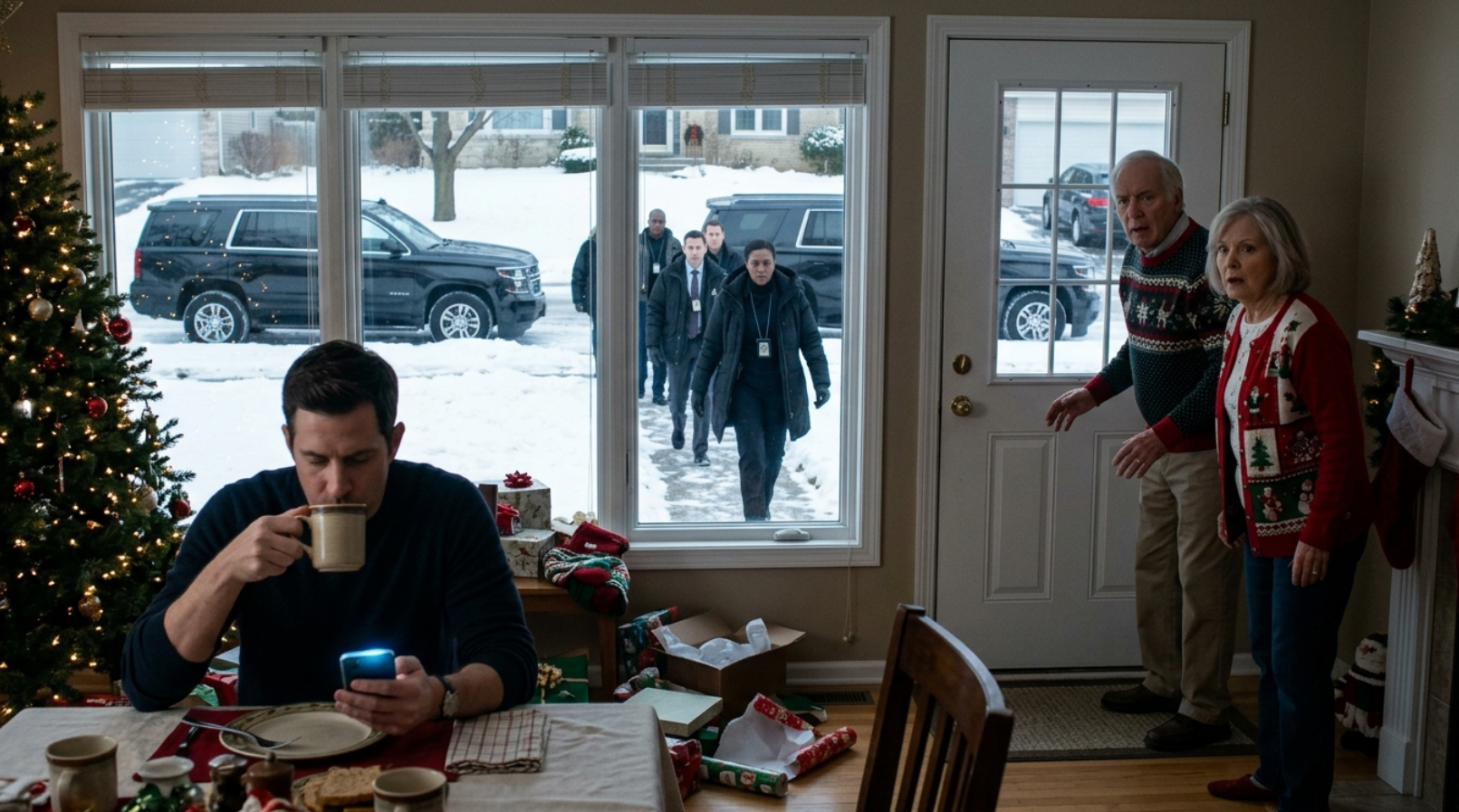
Dad looked toward the Christmas tree.
For the first time that evening, the decorations seemed completely out of place.
The following morning, I woke up in the guest room of my parents’ house.
I had barely slept.
At 6:40 a.m., my phone rang.
It was Daniel.
“Alexis, we have an update.”
I sat up.
“What did you find?”
“The buyer has agreed to cooperate fully. Their records indicate that they received the additional authorization through the seller’s representative. They did not receive it directly from you.”
“Did they know about the property’s designation?”
“They received information about certain restrictions before the final offer. We are still determining what they understood and whether the transaction can be unwound or otherwise resolved.”
“And the document with the additional paragraph?”
“That remains under review. The original electronic records and the document history will be important.”
I looked through the window.
Snow covered the garden, and the Christmas lights were still glowing along the roof.
“What do you need from me?”
“Your original authorization, any correspondence about the property, and confirmation of who had permission to act on your behalf. Please preserve everything and send it through the designated channel.”
“I can do that.”
“Good. One more thing. The review has identified a payment arrangement that does not appear in the initial summary you were given.”
I closed my eyes.
“The finder’s fee?”
“Possibly more than that. We need to verify the records before drawing conclusions.”
After the call, I went downstairs.
Dad was already in the kitchen, sitting at the island with a cup of coffee. His usual morning newspaper lay unopened beside him.
He looked exhausted.
“You’ve made your point,” he said.
I stopped near the doorway.
“My point?”
“You wanted us to understand that we shouldn’t have sold the house. We understand. Now we need to find a way to put this behind us.”
“Have you returned the money?”
He stared at me.
“That isn’t so simple.”
“Then why are you asking me to put it behind us?”
He pushed his coffee away.
“Because we’re family.”
I had heard those words so many times that they had almost lost their meaning.
Family was the reason I was expected to forgive insults.
Family was the reason I was supposed to accept decisions I had never agreed to.
Family was the reason my parents believed they could take twenty percent of a multimillion-dollar transaction without asking me.
I pulled out a chair and sat across from him.
“Dad, if a stranger had sold my house using a document I never signed, would you tell me to put it behind me?”
He didn’t answer.
“If someone took millions of dollars from me and told me it was for my own good, would you ask me to protect that person’s feelings?”
He looked down at his hands.
“No,” he said quietly.
“Then why should the answer change because it’s you?”
For several seconds, neither of us spoke.
Finally, he whispered, “I never thought it would become this serious.”
That was the closest thing to an honest statement he had made since Christmas dinner.
I believed him.
He had thought the sale would be a simple financial arrangement. He had thought that because he was my father, he could make a decision on my behalf and explain it afterward. He had thought that if I objected, he could offer me the money and expect me to move on.
What he had not considered was that his confidence did not create legal authority.
“I need you to cooperate with the review,” I told him. “No more assumptions. No more private arrangements. And no more telling people that I authorized something I didn’t authorize.”
He nodded without looking at me.
For once, I did not ask him whether he understood.
I simply stood up and left the kitchen.
Three days after Christmas, the first major development arrived.
Meridian Property Holdings had suspended its plans for the property and instructed its legal representatives to preserve all relevant records.
The company had intended to renovate the house and resell it. Instead, its executives were now facing questions about the authorization they had relied upon, the timing of the closing, and the information supplied by the sellers.
The transaction had not simply disappeared.
There were contracts, payments, and competing claims that needed to be addressed.
But the assumption that the sale was final had been shaken.
Then Margaret contacted me again.
“Alexis, we’ve completed an initial comparison of the documents.”
I waited.
“The version of the authorization in your records does not contain the additional paragraph. The version submitted during the sale does.”
“I know.”
“We have also obtained information that may help establish when the paragraph was added. That information is being preserved for further examination.”
“Does it identify who changed the document?”
“Not conclusively yet. We are coordinating with the relevant professionals and reviewing the available records.”
I appreciated her honesty.
I did not want guesses.
I wanted facts.
Then she added, “There is another issue. The buyer’s records show that your parents requested that a portion of the proceeds be paid to an account separate from the main account used for the sale.”
My stomach tightened.
“Whose account?”
“The account appears to be associated with your mother. We are verifying the details and the stated purpose of the payment.”
I closed my eyes.
Mom had told everyone she was entitled to a finder’s fee because she had arranged the transaction.
But if the documents showed that the money had been directed into separate accounts, the review would need to establish precisely why.
“How much?” I asked.
“The records we have so far indicate a payment of $560,000 was allocated as the twenty-percent fee described to you. We are still reconciling the full distribution.”
Five hundred and sixty thousand dollars.
Mom had announced the fee at Christmas as though it were the most natural thing in the world.
She had smiled while explaining that her expertise deserved compensation.
But the amount was not a casual reward for helping someone find a buyer.
It was a substantial sum taken from a transaction involving property she had no established authority to sell.
“Thank you,” I said. “Please keep me informed through the official channel.”
When the call ended, I sat quietly for several minutes.
I wasn’t thinking about the money.
I was thinking about how easily my mother had said the words.
We handled everything, so we took a twenty-percent finder’s fee.
No hesitation.
No apology.
No recognition that the decision belonged to me.
She had truly believed that whatever she could get away with was something she deserved.
That realization hurt more than the sale itself.
The next confrontation happened at my parents’ house.
Mom had invited Natalie and Richard over, apparently hoping that a family meeting could persuade everyone to stop discussing the transaction.
When I arrived, they were seated around the dining table.
Mom had prepared lunch.
Dad stood beside the window.
Natalie looked as though she had not slept properly in days.
“Let’s settle this,” Mom said as soon as I entered.
I took a seat.
“I’m listening.”
She folded her hands.
“We made a mistake. We understand that now. But the house is still worth millions, and you will receive your share once everything is resolved.”
“My share?”
“Yes. The money is there. Nobody intended to leave you with nothing.”
I looked at her.
“You didn’t ask me whether I wanted to sell.”
“We thought it was the best decision.”
“You didn’t ask me whether you agreed with the price.”
“It was a good price.”
“You didn’t ask me whether you agreed to pay yourselves $560,000.”
Her expression hardened.
“We did the work.”
“You didn’t have permission.”
Mom looked toward Dad.
He remained silent.
Then Natalie spoke.
“Alexis, I know you’re upset, but think about what this is doing to the family. Dad can barely sleep. Mom has been crying every night. Richard and I are caught in the middle.”
I turned to her.
“You’re not in the middle. You’re sitting at a table discussing how to make the consequences disappear without addressing what happened.”
She looked away.
Richard cleared his throat.
“Maybe we can agree on a financial settlement. If your parents repay the fee, perhaps you can withdraw your complaint.”
“I haven’t made a private complaint that I can simply withdraw. The transaction is under review, and the relevant people need to establish what happened.”
“So you want them punished?”
“No. I want the property issue resolved lawfully. I want the money accounted for. And I want the truth about the documents.”
Dad finally turned from the window.
“What if we give you the entire fee?”
I stared at him.
“You still don’t understand.”
He looked frustrated.
“Then explain it to me!”
“The fee is not the only issue. The house was transferred without my authorization. A document was submitted that contains language I never signed. And you are all still trying to negotiate with me as though the only problem is how much money I receive.”
Nobody spoke.
I continued.
“If the sale had been handled properly, we could have discussed whether selling made sense. We could have obtained the necessary advice, contacted the appropriate office, and made a decision based on accurate information. Instead, you decided that my absence gave you the right to act for me.”
Mom wiped her eyes.
“We were trying to help you.”
“Then why did you never call me?”
She opened her mouth.
Nothing came out.
I waited.
Finally, she whispered, “You would have said no.”
The room became silent.
There it was.
The truth, spoken so softly that she seemed surprised to hear herself say it.
They hadn’t forgotten to ask.
They had avoided asking because they suspected I would refuse.
They had known my answer might interfere with the outcome they wanted.
So they had acted first and expected me to accept the result afterward.
I stood.
“Thank you for finally telling the truth.”
Mom reached for my hand.
“Alexis, please.”
I stepped back gently.
“I love you. But I won’t pretend this was an innocent misunderstanding just because admitting what happened is uncomfortable.”
Then I left.
For the first time in my life, I did not turn around to see whether my mother was crying.
The investigation continued for several weeks.
During that time, I returned to work and followed the instructions provided by the officials handling the matter.
I submitted my original documents.
I answered questions about the property’s designation.
I provided the correspondence showing why I had purchased the house and why the authorization I gave my parents had been deliberately limited.
I also learned that the buyer had relied on several representations made during the sale, some of which were inconsistent with the original property records.
The company had its own responsibilities to examine, but the available evidence did not establish that every person involved had known the same things or acted with the same intentions.
That distinction mattered.
I wanted the facts established, not an invented villain to make the story easier.
Eventually, the document examination produced an important finding.
The additional paragraph had not been present in the original file I signed. The available electronic records showed that the version containing the extra language had been created later.
The examination also identified the account used to transmit that version to the transaction representatives.
It was an account associated with my father’s office.
That did not, by itself, establish who had physically added the paragraph or what every participant had known. Those questions required further examination.