THE NIGHT MY SON LOCKED HIS MOTHER OUT. I came home from work and found my wife standing outside our own gate with a tiny grocery bag in her hand. At first, I thought Linda was waiting for me.
She often stood near the front garden in the evenings, especially in spring when the roses were blooming. She would water them slowly, wave at passing neighbors, and complain that I always planted them too close together. But that evening, she was not looking at the flowers.
She was standing beside the locked gate, staring through the iron bars like a stranger who had been told she no longer belonged behind them.
I parked my truck near the curb and stepped out.
“Linda?” I called. “What are you doing out here?”
She turned toward me.
My wife of thirty-eight years looked humiliated.
Her shoulders were bent, and her eyes were red. In one hand, she held a small paper grocery bag containing bread, milk, and a bottle of heart medication. Her purse hung from her shoulder, and her house keys were clenched uselessly in her fist.
“Tom,” she whispered, “Ethan changed the code.”
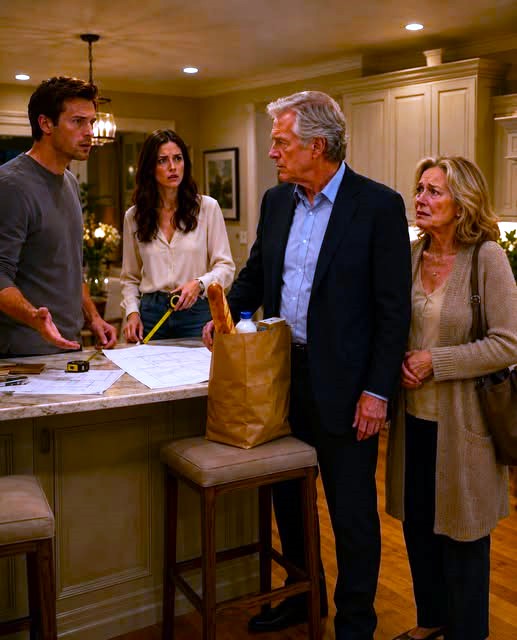
My chest tightened.
“What?”
She looked down at the bag.
“He said the house belongs to him now.”
For a few seconds, I thought I had misunderstood her.
“Who said that?”
“Ethan.”
The name sounded wrong coming from her mouth.
Ethan was our only son.
He was thirty-two years old, married, educated, and perfectly capable of understanding the difference between his parents’ generosity and his own entitlement.
He and his wife, Ashley, had been staying with us for six months.
They had originally asked to stay for three weeks.
Their apartment lease had ended, and the house they wanted to buy was not ready. At least, that was the explanation Ethan had given us.
“Just until everything is finalized,” he had said.
Linda had immediately agreed.
She prepared the guest room, cleared space in the bathroom, and stocked the refrigerator with Ashley’s favorite yogurt.
Three weeks became two months.
Two months became six.
During that time, Ethan paid no rent.
Ashley bought groceries twice.
They complained that our internet was slow, our furniture was outdated, and our kitchen needed to be opened into the dining room.
Still, Linda defended them.
“They’re under pressure,” she would say.
“They’re trying to build their future.”
That evening, however, our son had apparently decided his future required throwing his mother into the street.
I stepped closer to Linda.
“Tell me exactly what happened.”
She swallowed hard.
“I went to the pharmacy and grocery store. When I returned, the gate code didn’t work. I thought I had typed it incorrectly, so I tried again.”
Her voice trembled.
“Then Ethan came outside.”
“What did he say?”
“He told me he had changed the code because Ashley and he needed privacy.”
I stared at her.
“Privacy?”
“He said we had been discussing downsizing for years and that it made sense for them to start taking control of the property.”
“We have never discussed giving them this house.”
“I know.”
“What else did he say?”
Linda wiped her cheek quickly.
“He said I had been living off his future long enough.”
My hands curled into fists.
Linda and I had worked for everything we owned.
I had spent thirty-four years repairing heavy equipment for a construction company. I worked weekends, holidays, and double shifts when Ethan was young.
Linda had been a school secretary for nearly three decades. She packed lunches before sunrise, helped children who came to school hungry, and returned home every afternoon to cook for our family.
We paid our mortgage.
We covered Ethan’s college tuition.
We helped with his wedding.
We paid off one of his student loans when he said the interest was overwhelming him.
And now he had told his mother she was living off his future.
“Where is he?” I asked.
“Inside.”
“And Ashley?”
“With him.”
Linda looked frightened.
“Tom, please don’t fight him.”
“I’m not going to fight him.”
I picked up the grocery bag gently and held out my free hand.
“I’m going to remind him.”
I walked to the keypad and entered the old code.
Denied.
I entered it again.
Denied.
Linda stood beside me, silent and ashamed, although she had done nothing wrong.
That was the part that hurt most.
Our son had made his own mother feel like a trespasser.
I looked toward the security camera above the gate.
Its small red light blinked.
Ethan was watching us.
He knew we were standing there.
He could have opened the gate from his phone.
He did not.
I turned away.
“Come with me.”
We walked around the side of the property toward the detached garage.
Ethan had forgotten one important thing.
I had built this house long before smart locks, security systems, and phone-controlled gates.
Behind the shed, beneath an old metal flowerpot, was a spare key to the manual side entrance. I had hidden it there fifteen years earlier and never told anyone except Linda.
I retrieved the key and opened the narrow wooden gate beside the garage.
We entered the backyard.
Through the kitchen windows, I saw Ethan and Ashley standing near the counter.
Ashley held a tape measure.
Several paint samples and renovation catalogs were spread across our kitchen table.
They were measuring our walls.
I opened the back door.
Ethan spun around.
His face went pale when he saw us.
“Dad,” he said. “How did you get in?”
I placed Linda’s grocery bag on the counter.
“That is your first question?”
Ashley recovered more quickly.
She folded the tape measure and forced a smile.
“Tom, we were going to explain everything.”
“Good,” I said. “Explain why my wife was standing outside her own gate.”
Ethan glanced at Linda.
“Mom is being dramatic.”
Linda flinched.
I stepped between them.
“Choose your next words carefully.”
He lifted both hands.
“I didn’t throw her out. I told her we all needed to have a serious discussion about the future.”
“You changed the gate code.”
“Because she keeps coming and going without telling us.”
I stared at him.
“She lives here.”
“So do we.”
“For free.”
Ashley crossed her arms.
“That’s not fair.”
I turned toward her.
“You have lived in our house for six months. You have not paid rent, electricity, water, insurance, taxes, or groceries. Which part is unfair?”
Her cheeks reddened.
“We contribute in other ways.”
I looked around the kitchen.
A sink full of their dishes sat beneath the window.
Three delivery boxes from expensive restaurants were stacked beside the trash can.
Ashley’s handbag rested on one of Linda’s handmade dining chairs.
“What ways?” I asked.
She opened her mouth but said nothing.
Ethan stepped forward.
“Dad, this is bigger than groceries. You and Mom are getting older.”
“I’m sixty-four, Ethan. Your mother is sixty-two. We are not waiting for someone to assign us rooms in a nursing home.”
“That isn’t what I meant.”
“Then say what you meant.”
He took a breath.
“The house is too much for you. The maintenance, the yard, the stairs—it’s obvious. Ashley and I have been talking, and it makes sense for us to take over.”
Linda stared at him.
“Take over what?”
“The property.”
“You mean our property?” I asked.
“Eventually, it will be mine.”
The words hung in the kitchen.
Not ours.
Mine.
Ashley touched his arm.
“Ethan, maybe we should calm down.”
“No,” he said. “This needs to be said.”
He looked at me with the confidence of a man who had rehearsed his speech.
“You’ve told me my whole life that this house was built for the family.”
“It was.”
“I am the family.”
“So is your mother.”
“That’s not what I mean.”
“What do you mean?”
He hesitated.
I could see the calculation behind his eyes.
He wanted to sound reasonable while saying something unforgivable.
“You and Mom had your time,” he finally said. “Ashley and I are trying to start ours.”
Linda placed one hand over her chest.
I noticed immediately.
“Are you all right?” I asked.
She nodded, but her face had lost color.
The doctor had recently adjusted her heart medication. Stress was the last thing she needed.
Ethan saw her discomfort and sighed.
“See? This is exactly what I’m talking about. You both need somewhere smaller and easier.”
“Where?” Linda asked quietly.
“We found a senior community about twenty minutes away.”
She looked at him in disbelief.
“You found us a senior community?”



