Part 1
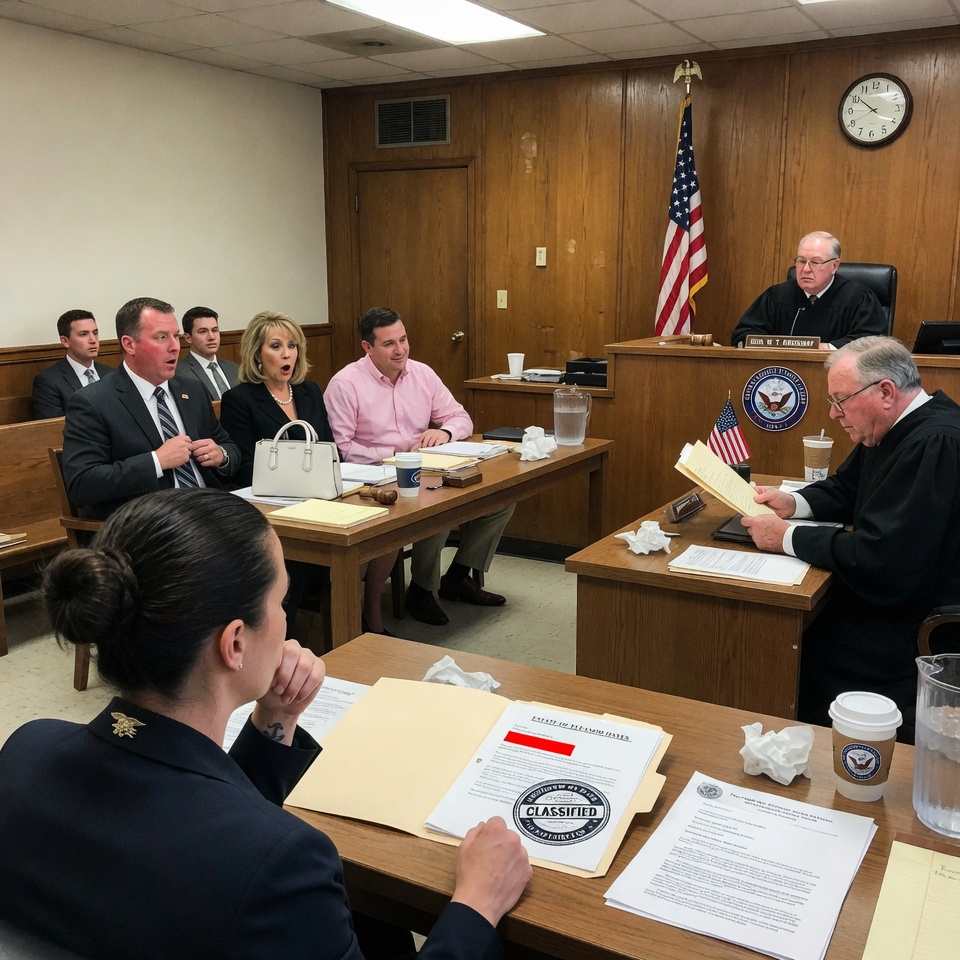
The air in the courtroom was thick enough to choke on—a heavy mix of lemon polish, old regret, and my mother’s expensive perfume. I kept my eyes fixed on the grain of the wooden table in front of me. If I looked up, I’d have to see my father’s pressed suit and my brother’s smug, hungry face. I’d have to see the way my mother’s pearls trembled against her throat every time she lied about who I was.
I had survived sandstorms that peeled paint off metal. I had heard the zip and crack of rounds in the dark. But the silence of your own family disowning you in public? That was a different kind of war.
My father’s lawyer, a young man with teeth too white for this dusty town, cleared his throat.
— We are here today because the Hayes family believes the defendant, Miss Sarah Hayes, is unfit to manage the estate of the late Eleanor Hayes. The family has grave concerns about her lifestyle.
My father stood up. He straightened his jacket the way he used to before church—like he was doing God a favor by showing up.
— Your Honor, he said, voice booming with the confidence of a man who has never been wrong in his own living room. We’ve put a stop to that embarrassing job of hers. That nonsense. We’ve ended it. My daughter is not stable enough to inherit the house.
I felt my jaw lock. Embarrassing.
I saw my brother smirk. My mother nodded, a tight, pitiful shake of her head, like I was a stray dog who’d bitten the mailman.
The judge, an old man with thick glasses and the tired posture of someone who’d seen every kind of family rot there was, didn’t look up from the file. He just turned a page. Then another. His finger traced down a redacted paragraph with a government seal on it.
He stopped.
He took off his glasses. He cleaned them. He put them back on. He looked at my father like he’d just found a roach in his breakfast.
— Wait, the judge said. His voice cracked the silence like a gavel on bone.
— This is the SEAL. The one who was just awarded the Navy Cross.
My mother’s hands went slack. The pearls stopped trembling.
— I need to see the rest of this, the judge murmured, flipping to the classified addendum.
I watched the color drain from my brother’s face. It was a beautiful, quiet thing. I didn’t smile. I just breathed. Because for the first time in ten years, the room smelled like the truth. And it was burning their lungs.
I wanted to scream. I wanted to tell them about the weight of a rucksack in 120-degree heat. About the face of a teammate who knows you’re the only thing standing between him and the black. About the sound a helicopter doesn’t make when you’re praying for it to come.
But I didn’t. I had learned a long time ago that words were wasted on people who had already written the end of your story in their heads.
My father’s mouth opened. Nothing came out but air.
I turned my head slowly and looked at them—really looked at them. The people who thought I was selling my body or doing dr*gs in an alley. The people who thought my silence was shame. They had no idea that my silence was the only thing keeping their safe, little world from being shattered by the things I had seen.
And now the judge knew.
I wondered if the truth would set us free. Or if it would just be the final nail in a coffin that had been sealed since the day I enlisted.
Part 2 – The Full Story
The judge’s words hung in the air like smoke after a gunshot. You could feel them pressing down on every person in that room—the bailiff frozen by the door, the court reporter with her fingers hovering motionless above the stenotype machine, the few townsfolk in the gallery who had come to watch the Hayes family drama unfold like a matinee show.
“Wait. This is the SEAL. The one who was just awarded the Navy Cross.”
My father’s face went through a transformation I had never witnessed in thirty-two years of knowing him. First came the confusion—his brow furrowing like he’d misheard a stock report on the radio. Then the slow, creeping recognition that the judge wasn’t joking. Then the collapse. His shoulders dropped. His jaw went slack. The man who had stood before this courtroom five minutes ago like a titan defending the family honor now looked like someone had pulled a rug out from under his entire existence.
My mother’s hands—those delicate hands that had clutched pearl necklaces through every church service and garden club meeting—fell into her lap like dead birds. Her mouth opened. Closed. Opened again. No sound came out.
My brother. God, my brother. I almost felt sorry for him. The smirk that had been plastered on his face since we walked through those heavy oak doors evaporated so fast it was almost comical. He looked at me. Then at the judge. Then back at me. His eyes were searching for the lie, the prank, the misunderstanding. But there was none to find.
The judge cleared his throat and adjusted his glasses. He was an older man, Judge Morrison, with silver hair cropped close and the weathered face of someone who had served before he sat on the bench. Vietnam, if I remembered correctly from the veterans’ dinner my grandmother used to drag me to. He understood service. He understood sacrifice. And right now, he understood that he was holding something sacred in his hands.
“Let me read this for the record,” he said, his voice dropping into something more solemn than courtroom procedure required. “The President of the United States takes pleasure in presenting the Navy Cross to Chief Petty Officer Sarah Elizabeth Hayes, United States Navy, for extraordinary heroism in connection with military operations against an armed enemy force…”
He paused. Looked up at my father.
“Shall I continue, Mr. Hayes? Or would you like to withdraw your petition now?”
My father couldn’t speak. His throat worked like he was trying to swallow a stone.
The judge turned another page. His eyes widened slightly.
“There’s a classified addendum here. I can’t read the details aloud, but the summary indicates that Chief Petty Officer Hayes—” he emphasized the title with pointed precision “—led a rescue operation that extracted twelve American personnel and eight allied civilians from a compromised position under sustained enemy fire. She disregarded a direct recall order to remain with wounded teammates and personally carried two injured service members to the extraction point while providing covering fire.”
The courtroom was so quiet I could hear the fluorescent lights humming overhead. That persistent, mechanical buzz that had been the soundtrack of my life for fifteen years—through briefings, through debriefings, through the long nights waiting for the next mission.
“Your Honor,” the lawyer said, his confident voice now thin and reedy, “my clients were unaware—”
“Clearly,” Judge Morrison interrupted. “Clearly they were unaware. Which raises a rather significant question for this court.”
He removed his glasses and rubbed the bridge of his nose.
“Mr. and Mrs. Hayes, you have stood before me today and characterized your daughter’s employment as ’embarrassing,’ ‘unstable,’ and ‘shameful.’ You have suggested she is unfit to manage property left to her by her grandmother. You have implied—no, you have stated—that she has been living a life of irresponsibility and secrecy that renders her incapable of handling the estate.”
He leaned forward.
“And yet the United States Navy, an organization I know something about, has seen fit to entrust her with the lives of her fellow service members, with classified operations, and with one of the highest honors this nation can bestow. So I find myself in a curious position. Either the Navy is a poor judge of character and capability—which, in my experience, it is not—or you are profoundly, willfully ignorant of who your daughter actually is.”
My mother made a sound. It was small and broken, like a teacup cracking.
“Your Honor,” my father managed, his voice a rasp. “We didn’t… she never told us…”
“Did you ask?” The judge’s question was gentle but unyielding. “Did you ever truly ask?”
The silence that followed was its own answer.
My brother’s lawyer whispered something urgent to him, but he waved it away. He was staring at me now with an expression I couldn’t quite read. Not anger. Not exactly. Something closer to awe mixed with a terrible, dawning shame.
“Your Honor,” the lawyer tried again, “my clients wish to request a brief recess to—”
“Granted.” Judge Morrison’s gavel came down with a crack that made my mother jump. “Thirty minutes. And I suggest you use that time to have a conversation that is long overdue.”
He stood, and we all rose with him. But before he left the bench, he looked directly at me.
“Chief Hayes,” he said, and the title landed in the room like a challenge to anyone who had ever called me anything less. “Thank you for your service.”
I nodded once. “Thank you, Your Honor.”
He disappeared through the door behind the bench, and the spell broke. The bailiff announced the recess. The court reporter began packing her equipment. The gallery spectators—there were maybe a dozen of them, retirees and courthouse regulars who came to watch the drama—began whispering frantically among themselves.
I stayed seated.
My family didn’t move either. We were frozen in a tableau of everything we had never said to each other.
The bailiff approached my table with a pitcher of water and a clean glass. He was a large man with a graying mustache and kind eyes that had seen every variety of human misery pass through this room.
“Thought you might need this, ma’am,” he said quietly.
“Thank you.”
He leaned in slightly. “My boy serves. Marine Corps. Okinawa.” He paused. “I know what it means. What you did.”
I met his eyes. “Thank him for me.”
He nodded and stepped back, returning to his post by the door.
I poured water into the glass and drank slowly. The cold liquid grounded me. Focused me. It was a technique we learned in SERE training—find the small, physical sensations that anchor you to the present moment when everything else is chaos.
My father stood up first. His movements were stiff, mechanical, like a man learning to walk again after a stroke. He took two steps toward my table and stopped.
“Sarah.”
I looked up at him.
“I…” He stopped. Started again. “I don’t know what to say.”
“That’s a first,” I said quietly.
He flinched like I’d struck him.
My mother rose and came to stand beside him. She was crying now—silent tears that tracked through her carefully applied makeup. She reached for my hand but stopped short, her fingers hovering in the air between us.
“All those years,” she whispered. “All those years I thought… I was so afraid you were lost. I thought you were doing something terrible. Something dangerous. Something that would get you killed or arrested or…”
“Something shameful,” I finished for her.
She closed her eyes. “Yes.”
“I was doing something dangerous,” I said. “You were right about that part. But it wasn’t shameful. It was the most honorable thing I’ve ever done.”
My brother approached last. He hung back near the railing that separated the gallery from the court proper, his hands shoved deep in his pockets, his shoulders hunched. He looked younger than his thirty-five years. Smaller.
“Navy Cross,” he said, testing the words. “That’s… that’s like the Medal of Honor, right? One step down?”
“Something like that.”
He shook his head slowly. “And I’ve been telling people you were probably doing dr*gs in some city somewhere. Or living off some guy. Or…” He couldn’t finish.
“Or embarrassing the family,” I said.
“Yeah.” His voice cracked. “Yeah, that.”
We stood there in the emptying courtroom, four people who shared blood and history and almost nothing else. The afternoon light was shifting through the tall windows, casting long shadows across the worn wooden floor. Outside, I could hear the faint sound of traffic on Main Street, the ordinary noise of a town that had no idea everything was changing inside these walls.
“Grandma knew,” my mother said suddenly. “Didn’t she?”
“Yes.”
“How? How did she know when we didn’t?”
I thought about that. About the letters I had written to my grandmother from every deployment, every base, every dusty forward operating post. Letters that I sealed with a kiss and sent into the void, trusting her to keep my secrets safe. Letters that my parents never saw because they had stopped asking about my life years ago.
“Because she asked,” I said. “And she listened when I answered.”
My mother’s face crumpled.
“Can we go somewhere?” my father asked. “Somewhere private? Just the four of us?”
I looked at the clock on the wall. Twenty-five minutes until court resumed.
“There’s a room down the hall,” I said. “The law library. It’s usually empty this time of day.”
I knew this courthouse. I had spent hours here as a teenager, volunteering for my grandmother’s historical society, organizing old property records and dusting shelves full of leather-bound law books. I knew every corner, every creaking floorboard, every window that looked out over the town square.
We walked down the corridor in silence. My mother kept glancing at me like she was seeing a stranger. My father walked with his head down, studying the pattern of the linoleum floor. My brother trailed behind, occasionally clearing his throat like he wanted to say something but couldn’t find the words.
The law library was exactly as I remembered it—a small room lined with dark wooden shelves, the air thick with the smell of old paper and binding glue. A large oak table dominated the center, surrounded by heavy chairs that had probably been there since the building was constructed in 1923.
I sat down at the head of the table without thinking. It was instinct—the position of command. My family arranged themselves around me, and for the first time in my life, they looked at me like I belonged there.
“Tell us,” my father said. “Please. Tell us everything.”
I took a long breath. The kind you take before you breach a door or deliver bad news to a waiting family.
“Where do you want me to start?”
“The beginning,” my mother whispered. “Start at the beginning.”
The beginning.
Where was the beginning, really?
I suppose it started when I was seventeen years old, standing on the porch of the very house they were trying to take from me. My grandmother’s house. The old Hayes farmhouse out on County Road 7, with its wraparound porch and its creaking swing and its garden that bloomed with roses every June like clockwork.
It was the summer before my senior year of high school. The air was thick with humidity and the smell of cut grass. My grandmother—Eleanor Hayes, everyone called her Ellie—was sitting in her rocking chair, working on one of her endless knitting projects. A scarf, I think. Deep blue, like the ocean at twilight.
“You’ve got that look again,” she said without glancing up from her needles.
“What look?”
“The one you get when you’re thinking about leaving.”
I leaned against the porch railing and watched a pair of cardinals chase each other through the maple tree. “I don’t know what I’m thinking.”
“Yes, you do. You’re just afraid to say it out loud.”
I was quiet for a long moment. Then, “Grandma, what if I don’t want the life they want for me?”
She set down her knitting and gave me her full attention. That was something she always did—when you spoke, she listened. Not the way my parents listened, waiting for their turn to talk or searching for the flaw in your argument. She listened like your words mattered.
“What life do you want, Sarah?”
“I don’t know yet. Something… bigger. Something that matters. Not just staying here and marrying someone from church and having babies and pretending I’m happy.”
“And what does ‘mattering’ look like to you?”
I thought about the recruiter who had come to the high school career fair that spring. The Navy officer with the crisp white uniform and the quiet confidence. She had talked about service, about being part of something larger than yourself, about seeing the world and making a difference. My parents had thrown away the brochure I brought home.
“I think I want to serve,” I said. “Military. Navy, maybe.”
My grandmother didn’t react with shock or disapproval. She just nodded slowly, her eyes thoughtful.
“Your grandfather served,” she said. “Korea. Army infantry. He never talked about it much, but I know it shaped him. Made him who he was.”
“I remember.”
“He would be proud of you. I hope you know that.”
“My parents won’t be.”
“No,” she agreed. “They won’t. They’ve got their own ideas about what a woman’s life should look like. About what your life should look like. But Sarah…” She reached out and took my hand. Her fingers were thin and cool, the skin papery with age. “You don’t belong to them. You belong to yourself. And if you let them decide who you get to be, you’ll spend the rest of your life wondering who you might have become.”
I felt tears prick at my eyes. “They’ll be so angry.”
“Probably. But anger fades. Regret doesn’t.”
She squeezed my hand once and released it.
“Now,” she said, picking up her knitting again, “tell me about this Navy business. What exactly would you be doing?”
And so I told her. Everything I had learned from the recruiter, everything I had researched at the library because I couldn’t look it up at home without my parents seeing the browser history. The different rates, the training pipeline, the possibilities. She listened to all of it, asking questions here and there, never once telling me I was being foolish or unrealistic or that I should settle down and find a nice boy.